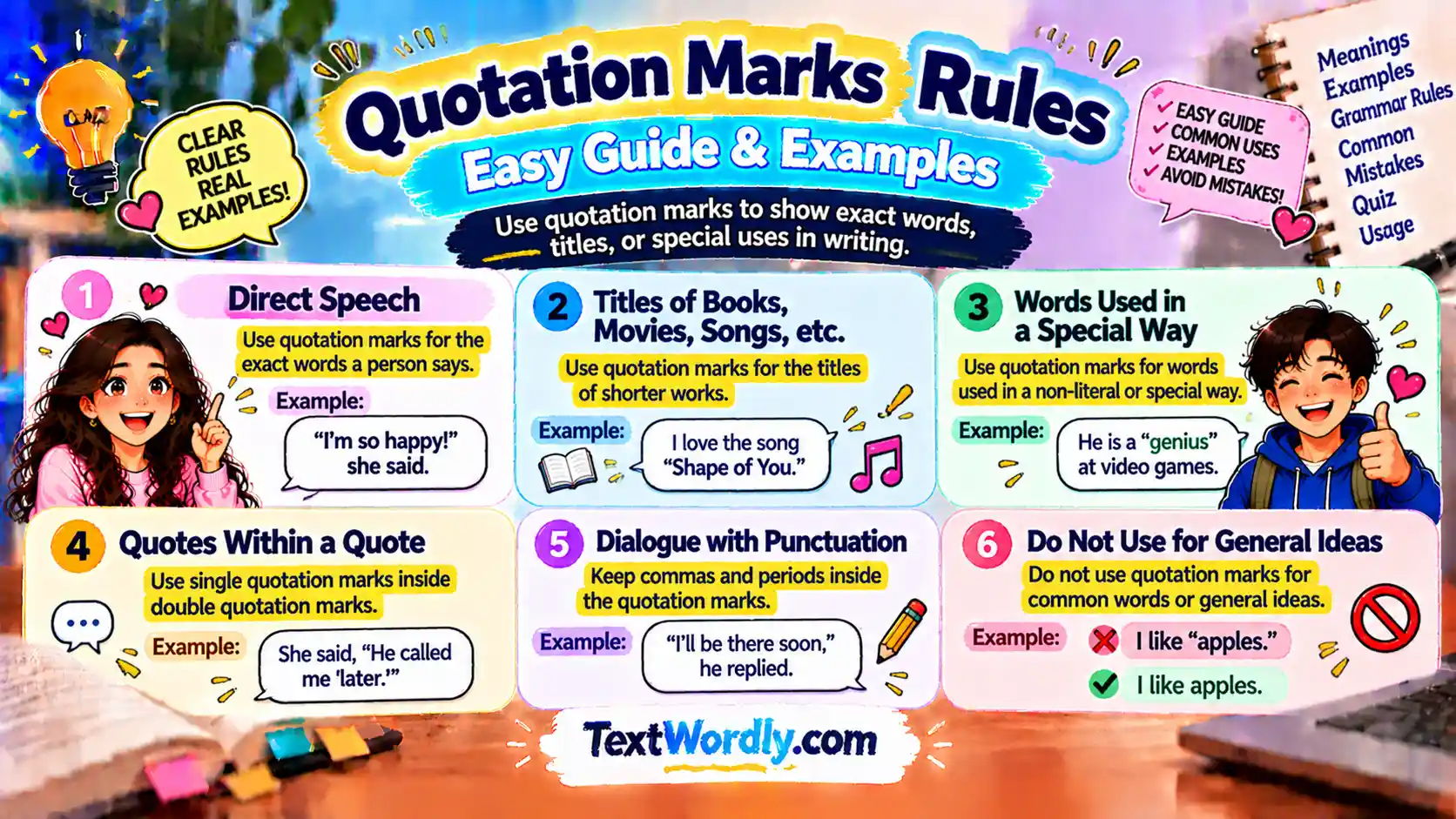
Quotation Marks Rules: Have you ever wondered whether to put a period inside or outside quotation marks? Or whether to use single quotation marks (‘ ’) or double quotation marks (“ ”) when writing a sentence?
These small punctuation marks can be confusing, especially when you write dialogue, essays, emails, or stories.
Quotation marks show someone’s exact words, identify certain titles, and highlight specific expressions. They also help readers understand where quoted language begins and ends.
Learning the correct quotation marks rules makes your writing clearer, more professional, and easier to read.
This complete guide explains American English quotation rules with practical examples, comparison tables, common mistakes, and simple writing tips.
QUICK ANSWER
In American English, use double quotation marks (“ ”) for direct quotations. Periods and commas normally go inside closing quotation marks. Question marks and exclamation points depend on meaning, while colons and semicolons normally go outside.
| Direct speech | She said, “Hello.” |
| Comma | “I’m ready,” he said. |
| Question mark | He asked, “Are you ready?” |
| Nested quotation | “She said, ‘Wait,’” he explained. |
| Semicolon | She called it “excellent”; I disagreed. |
TL;DR — Quotation Marks Rules
- Double quotation marks (“ ”): Use for direct quotations in American English.
- Single quotation marks (‘ ’): Use for quotations inside other quotations.
- Periods and commas: Normally belong inside closing quotation marks.
- Question marks and exclamation points: Placement depends on meaning.
- Colons and semicolons: Normally go outside closing quotation marks.
- Dialogue: Start a new paragraph when the speaker changes.
- Titles: Use quotation marks for short works and italics for many longer works.
- Academic writing: Follow the required citation style.
1. What Are Quotation Marks in English Grammar?
Quotation marks are punctuation symbols that identify quoted words, certain titles, and expressions being discussed.
American English commonly uses two types.
“ ”
Double Quotation MarksMain quotations in American English Copy
‘ ’
Single Quotation MarksQuotations inside quotations Copy
Examples ✍️
Sarah said, “I love reading.”
My teacher explained, “The word ‘beautiful’ is an adjective.”
Quotation marks help separate the speaker’s exact words from the surrounding sentence.
2. When Should You Use Quotation Marks?
Use quotation marks when reproducing someone’s exact words or identifying certain short works and expressions.
| Situation | Example |
|---|---|
| Direct speech | “Good morning,” she said. |
| Exact quotation | The sign read, “Keep Out.” |
| Short story title | “The Tell-Tale Heart” |
| Article title | “How to Save Money” |
| Quote inside a quote | “He shouted, ‘Stop!’” |
| Word discussed as a word | The word “happy” is an adjective. |
Quick Rule
If you are repeating someone’s exact words, quotation marks are usually appropriate.
If you are simply reporting the meaning of what someone said, quotation marks are generally unnecessary.
3. Double vs Single Quotation Marks
In standard American English, double quotation marks are the default for primary quotations.
Single quotation marks appear inside double quotation marks.
Double Quotation Marks
She said, “I finished my homework.”
Single Quotation Marks
He explained, “My teacher said, ‘Study carefully.’”
| Type | Main Use |
|---|---|
| Double quotation marks | Primary quotation |
| Single quotation marks | Quotation inside a quotation |
British publications sometimes reverse this pattern, although house styles vary.
For a US audience, use the American convention consistently.
4. Quotation Marks for Direct and Indirect Speech
Direct speech repeats someone’s exact words.
Indirect speech reports what someone said without reproducing the original wording.
Direct Speech
Maria said, “I am tired.”
Indirect Speech
Maria said that she was tired.
Only the first sentence needs quotation marks.
Partial Quotations
A quotation may contain only part of someone’s statement.
Example: Maria described the journey as “long and exhausting.”
The quoted fragment fits naturally into the sentence.
Capitalization Rule
Capitalize the first word of a complete quoted sentence when appropriate.
Correct: Sarah said, “The train is late.”
A quoted fragment normally retains lowercase when integrated into a sentence.
Correct: Sarah described the train as “unusually crowded.”
5. Quotation Marks with Periods and Commas
In standard American English, periods and commas normally go inside closing quotation marks.
Period Examples
Correct: She said, “I am happy.”
Correct: I enjoyed the story “The Gift of the Magi.”
Comma Examples
Correct: “Come here,” he said.
Correct: She called the movie “amazing,” although I disagreed.
Correct vs Incorrect
| Incorrect | Correct |
|---|---|
| She said, “Hello”. | She said, “Hello.” |
| “Let’s go”, he said. | “Let’s go,” he said. |
| I read “The Story”. | I read “The Story.” |
Academic Citation Exception
Citation formatting can affect final punctuation.
For example, in MLA style:
The author described the result as “unexpected” (24).
Here, the period follows the parenthetical citation.
6. Quotation Marks with Question Marks and Exclamation Points
Question marks and exclamation points follow meaning rather than the automatic inside rule used for periods and commas.
Question Inside the Quotation
Correct: She asked, “Are you coming?”
The quoted words form a question.
Whole Sentence Is a Question
Correct: Did he really say, “I am leaving”?
The surrounding sentence is a question.
Exclamation Inside the Quote
Correct: She shouted, “Watch out!”
Exclamation Outside the Quote
Correct: I cannot believe he called the movie “boring”!
Easy Rule
Ask yourself: Does the punctuation belong to the quoted words or the surrounding sentence?
Place it accordingly.
7. Quotation Marks with Colons and Semicolons
Colons and semicolons normally appear outside closing quotation marks in American English.
Semicolon Example
Correct: She described the plan as “ambitious”; her colleagues agreed.
The semicolon connects two related clauses.
Colon Example
Correct: The article discussed three “essential skills”: reading, writing, and speaking.
The colon introduces a list.
Comparison Table
| Punctuation | Standard American Placement |
|---|---|
| Period | Inside |
| Comma | Inside |
| Question mark | Depends on meaning |
| Exclamation point | Depends on meaning |
| Colon | Outside |
| Semicolon | Outside |
This table provides a quick reference for the most common punctuation situations.
8. Quotation Marks in Dialogue
Dialogue shows characters speaking in stories, novels, interviews, and other writing.
Quotation marks help readers identify spoken words.
Basic Dialogue Example 📖
“Are you ready for the exam?” Sarah asked.
“Yes,” Daniel replied. “I studied all night.”
“That’s great,” Sarah said.
Dialogue Tags
A dialogue tag identifies who is speaking.
Correct: “I’m ready,” Emma said.
Correct: Emma said, “I’m ready.”
Action Beats
An action beat describes what a character does rather than how they speak.
Correct: “I’m ready.” Emma picked up her bag.
The action is a separate sentence, so the quoted statement ends with a period.
Interrupted Dialogue
Correct: “I was thinking,” Emma said, “that we should leave early.”
The dialogue tag interrupts one sentence, so the quoted sentence resumes with a lowercase word.
Multiple Speakers
Start a new paragraph when the speaker changes.
For a long speech that continues across paragraphs, writers may open quotation marks at the beginning of each paragraph and close them only at the end of the final paragraph.
9. How to Write Quotes Inside Quotes
Sometimes a speaker quotes another person’s words.
In American English, use single quotation marks inside double quotation marks.
Example
“My mother said, ‘Finish your homework,’” Anna explained.
The outer quotation marks contain Anna’s words.
The inner quotation marks contain her mother’s words.
Another Example
He said, “The teacher asked, ‘Where is your notebook?’”
The question mark belongs to the inner question.
Helpful Tip
When nested quotations become difficult to follow, consider rewriting the sentence.
Clear writing is more important than creating several layers of quotation marks.
10. Quotation Marks for Titles and Special Terms
Quotation marks are commonly used around titles of shorter works.
Titles That Usually Use Quotation Marks
- Short stories
- Articles
- Poems
- Songs
- Television episodes
Titles That Usually Use Italics
- Books
- Newspapers
- Albums
- Television series
- Movies
| Quotation Marks | Italics |
|---|---|
| “The Tell-Tale Heart” | The Great Gatsby |
| “The Road Not Taken” | Leaves of Grass |
| “Imagine” | Imagine (album) |
Scare Quotes
Quotation marks can also suggest doubt, irony, or an unusual use of a word.
Example: The company promised a “free” service that required a monthly fee.
Use scare quotes carefully. Too many can make your writing sound sarcastic or unclear.
11. Quotation Marks in Academic Writing
Academic writing requires accurate quotation and citation practices.
Short Quotations
Short quotations usually appear inside quotation marks.
Example: The researcher described the findings as “unexpected.”
If you quote another source, provide the required citation.
Brackets in Quotations
Square brackets can show words added or changed for clarity.
Example: “They [the students] completed the assignment.”
Ellipses in Quotations
Ellipses indicate omitted material.
Example: “The results … supported the original conclusion.”
Do not use ellipses to remove words in a way that changes the original meaning.
Academic Integrity
Always reproduce quoted material accurately and cite the source according to the required style guide.
12. Block Quotations in APA and MLA
Long quotations may require special formatting instead of ordinary quotation marks.
APA 7 Block Quotations
APA generally uses block quotation formatting for quotations of 40 words or more.
The quotation is indented, and quotation marks are omitted around the entire block.
MLA 9 Block Quotations
MLA generally uses block formatting for quotations that extend beyond four lines of prose or three lines of verse.
APA vs MLA Comparison
| Feature | APA 7 | MLA 9 |
|---|---|---|
| Block quote threshold | 40 words or more | More than 4 prose lines or 3 verse lines |
| Quotation marks | Omitted around block | Omitted around block |
| Citation style | Author-date | Author-page |
| Formatting | Indented block | Indented block |
Follow the exact indentation and punctuation rules required by your instructor or publication.
13. American vs British Quotation Marks
American and British English use similar quotation principles, but their editorial conventions can differ.
| Rule | American English | British English |
|---|---|---|
| Primary quotation | Usually double | Often single |
| Nested quotation | Usually single | Often double |
| Periods and commas | Normally inside | Often meaning- or style-dependent |
| Question marks | Meaning-based | Meaning-based |
American Example
She said, “I am ready.”
British Example
She said, ‘I am ready.’
Neither approach is universally required across every publication.
For TextWordly.com’s US audience, American English conventions provide the clearest default.
14. Common Quotation Marks Mistakes
Here are common mistakes and their corrections.
| Incorrect | Correct |
|---|---|
| She said, “Hello”. | She said, “Hello.” |
| “Come here”, he said. | “Come here,” he said. |
| He asked, “Are you ready”? | He asked, “Are you ready?” |
| She said “I am tired.” | She said, “I am tired.” |
| He said, “She shouted, “Stop!”” | He said, “She shouted, ‘Stop!’” |
Common Mistake: Unnecessary Emphasis
Incorrect: We offer “excellent” customer service.
Better: We offer excellent customer service.
Unnecessary quotation marks can imply that a word is doubtful or ironic.
Common Mistake: Confusing Titles
Incorrect in standard book-title formatting: I read “The Great Gatsby.”
Correct: I read The Great Gatsby.
Use quotation marks and italics according to the type of work and the required editorial style.
15. Real-Life Examples and Practice Exercises
Quotation marks appear in many everyday situations.
School 🎓
The teacher said, “Please submit your assignment.”
Workplace 💼
My manager explained, “The meeting starts at nine.”
Family 🏠
Mom asked, “Did you finish your homework?”
Storytelling 📖
“I found the missing key!” Emma shouted.
Quick Practice Quiz
Test Your Knowledge0 of 4 answered
1. Which sentence is correct in American English?She said, “Hello”.She said, “Hello.”
2. Which question is punctuated correctly?Did he say, “I’m leaving”?Did he say, “I’m leaving?”
3. Where does the semicolon belong?She called it “great;” I disagreed.She called it “great”; I disagreed.
4. Which nested quotation is correct?He said, “She yelled, ‘Stop!’”He said, “She yelled, “Stop!””
16. Quotation Marks Rules FAQs and Final Thoughts
Frequently Asked Questions
What are the basic rules for quotation marks?
Use double quotation marks for direct speech in American English. Periods and commas normally go inside closing marks, while question marks depend on meaning.
Do periods go inside quotation marks?
Yes, in standard American English. Academic parenthetical citations can change the position of the final period.
Do commas go inside quotation marks?
Yes. Commas normally appear inside closing quotation marks in American English.
When should I use single quotation marks?
Use single quotation marks for a quotation inside another quotation.
Where do question marks go with quotation marks?
Inside if the quoted words are a question; outside if the surrounding sentence is the question.
Do semicolons go inside quotation marks?
No. Semicolons normally go outside closing quotation marks.
Should book titles have quotation marks?
Generally not. Book titles are italicized in common American editorial styles.
What are scare quotes?
Scare quotes suggest irony, doubt, or a special use of a word.
What is a block quotation?
A block quotation is a longer quotation formatted separately from the surrounding text, usually without enclosing quotation marks.
Are British quotation rules different?
Yes. Some British styles prefer single primary quotation marks and different punctuation-placement conventions.
Final Thoughts
Understanding quotation marks rules helps you communicate clearly and avoid common punctuation mistakes.
Remember these essential principles: use double quotation marks for direct speech in American English, place periods and commas inside closing quotation marks, and position question marks and exclamation points according to meaning.
Use single quotation marks for nested quotations, follow title-formatting conventions, and apply the correct academic citation style when quoting sources.