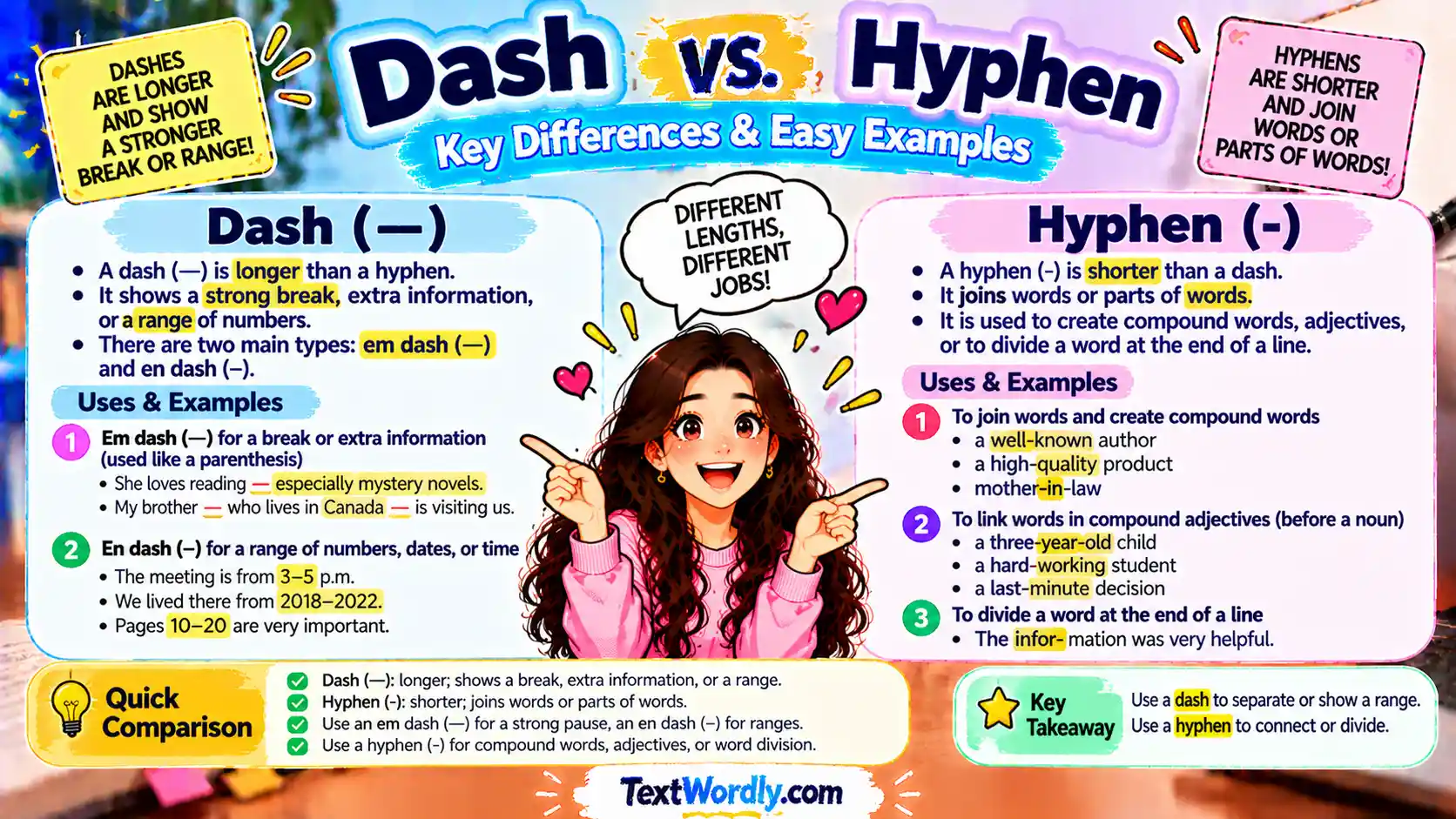
Dash vs Hyphen: Have you ever wondered whether to use a dash (—) or a hyphen (-)? These punctuation marks look similar, but they serve different purposes in English writing.
A hyphen joins words or parts of words. A dash can create a pause, emphasize information, or connect a range of numbers. There are two common types of dashes: the em dash (—) and the en dash (–).
Understanding dash vs hyphen helps you avoid punctuation mistakes in emails, essays, articles, and professional documents.
This guide explains the differences with simple rules, comparison tables, and everyday examples.
QUICK ANSWER
A hyphen (-) joins words, such as well-known. An en dash (–) connects ranges, such as pages 10–20. An em dash (—) creates a strong sentence break, such as I tried—but failed.
–
Hyphenwell-known Copy
–
En Dash10–20 Copy
—
Em DashWait—what? Copy
TL;DR
- Hyphen (-): Joins words and word parts.
- En dash (–): Shows ranges and certain relationships.
- Em dash (—): Creates emphasis, explanations, or interruptions.
- Minus sign (−): Represents subtraction or negative values.
Remember: Hyphens join words, en dashes connect ranges, and em dashes interrupt sentences.
1. What Is a Hyphen?
A hyphen (-) is a short punctuation mark that connects words or word elements.
It appears in compound adjectives, some compound nouns, numbers, and certain prefixed words.
Examples ✍️
- A well-known author
- A part-time employee
- A twenty-one-year-old student
- My mother-in-law
- A self-aware person
Hyphens help readers understand how words work together.
For example, a small-business owner means someone who owns a small business. Without the hyphen, a small business owner could also describe an owner who is physically small.
However, not every compound word requires a hyphen. Dictionary spellings and sentence context matter.
2. What Is a Dash?
A dash is a punctuation mark used to separate information or connect related elements.
English commonly uses two types.
Em Dash (—)
The em dash creates emphasis or an interruption.
Example: She had one goal—to graduate.
En Dash (–)
The en dash commonly shows a range.
Example: Read pages 15–25.
Unlike a hyphen, a dash usually doesn’t join ordinary word parts.
An em dash changes the rhythm of a sentence, while an en dash often indicates a connection between numbers, dates, or terms.
3. Dash vs Hyphen: Key Differences
The most important difference is their purpose.
| Feature | Hyphen (-) | Dash (– or —) |
|---|---|---|
| Main function | Joins words | Connects ranges or separates ideas |
| Length | Shorter | Longer |
| Common use | Compound words | Ranges and sentence breaks |
| Example | Well-known writer | Wait—really? |
| Spacing | Usually no spaces | Depends on type and style |
Easy Memory Trick 💡
Hyphen = Join
En Dash = Connect
Em Dash = Emphasize
This simple rule covers their most common uses.
4. Types of Dashes and Similar Symbols
Four similar-looking marks have different functions.
| Symbol | Name | Main Use | Example |
|---|---|---|---|
- | Hyphen | Joining words | Full-time |
– | En dash | Ranges | 2015–2025 |
— | Em dash | Sentence breaks | I knew—or thought I knew. |
− | Minus sign | Mathematics | 8 − 3 = 5 |
The minus sign is a mathematical symbol, not a punctuation dash.
Although people sometimes substitute hyphens for other marks when typing, professionally edited text distinguishes these characters.
The correct symbol makes your writing clearer and more consistent.
5. When Should You Use a Hyphen?
Use a hyphen when connected words need to function as one unit.
Compound Adjectives
She bought a high-quality camera.
Compound Nouns
My sister-in-law lives nearby.
Compound Numbers
Thirty-five students attended.
Certain Prefixes
He is an ex-president.
She is a self-employed designer.
Not every prefix needs a hyphen. For example, rewrite is normally written as one word.
Check a reliable dictionary when a compound spelling is uncertain.
6. When Should You Use an Em Dash?
An em dash (—) creates a noticeable break within a sentence.
For Emphasis
I wanted only one thing—success.
For Extra Information
My brother—a talented musician—performed yesterday.
For an Interrupted Conversation
“I was going to tell you—”
“Don’t say another word!”
Instead of a Colon
She made one decision—to leave.
An em dash can sometimes replace commas, parentheses, or a colon. However, it often creates a stronger or more conversational effect.
Avoid using too many em dashes in a single paragraph.
7. When Should You Use an En Dash?
An en dash (–) commonly indicates ranges or relationships.
Number Ranges
Read pages 20–35.
Date Ranges
The exhibition covered the years 2015–2020.
Time Ranges
The meeting runs 9–11 a.m.
Relationships
The New York–London route is busy.
Open Compounds
The phrase pre–World War II uses an en dash in editorial styles that distinguish a prefix attached to an open compound.
Here, pre applies to the entire phrase World War II.
Important: Write from 2015 to 2020, not from 2015–2020.
8. Hyphen Rules for Compound Words and Prefixes
Hyphenation depends on grammar, position, and established spelling.
Before a Noun
A full-time employee.
A five-year contract.
After a Noun
She works full time.
The contract lasts five years.
Many compound modifiers lose their hyphens when they appear after the noun, but this is not a universal rule.
Adverbs Ending in -ly
Correct: A highly skilled worker.
Avoid: A highly-skilled worker.
Fractions
He received a one-third share.
Suspended Hyphens
We offer two- and three-day courses.
The first hyphen shows that two- shares the word day with the second expression.
Line Breaks
A hyphen may also divide a word at the end of a printed line. Follow the publication’s word-division rules rather than splitting words arbitrarily.
9. Dash vs Hyphen in Sentences
These examples show how each mark works.
| Sentence | Correct Mark | Reason |
|---|---|---|
| She has a part-time job. | Hyphen | Compound adjective |
| I tried—but failed. | Em dash | Strong sentence break |
| Read pages 10–20. | En dash | Page range |
| He is twenty-one. | Hyphen | Compound number |
| The New York–London flight is delayed. | En dash | Relationship |
| She is self-employed. | Hyphen | Established compound |
A useful question is: Are the words forming one expression, or are you separating or connecting larger ideas?
If words form a compound, you may need a hyphen. If you’re showing a range, use an en dash. For a strong sentence break, use an em dash.
10. Dash vs Hyphen in American and British English
American and British English use the same basic punctuation marks, but editorial conventions may differ.
American English
Many American publishers use unspaced em dashes:
She was ready—or so she thought.
British English
Some British publishers prefer spaced en dashes for sentence breaks:
She was ready – or so she thought.
However, neither convention applies universally to every publication in either country.
Hyphenation also depends on dictionary conventions and house style.
For an American audience, a consistent US editorial style is a practical choice.
11. Should You Put Spaces Around Dashes and Hyphens?
Spacing depends on the punctuation mark and style guide.
| Mark | Common Formatting |
|---|---|
| Hyphen | Well-known |
| En dash for ranges | 10–20 |
| Unspaced em dash | Wait—really? |
| Spaced en dash | Wait – really? |
Hyphen Rule
Do not add spaces around an ordinary compound-word hyphen.
Correct: A well-known writer.
Incorrect: A well – known writer.
Em Dash Rule
Chicago-style American prose commonly uses em dashes without spaces.
Other organizations may use spaced em dashes.
Follow the style required by your school, workplace, or publisher.
12. How to Type Dashes and Hyphens
You can type a hyphen directly from your keyboard.
For en dashes and em dashes, use supported shortcuts or character menus.
Windows
| Symbol | Common Shortcut |
|---|---|
| Hyphen (-) | Hyphen key |
| En dash (–) | Alt + 0150 |
| Em dash (—) | Alt + 0151 |
Numeric Alt codes generally require a numeric keypad and compatible application.
Mac
| Symbol | Shortcut |
|---|---|
| Hyphen (-) | Hyphen key |
| En dash (–) | Option + - |
| Em dash (—) | Shift + Option + - |
Microsoft Word and Google Docs
You can also use character insertion menus to find the correct symbols.
In Google Docs, choose Insert → Special characters and search for the symbol name.
Automatic dash substitutions depend on the software and its settings.
13. Dash vs Hyphen in Academic and Professional Writing
Correct punctuation matters in academic papers, reports, resumes, and business communication.
APA Style
APA provides rules for compound modifiers, en dashes, and em dashes.
MLA Style
MLA has conventions for punctuation, including dashes and hyphenated expressions.
Chicago Style
Chicago offers detailed guidance on hyphenation, number ranges, and open compounds.
Academic Example
The results—although unexpected—supported the hypothesis.
Professional Example
We are hiring a full-time project manager.
Always follow the edition of the style guide required by your institution or publication.
14. Common Dash vs Hyphen Mistakes
Avoid these common errors.
Mistake 1: Using a Hyphen for a Sentence Break
Incorrect: I tried-but failed.
Correct: I tried—but failed.
Mistake 2: Using a Hyphen for a Range
Less precise: Pages 10-20.
Preferred in many edited styles: Pages 10–20.
Mistake 3: Incorrect Spaces
Incorrect: A well – known author.
Correct: A well-known author.
Mistake 4: Unnecessary Hyphenation
Incorrect: A highly-skilled teacher.
Correct: A highly skilled teacher.
Mistake 5: Mixing From with an En Dash
Avoid: The event runs from 2–4 p.m.
Correct: The event runs from 2 to 4 p.m.
Mistake 6: Confusing a Minus Sign with a Hyphen
For mathematical notation, use the proper minus sign when available:
8 − 3 = 5
15. Real-Life Dash vs Hyphen Examples
Here are examples from everyday situations.
Email ✉️
I have one request—please send the file today.
Workplace 💼
She is a detail-oriented employee.
School 📚
Read chapters 3–6 before Friday.
Social Media 📱
I finally did it—and I couldn’t be happier!
Travel ✈️
The New York–London flight departs tonight.
Job Application 📝
I am applying for a full-time position.
Creative Writing ✍️
He opened the letter—and immediately smiled.
Mathematics ➗
12 − 5 = 7.
These examples demonstrate how punctuation improves clarity when used correctly.
16. Dash vs Hyphen FAQs and Final Thoughts
Frequently Asked Questions
What is the main difference between a dash and a hyphen?
A hyphen joins words or word parts. A dash separates ideas or connects ranges, depending on whether it is an em dash or en dash.
Is a dash longer than a hyphen?
Yes. En dashes and em dashes are typically longer than hyphens.
What are the two main types of dashes?
The two common types are the en dash (–) and em dash (—).
When should I use a hyphen?
Use it in certain compound adjectives, nouns, numbers, and prefixed words.
Can a dash replace a comma?
An em dash can sometimes replace commas when you want a stronger interruption or more emphasis.
Should I use a hyphen or en dash for dates?
Many editorial styles prefer an en dash for date ranges, such as 2010–2020.
Is a hyphen the same as a minus sign?
No. A hyphen (-) joins words, while a minus sign (−) represents subtraction or negative values.
Should an em dash have spaces?
It depends on the style guide. Chicago-style American prose generally uses unspaced em dashes.
What is a suspended hyphen?
A suspended hyphen appears when two compounds share a final word, as in two- and three-day courses.
Is it well known or well-known?
Before a noun, write a well-known writer. After the noun, the writer is well known is commonly used.
Final Thoughts
Understanding dash vs hyphen makes your writing clearer, more accurate, and easier to read.
Use a hyphen (-) to connect words or word parts.
Use an en dash (–) to show ranges and certain relationships.
Use an em dash (—) to add emphasis, explanations, or interruptions.
And remember that the mathematical minus sign (−) is a separate character.
The simplest rule is: Hyphens join words, en dashes connect ranges, and em dashes separate ideas.