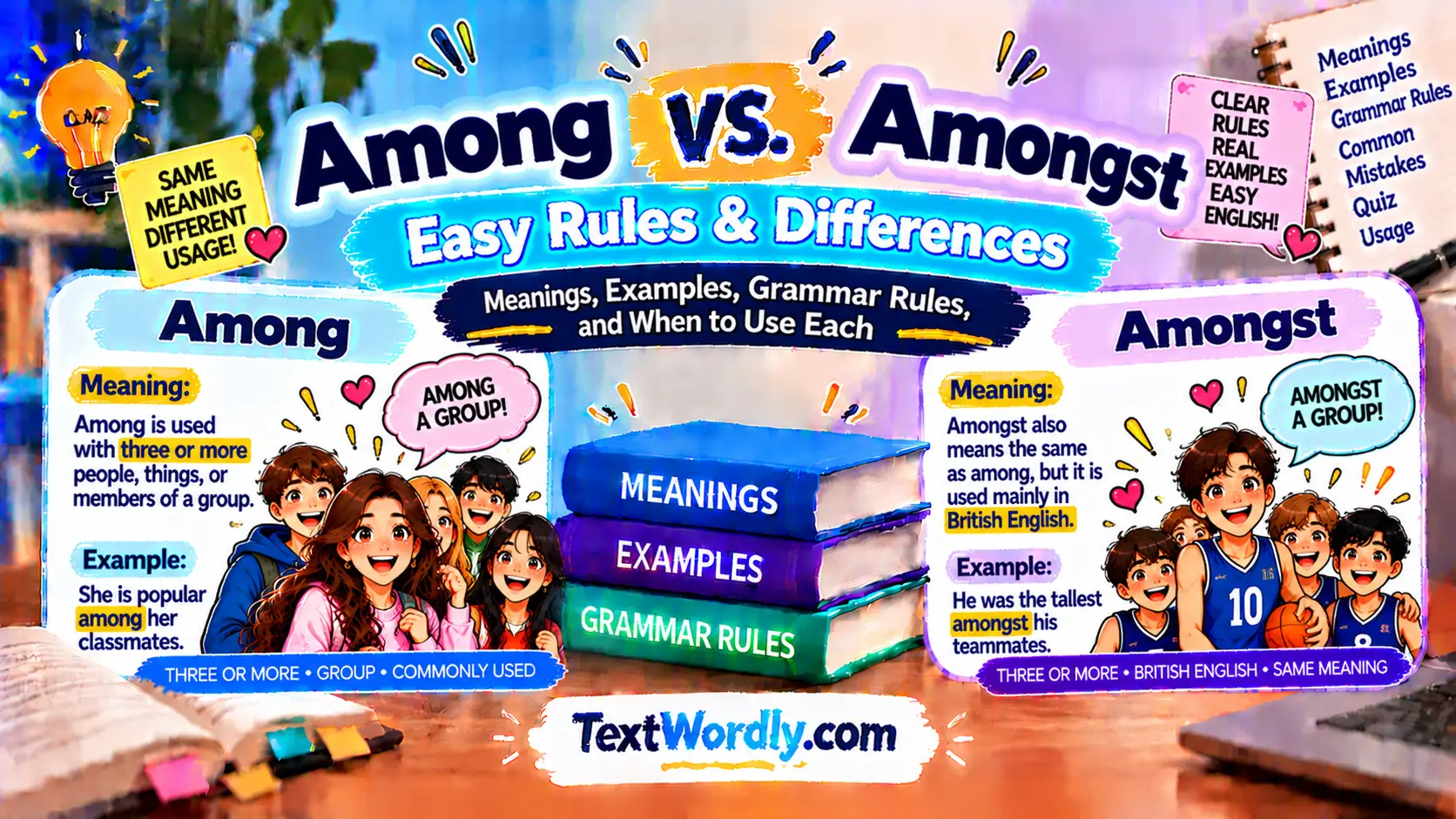
Among vs Amongst: Have you ever wondered whether you should write among or amongst? Both words appear in English books, conversations, essays, and professional writing. They look slightly different, but their meanings are nearly identical.
The difference between among vs amongst is mainly about style and frequency. Among is more common in modern English, especially in the United States. Amongst is a less common alternative that may sound more traditional, literary, or formal.
Both words are grammatically correct, so choosing the right one depends on your audience and writing style.
This guide explains their meanings, American and British English differences, pronunciation, common expressions, and grammar rules with simple examples.
QUICK ANSWER
Among and amongst mean the same thing. Both describe being surrounded by, included in, or sharing something within a group. Among is the preferred choice for most modern American English writing, while amongst is a valid alternative that can sound more traditional or literary.
| Among | Amongst |
|---|---|
| More common in modern English | Less common |
| Preferred in American English | More associated with British or literary usage |
| Natural in everyday writing | Can sound traditional |
| She sat among friends. | She sat amongst friends. |
TL;DR — Among vs Amongst
- Among and amongst have the same basic meaning.
- Among is more common in American and British English.
- Amongst is grammatically correct but less common.
- Both words can describe location, inclusion, or relationships within a group.
- Amongst may sound more traditional or literary.
- For everyday American English, among is usually the best choice.
- Between and among are not distinguished simply by the number of people or things involved.
1. What Does Among Mean?
Among is a preposition that describes being surrounded by, included in, or connected with a group of people or things.
It can also describe something shared or distributed within a group.
Examples ✍️
- She sat among her classmates.
- The house stood among tall trees.
- He was among the winners.
- The money was divided among the children.
Main Meanings of Among
| Meaning | Example |
|---|---|
| Surrounded by | The cabin stood among trees. |
| Included in a group | She was among the finalists. |
| Shared within a group | There was excitement among the students. |
| Distributed within a group | The gifts were shared among the children. |
Among is widely used in everyday conversation, academic writing, and business communication.
2. What Does Amongst Mean?
Amongst is an alternative form of among. It performs the same grammatical function and has the same basic meanings.
Examples
- She walked amongst the flowers.
- He felt comfortable amongst friends.
- The cottage stood amongst the hills.
- There was disagreement amongst the members.
All four sentences are grammatically correct.
However, amongst may sound more traditional or literary, particularly to American readers.
You do not need to use amongst to make a sentence more formal or correct.
3. Among vs Amongst: Key Differences
The distinction is mainly about frequency, tone, and regional preference rather than meaning.
| Feature | Among | Amongst |
|---|---|---|
| Meaning | Within or surrounded by a group | Same |
| Part of speech | Preposition | Preposition |
| American English | Very common | Less common |
| British English | Common | Also used |
| Everyday conversation | Natural | Less usual |
| Academic writing | Generally preferred | Less common |
| Grammar correctness | Correct | Correct |
Compare These Sentences
Among: The teacher walked among the students.
Amongst: The teacher walked amongst the students.
Both sentences communicate the same idea.
The first sounds more natural in contemporary American English.
4. When Should You Use Among?
Use among when you want clear, natural, modern English.
It works well in nearly every writing situation.
Everyday Conversation
She felt happy among her friends.
Academic Writing
The survey identified differences among participants.
Business Communication
The manager distributed responsibilities among team members.
Storytelling
A small cabin stood among the mountains.
For American readers, among is generally the safest choice because it is familiar, concise, and suitable for formal and informal contexts.
5. When Should You Use Amongst?
Use amongst when it suits the tone or style of your writing.
It may appear in literary descriptions, historical settings, or dialogue that deliberately sounds traditional.
Literary Example 📖
The traveler disappeared amongst the shadows.
Descriptive Example
A quiet village rested amongst the hills.
Dialogue Example
“I have always felt at home amongst these people,” she said.
These sentences are acceptable, but among would also work.
The word amongst does not automatically make writing more elegant. Choose it because it fits your intended voice, not because you believe it is grammatically superior.
6. Among vs Amongst in American English
In American English, among is the more familiar and widely preferred form.
American readers generally expect sentences such as:
- She stood among the crowd.
- The prize was shared among the winners.
- He was among the first to arrive.
Using amongst is not a grammatical mistake, but it may sound unusually formal, traditional, or literary.
For US-focused websites, essays, school assignments, and professional emails, among is the recommended default.
7. Among vs Amongst in British English
British English uses both among and amongst.
Although amongst is more strongly associated with British English than American English, among is also common in Britain.
British English Examples
She walked among the trees.
She walked amongst the trees.
Both sentences are correct.
Individual writers and publications may prefer one form over the other.
There is no universal British English rule requiring amongst.
8. Among vs Amongst in Formal Writing
Some people believe that amongst is more formal than among.
It can sound more traditional, but that does not necessarily make it the better choice for professional or academic writing.
Academic Example
Preferred: The results varied among the participants.
Business Example
Preferred: The information was shared among employees.
Literary Example
Acceptable: A sense of unease spread amongst the villagers.
For most modern American formal writing, among is the clearer and more natural option.
Consistency also matters. Follow your publication’s style guide when one is available.
9. Among vs Between: Grammar Rules
A common grammar shortcut says:
Between is for two things, and among is for three or more.
However, this rule is incomplete.
Between can describe distinct relationships involving more than two people or things.
Examples
Among: The child stood among the spectators.
Between: The agreement was signed between four companies.
Among: The teacher distributed worksheets among the students.
Easy Comparison
| Among | Between |
|---|---|
| Often treats people or things as a group | Often emphasizes distinct relationships |
| She stood among the crowd. | The road runs between three villages. |
| The gifts were shared among the children. | Negotiations continued between the four companies. |
Choose the word based on the relationship you want to describe, not simply the number of people or things involved.
10. Common Expressions with Among
Several common English expressions use among.
Among Other Things
Means that something is one example from a larger group of things.
Example: She enjoys reading, hiking, and painting, among other things.
Among Others
Refers to additional people or things not specifically named.
Example: Several teachers, among others, attended the meeting.
Among Themselves
Describes people doing something within their own group.
Example: The students discussed the project among themselves.
Among the Best
Means included in a group considered especially good.
Example: This restaurant is among the best in town.
First Among Equals
Describes someone who has a leading position within a group whose members are otherwise considered equal.
Example: The committee chair was regarded as first among equals.
Some expressions can also appear with amongst, but the among forms are generally more natural in American English.
11. Among vs Amongst Pronunciation
Both words have two syllables, with stress on the second syllable.
| Word | American English IPA | Key Difference |
|---|---|---|
| Among | /əˈmʌŋ/ | Ends with the /ŋ/ sound |
| Amongst | /əˈmʌŋst/ | Adds /st/ after /ŋ/ |
The beginning of both words sounds the same.
The main difference is the extra consonant sounds at the end of amongst.
Pronunciation Tip
Focus on the second syllable. In amongst, pronounce the final consonant cluster clearly without adding another syllable.
12. History and Origin of Among and Amongst
The history of these words helps explain why English has two forms with nearly identical meanings.
Among developed from Old English forms associated with being in a group or mixture.
Amongst appeared later as a related form.
Both survived in English, but their frequency and stylistic associations changed over time.
Today, among is generally preferred in contemporary American English, while amongst remains an established alternative.
The extra letters in amongst do not create a separate grammatical meaning.
13. Common Among vs Amongst Mistakes
The biggest mistake is assuming that the two words have different meanings.
Mistake 1: Thinking Amongst Is Incorrect
Incorrect belief: Amongst is not a real word.
Correct: Amongst is a valid English preposition.
Mistake 2: Thinking Amongst Is Always Better in Formal Writing
Incorrect belief: Formal writing requires amongst.
Correct: Among is generally preferred in modern American formal writing.
Mistake 3: Using Between Only for Two People
Incorrect belief: Between can never refer to more than two people or things.
Correct: Between can describe distinct relationships involving three or more parties.
Mistake 4: Inconsistent Style
Avoid switching between among and amongst without a reason.
Choose a consistent form that suits your audience and the tone of your writing.
14. How to Choose Among or Amongst
The easiest way to remember the difference is:
Among = modern, common, and natural.
Amongst = same meaning, but less common and sometimes more traditional or literary.
Quick Decision Guide
Choose Your Writing ContextEveryday American EnglishAcademic essayBusiness emailLiterary or creative writingBritish English
RECOMMENDED CHOICE
Among
The most natural default for contemporary American English.
When in doubt, use among. It works naturally in almost every modern English context.
15. Among vs Amongst Examples and Practice Quiz
Here are some practical examples.
School 🎓
The teacher walked among the students.
Workplace 💼
Trust developed among the team members.
Nature 🌿
A small house stood amongst the trees.
Community 🏠
She was popular among her neighbors.
Academic Writing 📚
The study identified differences among participants.
Quick Practice Quiz
Test Your Knowledge0 of 4 answered
1. Which word is generally preferred in modern American English?AmongAmongst
2. Is amongst grammatically correct?YesNo
3. Which sentence is grammatically correct?She stood among her friends.She stood amongst her friends.Both sentences are correct.
4. Can between refer to more than two distinct parties?YesNo
16. Among vs Amongst FAQs and Final Thoughts
Frequently Asked Questions
What is the difference between among and amongst?
They have the same basic meaning. Among is more common, especially in American English.
Is amongst correct English?
Yes. Amongst is a grammatically correct alternative to among.
Is amongst British English?
It is more associated with British English, but it is not exclusively British.
Should Americans use among or amongst?
Americans should generally choose among for natural everyday and professional writing.
Is amongst more formal than among?
It may sound more traditional or literary, but it is not inherently more grammatically correct.
Can I use among and amongst interchangeably?
Usually, yes. They have the same basic meaning, although the tone may change.
Is among used for more than two things?
Yes. Among commonly describes something within a group.
Can between be used for three people?
Yes. Between can describe distinct relationships involving three or more people.
Which word is better for academic writing?
Among is generally the better default in modern American academic writing.
Is amongst outdated?
No. It is still used, although it is less common in contemporary American English.
Final Thoughts
Understanding among vs amongst is simple once you know that both words have the same basic meaning.
The real difference is their frequency, tone, and regional usage.
For most modern American English writing, among is the better choice because it sounds natural, clear, and familiar.