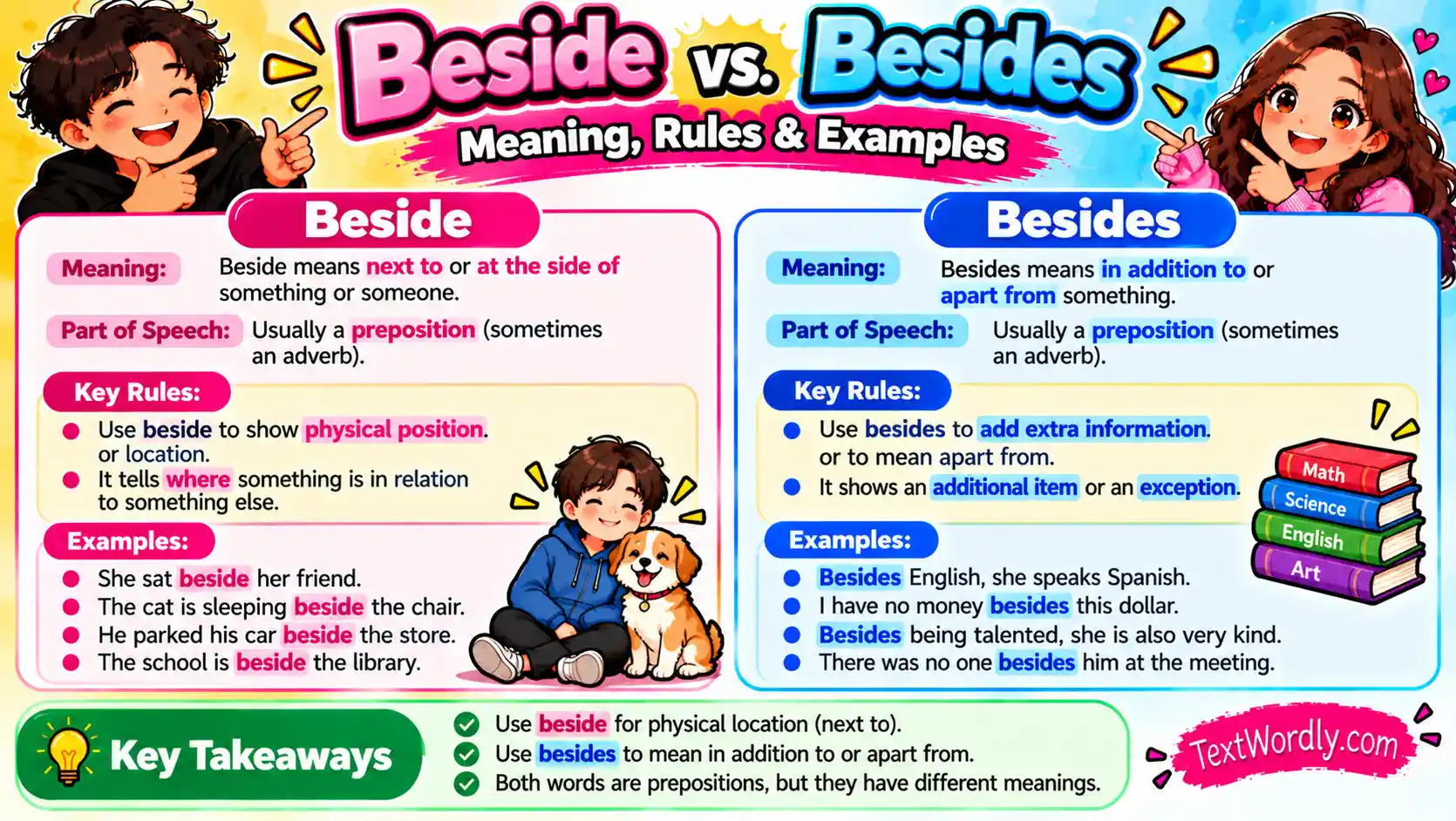
Have you ever wondered whether to write “sit beside me” or “sit besides me”? These two English words look almost the same, but they have different meanings and grammatical uses. That extra S can change what your sentence means.
The good news is that the difference is easy to learn. Beside usually means next to, while besides commonly means in addition to, apart from, or moreover. Once you understand these meanings, choosing the correct word becomes much easier.
This guide explains beside vs besides with simple grammar rules, American English pronunciation, everyday examples, comparison tables, common mistakes, and practice exercises.
Quick Answer: Beside vs Besides
Beside is a preposition that usually means next to or at the side of someone or something. Besides can be a preposition meaning in addition to or apart from, or an adverb meaning moreover. For example, “She sat beside me” describes location, while “Besides English, she studies Spanish” adds information.
TL;DR — Beside vs Besides
- 📍 Beside: Means next to or at the side of.
- ➕ Besides: Means in addition to or apart from.
- 📝 Beside: Functions as a preposition.
- 📝 Besides: Functions as a preposition or adverb.
- ✅ Correct: The chair is beside the table.
- ✅ Correct: Besides math, I study science.
- 💬 Correct: Besides, we don’t have enough time.
- 💡 Memory trick: Beside = position; besides = extra information.
Table of Contents
- Beside vs Besides: What’s the Difference?
- What Does Beside Mean?
- What Does Besides Mean?
- Beside vs Besides: Grammar Rules
- How to Use Beside in a Sentence
- How to Use Besides in a Sentence
- Besides as a Preposition vs an Adverb
- Beside vs Besides Pronunciation
- Beside vs Besides vs Except
- Beside the Point vs Besides the Point
- Besides That vs Beside That
- Common Beside vs Besides Mistakes
- Beside and Besides in Everyday Expressions
- Easy Tricks to Remember Beside vs Besides
- Beside vs Besides Practice Sentences
- Beside vs Besides Practice Quiz
Beside vs Besides: What’s the Difference?
The main difference between beside and besides is meaning. Beside usually describes where someone or something is located. Besides adds information, introduces another reason, or sometimes means apart from.
Both words can function as prepositions, but besides can also work as an adverb. This extra grammatical role makes besides useful when connecting ideas.
Beside vs Besides Comparison Table
| Feature | Beside | Besides |
|---|---|---|
| Main meaning | Next to | In addition to |
| Other meaning | Compared with | Apart from, moreover |
| Part of speech | Preposition | Preposition or adverb |
| Physical location | Yes | Not normally |
| Example | Sit beside me. | Besides me, three others came. |
| Sentence connector | No | Yes |
| Memory trick | Position | Addition |
Simple Examples
- The dog slept beside the bed.
- She stood beside her mother.
- Besides English, he speaks French.
- Besides, we already have enough food.
Easy rule: Use beside for position and besides for additional information.
What Does Beside Mean?
Beside is a preposition that usually means next to or at the side of someone or something. It describes a position or relationship between people, places, and objects.
Beside can also mean compared with, although this use is less common. It appears in expressions such as “beside the point” and “beside yourself.”
Beside Meaning With Examples
| Meaning | Example |
|---|---|
| Next to | The lamp is beside the sofa. |
| At the side of | She walked beside her friend. |
| Compared with | My problems seem small beside yours. |
| Not relevant | That detail is beside the point. |
Common Beside Sentences
- Please sit beside me.
- The keys are beside the phone.
- A small tree grows beside the house.
- He stood beside his brother.
- Her achievements are impressive beside mine.
Remember: Beside usually answers the question “Where?”
What Does Besides Mean?
Besides commonly means in addition to, apart from, or moreover. It helps add another person, thing, reason, or idea to a sentence.
Besides can function as either a preposition or an adverb. As a preposition, it usually comes before a noun or pronoun. As an adverb, it can introduce another point in a discussion.
Three Main Meanings of Besides
| Meaning | Example |
|---|---|
| In addition to | Besides coffee, we serve tea. |
| Apart from | Who besides Anna knows the answer? |
| Moreover | Besides, the weather looks bad. |
Besides Sentence Examples
- Besides math, I study science.
- Who besides Sarah attended?
- Besides, we don’t have enough time.
- She enjoys painting besides reading.
- Nobody besides my brother knew the secret.
Important: Besides does not always mean addition. In some questions and negative sentences, it can mean other than or apart from.
Beside vs Besides: Grammar Rules
Beside is a preposition. It usually connects a noun or pronoun to another part of a sentence and describes position or comparison.
Besides can be a preposition or an adverb. As a preposition, it introduces an additional or excluded person or thing. As an adverb, it adds another reason or point.
Grammar Comparison
| Word | Grammar Role | Example |
|---|---|---|
| Beside | Preposition | The bag is beside the chair. |
| Besides | Preposition | Besides music, she enjoys art. |
| Besides | Adverb | Besides, we are already late. |
Rule 1: Use Beside for Location
- The chair is beside the desk.
- He sat beside his father.
Rule 2: Use Besides for Addition
- Besides English, she speaks Spanish.
- We need paper besides pencils.
Rule 3: Use Besides to Add Another Reason
- Besides, it’s getting dark.
- Besides, we have already paid.
Grammar tip: If you can replace the word with next to, choose beside. If in addition to or moreover fits, choose besides.
How to Use Beside in a Sentence
Use beside when describing someone or something located next to another person or object. It is especially common in everyday descriptions of rooms, furniture, people, and places.
Beside also works in comparisons and fixed expressions. However, its most familiar meaning is physical closeness.
Beside Sentence Examples
- She sat beside her mother.
- The phone is beside the laptop.
- He parked beside the store.
- A chair stood beside the window.
- The dog slept beside the fireplace.
- I walked beside my friend.
- The school is beside the library.
- He placed the cup beside the plate.
- The little girl stood beside her father.
- A river flows beside the village.
Common Beside Patterns
| Pattern | Example |
|---|---|
| Sit beside | Sit beside me. |
| Stand beside | Stand beside the door. |
| Walk beside | Walk beside your friend. |
| Place beside | Place the book beside the lamp. |
| Live beside | They live beside the park. |
Writing tip: Beside is usually the correct choice when you are describing physical position.
How to Use Besides in a Sentence
Use besides when adding information, introducing another reason, or referring to someone or something apart from another person or thing.
Unlike beside, besides does not normally describe physical location. Its meaning depends on whether it functions as a preposition or an adverb.
Besides Sentence Examples
- Besides English, she speaks French.
- Who besides you knows the answer?
- Besides, we don’t have enough money.
- I enjoy swimming besides hiking.
- Nobody besides Jake was there.
- Besides coffee, the café sells tea.
- Besides, the restaurant is already closed.
- She studies history besides literature.
- What besides water should we bring?
- Besides, I have other plans.
Common Besides Patterns
| Pattern | Example |
|---|---|
| Besides + noun | Besides coffee, we sell tea. |
| Besides + pronoun | Who besides me is ready? |
| Besides + activity | Besides reading, she enjoys writing. |
| Besides, + sentence | Besides, it’s too expensive. |
Remember: Besides usually introduces something additional or identifies someone or something apart from another.
Besides as a Preposition vs an Adverb
Besides has two main grammatical roles: preposition and adverb. Knowing the difference helps you use it correctly and place commas where needed.
As a preposition, besides introduces a noun, pronoun, or noun phrase. As an adverb, it adds another reason or idea, often at the beginning of a sentence.
Besides as a Preposition
A preposition connects words and shows a relationship.
Examples:
- Besides English, she studies German.
- Who besides you attended?
- We need chairs besides tables.
Besides as an Adverb
An adverb can add information to an entire statement.
Examples:
- Besides, we have no time.
- Besides, the movie starts soon.
- Besides, I already finished my work.
Punctuation Rules
| Usage | Example | Comma Rule |
|---|---|---|
| Preposition at sentence start | Besides English, she speaks French. | Comma after introductory phrase |
| Preposition in the middle | Who besides you was there? | Usually no comma |
| Linking adverb | Besides, it’s raining. | Comma commonly follows besides |
| Transitional phrase | Besides that, we need more time. | Comma after introductory phrase |
Important: Don’t automatically place a comma after every use of besides. Check its role in the sentence.
Beside vs Besides Pronunciation
Beside and besides have almost identical pronunciations in American English. The main difference is the final Z sound in besides.
Both words have two syllables, with stress on the second syllable. The final S in besides is pronounced /z/, not /s/.
American English Pronunciation Table
| Feature | Beside | Besides |
|---|---|---|
| IPA | /bɪˈsaɪd/ | /bɪˈsaɪdz/ |
| Easy pronunciation | bih-SYDE | bih-SYDZ |
| Syllables | 2 | 2 |
| Stress | Second syllable | Second syllable |
| Final sound | /d/ | /dz/ |
How to Pronounce Beside
Say bih-SYDE.
The first syllable is short and unstressed. The second syllable sounds like side.
Example: The chair is beside the desk.
How to Pronounce Besides
Say bih-SYDZ.
Pronounce the same basic sounds as beside, but add a voiced /z/ sound at the end.
Example: Besides English, I study French.
Pronunciation tip: The extra S does not create another syllable.
Beside vs Besides vs Except
Beside, besides, and except have different meanings. Beside usually describes location, while besides can add information or mean apart from something. Except generally introduces an exclusion.
The main confusion happens between besides and except because besides sometimes means other than. The meaning depends on the sentence.
Comparison Table
| Word | Main Meaning | Example |
|---|---|---|
| Beside | Next to | She sat beside me. |
| Besides | In addition to | Besides Anna, three others came. |
| Besides | Apart from | Who besides Anna was there? |
| Except | Excluding | Everyone came except Anna. |
Besides for Addition
Besides can include an additional person or thing.
Example: Besides math, she studies science.
This means she studies math and science.
Except for Exclusion
Except normally removes someone or something from a group.
Example: Everyone attended except Ben.
This means Ben did not attend.
When Besides Means Apart From
In questions and negative sentences, besides can overlap with other than.
Example: Nobody besides Ben knew.
This means Ben was the only person who knew.
Key rule: Besides can add or identify an exception depending on context. Except normally signals exclusion.
Beside the Point vs Besides the Point
The correct idiom is “beside the point,” not “besides the point.” It means something is irrelevant or not connected to the main subject.
This expression does not describe physical location. It uses beside in a figurative way to show that an idea is outside the main discussion.
Correct Usage
- Your age is beside the point.
- That argument is beside the point.
- Whether the room is blue is beside the point.
- The price is beside the point if the product doesn’t work.
Common Mistake
❌ Your opinion is besides the point.
✅ Your opinion is beside the point.
What Does Beside the Point Mean?
It means not relevant to the issue being discussed.
Example: “We need to finish the project today. Who started it is beside the point.”
Memory trick: Think of an idea sitting beside, rather than directly on, the main point.
Besides That vs Beside That
Besides that and beside that are both possible expressions, but they have different meanings.
Besides that commonly means in addition to that. Beside that refers to something located next to a particular object or place. The surrounding sentence determines the meaning.
Besides That: Adding Information
Use besides that when introducing another fact, reason, or detail.
Examples:
- Besides that, we need more chairs.
- Besides that, the trip was expensive.
- Besides that, I have another question.
Beside That: Describing Location
Use beside that when referring to physical position.
Examples:
- Put the lamp beside that table.
- She stood beside that tree.
- The bag is beside that chair.
Comparison Table
| Expression | Meaning | Example |
|---|---|---|
| Besides that | In addition to that | Besides that, we’re late. |
| Beside that | Next to that | Sit beside that window. |
Quick tip: If you’re adding another point, choose besides that. If you’re describing location, choose beside that.
Common Beside vs Besides Mistakes
Most mistakes happen when writers use besides for physical location or beside when adding information. Confusion also appears in fixed expressions such as beside the point.
The easiest way to correct these mistakes is to replace the word with a simpler phrase and check whether the sentence still makes sense.
Common Mistakes and Corrections
| Incorrect | Correct | Reason |
|---|---|---|
| Sit besides me. | Sit beside me. | Next to |
| The keys are besides the phone. | The keys are beside the phone. | Physical location |
| Beside English, she speaks French. | Besides English, she speaks French. | Addition |
| Beside, we are late. | Besides, we are late. | Additional reason |
| That is besides the point. | That is beside the point. | Fixed idiom |
| He was besides himself with worry. | He was beside himself with worry. | Fixed idiom |
| Beside that, we need more time. | Besides that, we need more time. | Adding information |
Three Quick Grammar Checks
1. Does the sentence mean next to?
Use beside.
2. Does it mean in addition to or moreover?
Use besides.
3. Is it the idiom meaning irrelevant?
Use beside the point.
Best tip: Check the meaning before choosing the spelling.
Beside and Besides in Everyday Expressions
Both words appear in useful English expressions. Some phrases describe location, while others communicate feelings, comparisons, or additional information.
Learning these expressions will help you understand natural American English and avoid spelling mistakes.
Common Beside Expressions
| Expression | Meaning | Example |
|---|---|---|
| Beside the point | Irrelevant | That’s beside the point. |
| Beside yourself | Overcome by emotion | She was beside herself with joy. |
| Sit beside | Sit next to | Sit beside me. |
| Stand beside | Stand next to or support | I’ll stand beside you. |
| Walk beside | Walk next to | He walked beside his friend. |
Common Besides Expressions
| Expression | Meaning | Example |
|---|---|---|
| Besides that | In addition to that | Besides that, we need food. |
| Besides everything else | Along with other matters | Besides everything else, it was costly. |
| Besides me | Apart from or in addition to me | Who besides me knows? |
| Besides, | Moreover | Besides, it’s getting late. |
Figurative Meaning of Beside
Beside yourself means feeling such strong emotion that you seem unable to control your reaction.
Example: She was beside herself with excitement when she heard the news.
Remember: Fixed expressions do not always follow the most basic meaning of a word.
Easy Tricks to Remember Beside vs Besides
The easiest memory trick is to connect beside with side. If something is beside you, it is at your side.
For besides, remember the extra S as a reminder of something more. This is a memory aid, not an official grammar rule, but it can help you choose the right word.
Trick 1: Beside = At Your Side
Beside contains the word side.
Example: The dog sat beside me.
Think: The dog sat at my side.
Trick 2: Besides = Something More
Besides has an extra S.
Think: Something extra is being added.
Example: Besides math, I study science.
Trick 3: Use the Replacement Test
Replace the word with next to.
If the sentence still makes sense, use beside.
Replace it with in addition to or moreover.
If that fits, use besides.
Trick 4: Remember the Fixed Idiom
Always write:
Beside the point
Not:
Besides the point
Trick 5: Practice Two Model Sentences
- Sit beside me.
- Besides, we have enough time.
Quick reminder: Beside describes position. Besides adds information or introduces another point.
Beside vs Besides Practice Sentences
Practice is one of the best ways to remember the difference between beside and besides. The following sentences show how both words work in everyday American English.
Pay attention to whether the sentence describes physical location, adds information, or introduces another reason.
Beside Sentence Examples
- She sat beside her mother.
- The phone is beside the laptop.
- He parked beside the store.
- A chair stood beside the window.
- The dog slept beside the fireplace.
- I walked beside my friend.
- The school is beside the library.
- He placed the cup beside the plate.
- The child stood beside her father.
- A river flows beside the village.
- The teacher stood beside the board.
- She put her shoes beside the door.
- His achievements look impressive beside mine.
- The question is beside the point.
- He was beside himself with excitement.
- The bicycle is beside the garage.
Besides Sentence Examples
- Besides English, she speaks French.
- Who besides you knows the answer?
- Besides, we don’t have enough money.
- I enjoy swimming besides hiking.
- Nobody besides Jake was there.
- Besides coffee, the café sells tea.
- Besides, the restaurant is closed.
- She studies history besides literature.
- What besides water should we bring?
- Besides, I already have plans.
- Besides my sister, two friends came.
- Who besides the manager approved it?
- Besides that, we need more time.
- I have several hobbies besides reading.
- Besides, the weather looks terrible.
- Nobody besides Emma knew the password.
Fill in the Blanks
Choose beside or besides.
- The chair is ______ the table.
- ______ English, she studies Spanish.
- Please sit ______ me.
- ______, we are already late.
- That argument is ______ the point.
Answers:
- Beside
- Besides
- Beside
- Besides
- Beside
Beside vs Besides Practice Quiz
Now test your understanding of beside vs besides. This quiz includes 10 multiple-choice questions and five correction exercises.
Try answering the questions before checking the answers. Focus on location, addition, sentence connectors, and fixed expressions.
10 Multiple-Choice Questions
1. Which word usually means next to?
A. Besides
B. Beside
C. Except
D. Moreover
2. Which word can mean in addition to?
A. Beside
B. Besides
C. Next to
D. Near
3. Choose the correct sentence.
A. Sit besides me.
B. Sit beside me.
C. Sit except me.
D. Sit moreover me.
4. Which sentence uses besides correctly?
A. The bag is besides the chair.
B. Besides English, she speaks Spanish.
C. He sat besides his brother.
D. The lamp is besides the bed.
5. Which expression is correct?
A. Besides the point
B. Beside the point
C. Except the point
D. Moreover the point
6. Which word can function as an adverb?
A. Beside
B. Besides
C. Both always
D. Neither
7. Complete the sentence: “The dog slept ______ the bed.”
A. besides
B. beside
C. moreover
D. except
8. Complete the sentence: “______, we don’t have enough time.”
A. Beside
B. Besides
C. Next to
D. Near
9. Which word usually introduces an exclusion?
A. Beside
B. Besides
C. Except
D. Moreover
10. Which sentence is correct?
A. He was besides himself with joy.
B. He was beside himself with joy.
C. He was except himself with joy.
D. He was moreover himself with joy.
Answer Key With Explanations
| Question | Answer | Explanation |
|---|---|---|
| 1 | B | Beside usually means next to. |
| 2 | B | Besides can mean in addition to. |
| 3 | B | Beside describes physical position. |
| 4 | B | Besides introduces an additional subject. |
| 5 | B | Beside the point is the correct idiom. |
| 6 | B | Besides can function as an adverb. |
| 7 | B | Beside means next to the bed. |
| 8 | B | Besides adds another reason. |
| 9 | C | Except usually introduces exclusion. |
| 10 | B | Beside yourself is the correct idiom. |
Five Correction Exercises
Exercise 1
Incorrect: The chair is besides the table.
Correct: The chair is beside the table.
Explanation: The sentence describes physical location.
Exercise 2
Incorrect: Beside English, she studies French.
Correct: Besides English, she studies French.
Explanation: Besides means in addition to.
Exercise 3
Incorrect: Your age is besides the point.
Correct: Your age is beside the point.
Explanation: Beside the point is the correct idiom.
Exercise 4
Incorrect: Beside, we are already late.
Correct: Besides, we are already late.
Explanation: Besides works as an adverb introducing another reason.
Exercise 5
Incorrect: She was besides herself with worry.
Correct: She was beside herself with worry.
Explanation: Beside yourself is a fixed expression.
Practice Score Guide
| Score Out of 15 | Result |
|---|---|
| 13–15 | Excellent understanding |
| 10–12 | Very good progress |
| 7–9 | Keep practicing |
| 0–6 | Review the grammar rules |
This score guide is for informal practice rather than standardized assessment.
Frequently Asked Questions
1. What is the difference between beside and besides?
Beside usually means next to or at the side of something. Besides means in addition to, apart from, or moreover. For example, “Sit beside me” and “Besides English, she studies Spanish.”
2. Is it sit beside me or sit besides me?
The correct standard expression is sit beside me because beside describes physical location.
3. Can besides mean except?
Yes. Besides can mean apart from or other than, especially in questions and negative sentences. For example, “Nobody besides Sarah knew.”
4. Is besides a preposition or an adverb?
Besides can be both. It is a preposition in “Besides English, she speaks French” and an adverb in “Besides, it’s too late.”
5. Is it beside the point or besides the point?
The correct idiom is beside the point. It means irrelevant or unrelated to the main issue.
6. What does besides that mean?
Besides that means in addition to that. It introduces another fact, reason, or detail.
7. How do you pronounce beside and besides?
Beside is pronounced /bɪˈsaɪd/. Besides is pronounced /bɪˈsaɪdz/. Both have two syllables, but besides ends with a voiced /z/ sound.
8. How can I remember beside vs besides?
Remember that beside means next to, while besides usually adds information. Think of beside as at your side and besides as something more.
Conclusion
The difference between beside and besides becomes easy once you understand their meanings. Beside usually describes position, while besides adds information, introduces another reason, or sometimes means apart from.
Remember two simple examples: “Sit beside me” and “Besides, we have enough time.” Use beside for location and besides for addition. With these rules and a little practice, you’ll be able to choose the correct word confidently.
References and Further Reading
- Cambridge Dictionary — Beside — Meaning, pronunciation, and usage.
- Cambridge Dictionary — Besides — Preposition and adverb meanings.
- Merriam-Webster — Beside — Definitions and idioms.
- Merriam-Webster — Besides — Additional meanings and examples.
- Oxford Learner’s Dictionaries — Beside — Learner-focused examples.
- Oxford Learner’s Dictionaries — Besides — Grammar and pronunciation.
- Scribbr — Besides — Grammar explanations and word comparisons.
Editorial Note: This article follows standard American English grammar and usage. Pronunciation symbols reflect common dictionary transcriptions. All practice sentences, quizzes, and correction exercises are original educational examples.