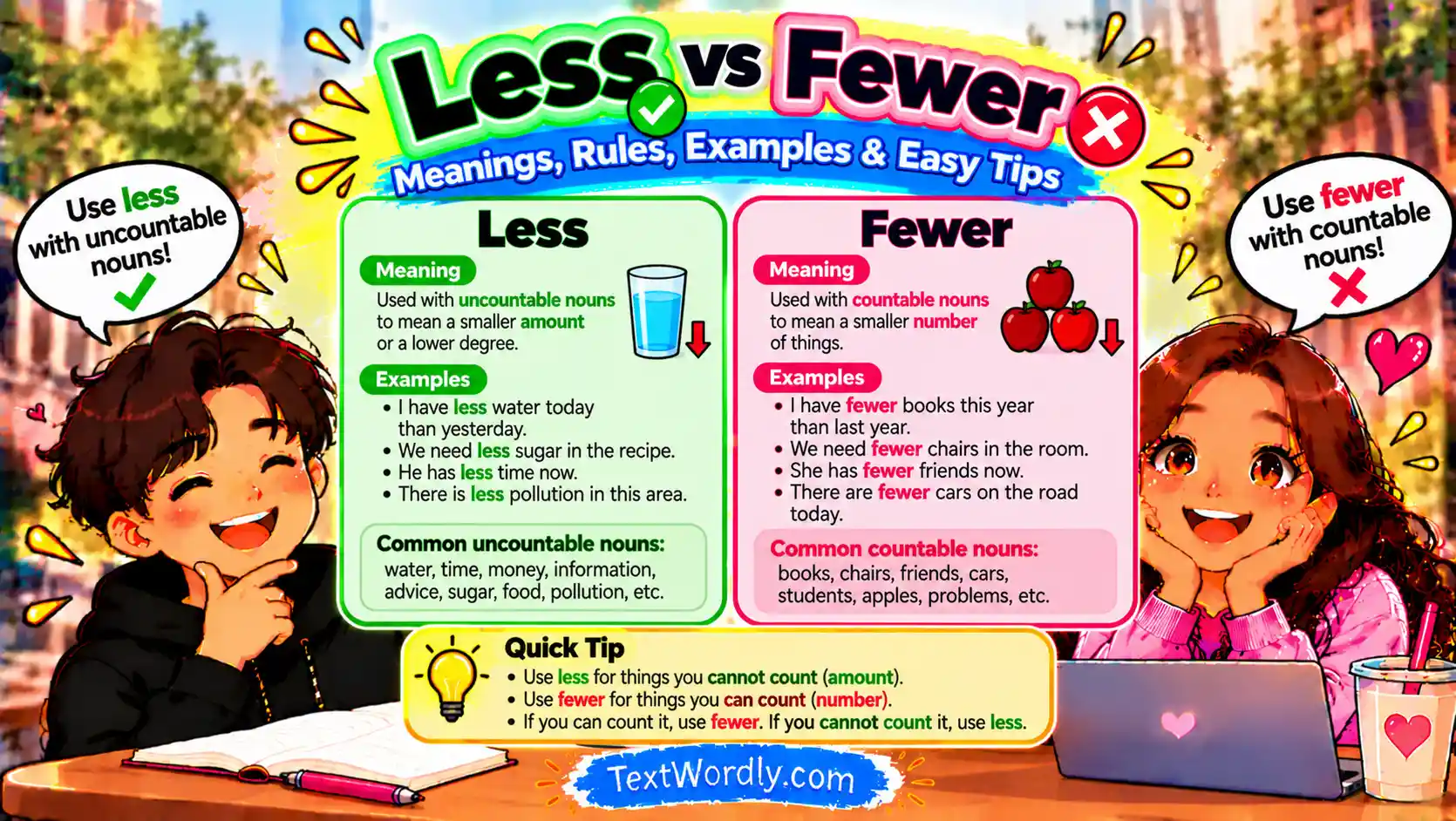
Less vs fewer is a common grammar confusion for students, English learners, and everyday writers. Both words describe a smaller quantity, but they are not always interchangeable.
The main difference depends on whether you’re counting individual things or measuring an amount. This guide explains the rules, useful exceptions, and common mistakes with practical examples.
Quick Answer
Use fewer with plural countable nouns, such as fewer books or fewer people. Use less with uncountable nouns, such as less water or less money. Measurements, singular nouns, and certain everyday expressions have exceptions.
TL;DR
- Fewer means a smaller number of countable things.
- Less means a smaller amount or degree.
- Say fewer people, but less traffic.
- Measurements commonly use less than.
- One less is acceptable with singular count nouns.
- Check the noun before choosing either word.
Less vs Fewer: Quick Difference
The basic rule is to use fewer for separate items and less for general amounts. This distinction works in most everyday sentences.
For example, you can count individual apples, but you measure the amount of juice. That difference determines which word fits.
| Feature | Less | Fewer |
|---|---|---|
| Meaning | Smaller amount | Smaller number |
| Noun type | Usually uncountable | Usually plural countable |
| Example | Less milk | Fewer bottles |
| Question | How much? | How many? |
| Base form | Little | Few |
What Does Less Mean?
Less is the comparative form of little. It describes a smaller amount, quantity, or degree.
It commonly appears with uncountable nouns, including water, money, patience, and information. It can also modify adjectives and adverbs.
- Less water: We used less water today.
- Less sugar: She wants less sugar in her tea.
- Less noise: The classroom has less noise now.
- Less expensive: This jacket is less expensive.
- Less often: I visit that store less often.
- Less time: We have less time to prepare.
- Less information: The second report contains less information.
- Less stress: Planning ahead can mean less stress.
What Does Fewer Mean?
Fewer is the comparative form of few. It describes a smaller number of countable people or things.
It usually appears before plural nouns, such as chairs, students, and mistakes. These nouns represent individual items.
- Fewer students: Fewer students attended class.
- Fewer books: This shelf contains fewer books.
- Fewer cars: There were fewer cars outside.
- Fewer mistakes: Maya made fewer mistakes.
- Fewer questions: Today’s quiz has fewer questions.
- Fewer visitors: The museum received fewer visitors.
- Fewer emails: I received fewer emails yesterday.
- Fewer delays: The new route caused fewer delays.
Countable and Uncountable Nouns
Countable nouns describe individual things that can be numbered. Examples include apples, chairs, and tickets.
Uncountable nouns describe substances, concepts, or amounts not normally counted individually. Examples include milk, furniture, and advice.
| Countable: Fewer | Uncountable: Less |
|---|---|
| Fewer apples | Less fruit |
| Fewer chairs | Less furniture |
| Fewer cars | Less traffic |
| Fewer assignments | Less homework |
| Fewer coins | Less money |
Remember: You can say three chairs, but not normally three furnitures. Say three pieces of furniture instead.
When to Use Less and Fewer
Start by identifying the noun being compared. Decide whether it names separate items or an overall amount.
Sometimes both words describe the same situation, but the noun changes. These comparisons make the difference clearer.
- Less food, but fewer meals.
- Less traffic, but fewer vehicles.
- Less work, but fewer tasks.
- Less luggage, but fewer suitcases.
- Less clothing, but fewer shirts.
- Less furniture, but fewer tables.
- Less coffee, but fewer cups of coffee.
- Less information, but fewer details.
Less Than vs Fewer Than
Both expressions compare quantities. Fewer than normally introduces a count of individual items.
Less than commonly introduces amounts, measurements, and degrees. The word after than does not always determine the choice.
- Fewer than ten students attended.
- Less than ten minutes remained.
- Fewer than five tickets were available.
- Less than five dollars was needed.
The important distinction is between counting items and measuring a quantity.
Less People or Fewer People?
Fewer people is preferred in formal American English. People are countable individuals, so the traditional rule favors fewer.
You may hear less people in casual conversation. However, fewer is the safer choice for academic and professional writing.
- Preferred: Fewer people attended the meeting.
- Preferred: Fewer people visited the museum.
- Preferred: Fewer people applied for the position.
Less Money or Fewer Money?
Less money is correct in ordinary English because money is an uncountable noun. It refers to an overall amount.
Individual currency units are countable. Use fewer when discussing the number of coins, bills, or payments.
- Less money: I spent less money today.
- Fewer coins: She carried fewer coins.
- Fewer bills: We received fewer bills this month.
Less vs Fewer With Time
Use less when describing time as a measured duration. This includes expressions containing plural units.
Use fewer when counting separate appointments, meetings, or work hours. The meaning determines the natural choice.
- Less than five minutes remained.
- Less than two hours passed.
- Fewer meetings were scheduled.
- Fewer hours were worked this week.
Less vs Fewer With Distance
Distance expressions usually describe measurements rather than individual objects. Therefore, less is common with miles, feet, and kilometers.
Use fewer when counting separate journeys, stops, or routes. These are individual events or things.
- The station is less than two miles away.
- We traveled less than ten kilometers.
- The train makes fewer stops.
- We took fewer trips this month.
One Less vs One Fewer
One less is widely accepted with singular countable nouns. It sounds natural in everyday American English.
One fewer is also possible, although it can sound less familiar. Neither expression should automatically be called incorrect.
- We have one less problem.
- That’s one less thing to worry about.
- There is one less ticket available.
With larger counts, two fewer problems and three fewer tickets follow the traditional pattern.
10 Items or Less or Fewer?
The supermarket sign 10 items or less is common and widely understood. It is an established everyday expression.
Traditional formal grammar prefers 10 items or fewer because items are countable. Both versions occur in English usage.
- 10 items or fewer: Traditional formal preference.
- 10 items or less: Common checkout wording.
- Up to 10 items: A clear alternative.
Less vs Fewer With Percentages and Weight
Percentages require attention to the quantity being discussed. Less than is common when comparing a percentage as a numerical value.
Weight is usually measured as one quantity. Counts of packages or individual objects follow the fewer pattern.
- Less than 20% of the budget remains.
- The package weighs less than five pounds.
- We shipped fewer packages this week.
Less vs Fewer in Formal and Informal English
Formal writing usually follows the traditional distinction between countable and uncountable nouns. This keeps comparisons clear and consistent.
Informal speech is more flexible, especially with established expressions. However, casual usage is not always the best choice for school assignments.
- Formal: Fewer customers arrived.
- Formal: Fewer errors appeared.
- Informal: Less people showed up.
- Established: One less thing to do.
Common Less vs Fewer Mistakes
Many mistakes happen when writers treat every quantity the same way. Checking the noun solves most problems.
However, don’t automatically change accepted measurement expressions. For example, less than five minutes is standard usage.
- ❌ Less books → ✅ Fewer books
- ❌ Fewer water → ✅ Less water
- ❌ Less mistakes → ✅ Fewer mistakes
- ❌ Fewer information → ✅ Less information
- ❌ Less chairs → ✅ Fewer chairs
- ❌ Fewer traffic → ✅ Less traffic
- ❌ Fewer patience → ✅ Less patience
- ❌ Less assignments → ✅ Fewer assignments
These corrections reflect standard formal preferences, not a claim that every informal alternative is impossible.
How to Remember Less vs Fewer
Use this memory trick: fewer = how many and less = how much. It works for most everyday examples.
Check whether the noun represents separate objects or an overall amount. Then consider whether a measurement exception applies.
- How many apples? Fewer apples.
- How much juice? Less juice.
- How many questions? Fewer questions.
- How much time? Less time.
- How many mistakes? Fewer mistakes.
- How much effort? Less effort.
- How many cars? Fewer cars.
- How much traffic? Less traffic.
Quick Practice Quiz
Choose less or fewer.
- We need ___ chairs.
- She drinks ___ coffee.
- There are ___ students today.
- The trip took ___ than an hour.
- I received ___ messages.
Answers: 1. fewer; 2. less; 3. fewer; 4. less; 5. fewer.
FAQs
What is the main difference between less and fewer?
Less usually describes an amount, while fewer describes a number of individual items. Say less water but fewer bottles.
Is it less people or fewer people?
Fewer people is preferred in formal English because people are countable. Less people occurs in informal speech.
Can less be used with countable nouns?
Yes. Accepted expressions include one less problem and less than five minutes. These patterns go beyond the basic classroom rule.
Why do we say less than five minutes?
The phrase measures a duration rather than counting separate objects. Therefore, less than five minutes is natural.
Is one less grammatically correct?
Yes. One less is acceptable with singular count nouns, such as one less question.
How can I remember less vs fewer?
Ask how many? for fewer and how much? for less. Then check whether the expression involves a measurement or another established exception.
Conclusion
The difference between less vs fewer becomes clearer when you identify the noun. Use fewer for individual countable items and less for amounts.
Remember that measurements and established expressions have exceptions. Practice the examples above to make confident choices in everyday English.