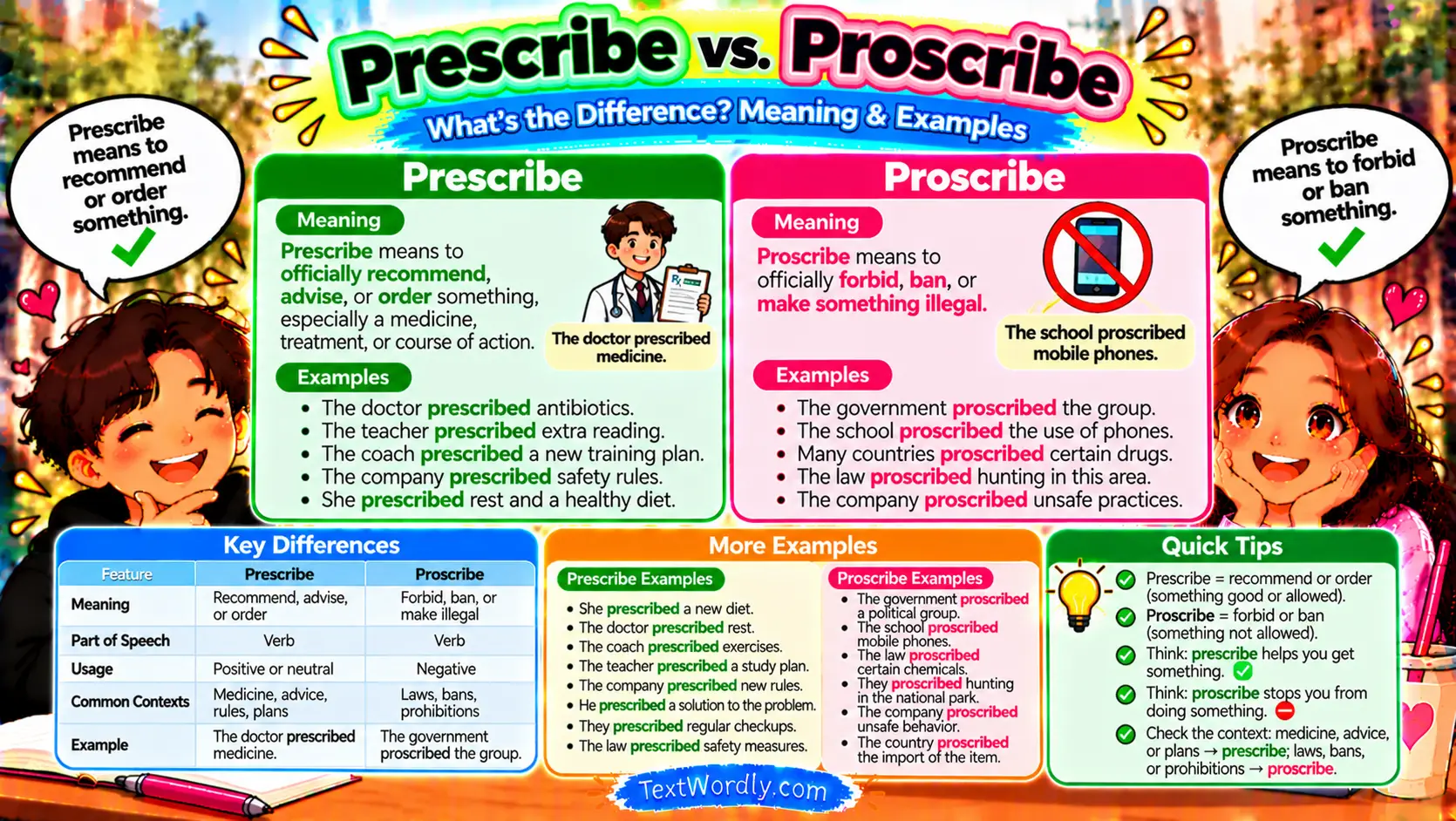
Prescribe and proscribe are commonly confused English words with nearly opposite meanings. Prescribe means to order, recommend, or officially specify something. Proscribe means to forbid, prohibit, or officially condemn something.
For example, a doctor may prescribe medication, while a law may proscribe dangerous behavior. One word tells you what should or must be done. The other tells you what is forbidden.
The difference between prescribe vs. proscribe is especially important in medical, legal, academic, and professional writing. Using the wrong word can completely change the meaning of a sentence.
This guide explains both words through simple definitions, pronunciation, grammar rules, comparison tables, real-world examples, common mistakes, and a practice quiz.
Quick Answer: Prescribe vs. Proscribe
- 💊 Prescribe: To authorize, order, recommend, or establish something as a rule.
- 🚫 Proscribe: To forbid, ban, outlaw, or officially condemn something.
Examples:
- “The doctor may prescribe medication after an examination.”
- “The law proscribes certain harmful activities.”
- “The company handbook prescribes safety procedures.”
- “The school policy proscribes bullying.”
Easy memory trick: Prescribe = prescription or instructions. Proscribe = prohibit.
TL;DR
| Word | Meaning | Example |
|---|---|---|
| Prescribe | Order, recommend, or specify | Prescribe medication |
| Proscribe | Forbid or officially ban | Proscribe dangerous conduct |
| Prescribed | Ordered or specified | Prescribed treatment |
| Proscribed | Forbidden or condemned | Proscribed activity |
| Prescription | Medical order or specified direction | A doctor’s prescription |
| Proscription | Official prohibition or condemnation | Proscription of an organization |
Bottom line: Use prescribe for instructions, requirements, or treatments. Use proscribe for prohibitions.
Prescribe vs. Proscribe: Quick Difference
The simplest way to understand prescribe vs. proscribe is to ask whether the sentence describes an instruction or a prohibition.
Prescribe establishes what someone should do, follow, or use.
Proscribe establishes what someone must not do.
Compare these sentences:
“The regulations prescribe annual safety training.”
“The regulations proscribe unsafe working practices.”
In the first sentence, the regulations require or specify training. In the second, they forbid unsafe conduct.
Side-by-Side Comparison
| Feature | Prescribe | Proscribe |
|---|---|---|
| Main meaning | Order, direct, recommend, specify | Forbid, prohibit, condemn |
| Part of speech | Verb | Verb |
| Common context | Medicine, procedures, regulations | Laws, bans, policies |
| Past tense | Prescribed | Proscribed |
| Related noun | Prescription | Proscription |
| Related adjective | Prescriptive | Proscriptive |
| Main question | What should be done? | What is forbidden? |
Quick rule: Prescribe gives directions or establishes requirements. Proscribe forbids something.
What Does Prescribe Mean?
Prescribe is a verb meaning to order, recommend, or officially specify something.
It has two particularly important uses: medical treatment and rules or procedures.
Prescribe in Medicine
In healthcare, prescribe means to authorize or direct medication or treatment.
Example:
“The physician decided to prescribe medication.”
This means the physician authorized a treatment for the patient.
A prescription may include instructions about dosage, frequency, and duration.
Not every healthcare professional has the same prescribing authority. The ability to prescribe depends on professional qualifications and applicable laws.
Prescribe as a Rule
Outside medicine, prescribe can mean to establish a required procedure or instruction.
Example:
“The handbook prescribes the steps employees must follow.”
Here, prescribes means specifies or directs.
Prescribe vs. Recommend
Recommend usually means to suggest something as suitable.
Prescribe can be stronger because it may involve formal authority or an established requirement.
For example:
“The trainer recommended regular exercise.”
“The regulations prescribed mandatory safety training.”
Key point: Prescribe is not limited to medicine. It also appears in formal rules, procedures, and instructions.
What Does Proscribe Mean?
Proscribe is a verb meaning to forbid, prohibit, outlaw, or officially condemn something.
It is more formal than everyday words such as ban and forbid.
Proscribe in Rules
“The school policy proscribes harassment.”
This means the policy prohibits harassment.
Proscribe in Law
“The law proscribes certain fraudulent practices.”
This means the law makes those practices unlawful.
Proscribe in Government
“The government proscribed the organization.”
This means the government officially banned or outlawed the organization.
Historical Meaning
Historically, proscribe could also mean to publicly condemn someone or declare a person an outlaw.
Example:
“The ancient rulers proscribed several political opponents.”
Important: Proscribe does not mean to recommend something. It means to forbid or officially condemn it.
Prescribe vs. Proscribe Comparison Chart
The following table shows how the words differ in practical situations.
| Situation | Correct word | Example |
|---|---|---|
| Medical treatment | Prescribe | The doctor prescribed medication. |
| Official prohibition | Proscribe | The law proscribes certain conduct. |
| Required procedure | Prescribe | The manual prescribes safety steps. |
| Banned activity | Proscribe | The policy proscribes unauthorized access. |
| Authorized treatment | Prescribe | The clinician prescribed therapy. |
| Forbidden organization | Proscribe | The government proscribed the group. |
| Required method | Prescribe | The instructions prescribe a specific method. |
| Prohibited behavior | Proscribe | The rules proscribe harassment. |
Same Context, Different Meaning
“The workplace policy prescribes protective equipment.”
The policy specifies or requires protective equipment.
“The workplace policy proscribes unauthorized equipment.”
The policy forbids certain equipment.
Another Example
“The school rules prescribe attendance requirements and proscribe bullying.”
The first verb describes a requirement. The second describes a prohibition.
Remember: Both words can appear in policies, but they perform different functions.
How to Pronounce Prescribe and Proscribe
Prescribe and proscribe share the same ending sound but have different first syllables.
| Word | Approximate American pronunciation | Stress |
|---|---|---|
| Prescribe | pri-SKRYBE | Second syllable |
| Proscribe | proh-SKRYBE | Second syllable |
Prescribe Pronunciation
Prescribe is commonly pronounced /prɪˈskraɪb/.
Example:
“The doctor will prescribe treatment.”
Proscribe Pronunciation
Proscribe is commonly pronounced /proʊˈskraɪb/.
Example:
“The regulations proscribe certain activities.”
Pronunciation Practice
Read these phrases aloud:
- Prescribe medication
- Prescribe a procedure
- Proscribe harmful conduct
- Proscribe an organization
Why Context Matters
In fast speech, the first syllables may be less distinct. Because both words end in the same stressed sound, listeners may rely on context.
Pronunciation tip: Both words stress -scribe. Focus on the opening vowel and the meaning of the sentence.
How to Use Prescribe in a Sentence
Use prescribe when someone authorizes a treatment, establishes a requirement, or specifies a procedure.
Medical Examples
- “The physician may prescribe medication after an evaluation.”
- “The doctor prescribed a new treatment.”
- “The specialist will prescribe therapy if appropriate.”
- “The clinician prescribed a treatment plan.”
- “The authorized provider may prescribe medication for the condition.”
Workplace and Legal Examples
- “The regulations prescribe safety procedures.”
- “The company handbook prescribes a reporting process.”
- “The law prescribes specific filing requirements.”
- “The contract prescribes how disputes must be resolved.”
- “The organization prescribed new administrative rules.”
Education and Everyday Examples
- “The instructor prescribed a specific essay format.”
- “The manual prescribes the correct installation method.”
- “The program prescribes regular training sessions.”
- “The guidelines prescribe a standard review process.”
- “The committee prescribed a new procedure for handling complaints.”
Writing tip: Common phrases include prescribe medication, prescribe treatment, prescribed procedure, and prescribed requirements.
How to Use Proscribe in a Sentence
Use proscribe when describing something that is officially forbidden, banned, or condemned.
Rules and Policies
- “The company policy proscribes workplace harassment.”
- “The school rules proscribe bullying.”
- “The handbook proscribes unauthorized equipment use.”
- “The regulations proscribe unsafe working practices.”
- “The organization proscribed discriminatory conduct.”
Legal and Government Examples
- “The law proscribes certain fraudulent activities.”
- “The government proscribed the organization.”
- “The legislation proscribed the harmful practice.”
- “The regulation proscribes unauthorized disclosure.”
- “The authorities proscribed certain public activities.”
Historical and Formal Examples
- “The ancient rulers proscribed political opponents.”
- “The official order proscribed the gathering.”
- “The institution proscribed conduct that violated its rules.”
- “The decree proscribed several organizations.”
- “The policy proscribes access to restricted information without authorization.”
Usage tip: Proscribe is relatively formal. In everyday writing, ban, forbid, or prohibit may sound more natural.
Prescribe, Prescribes, and Prescribed: Verb Forms
Prescribe and proscribe are regular verbs. Their forms follow the same grammatical pattern.
Prescribe Verb Forms
| Verb form | Word | Example |
|---|---|---|
| Base | Prescribe | Doctors prescribe treatments. |
| Third-person singular | Prescribes | She prescribes medication. |
| Simple past | Prescribed | He prescribed treatment. |
| Past participle | Prescribed | The doctor has prescribed medication. |
| Present participle | Prescribing | She is prescribing treatment. |
Proscribe Verb Forms
| Verb form | Word | Example |
|---|---|---|
| Base | Proscribe | Laws proscribe certain activities. |
| Third-person singular | Proscribes | The policy proscribes harassment. |
| Simple past | Proscribed | The government proscribed the group. |
| Past participle | Proscribed | The practice has been proscribed. |
| Present participle | Proscribing | The regulation is proscribing certain conduct. |
Grammar Rule
Because both base forms end in e, add -d to form the simple past and past participle.
- Prescribe → Prescribed
- Proscribe → Proscribed
Important: The verbs follow the same grammar pattern, but their meanings remain different.
Prescribed vs. Proscribed
Prescribed and proscribed are past-tense forms and past participles of their respective verbs.
They can also function as adjectives.
What Does Prescribed Mean?
Prescribed means ordered, specified, recommended, or required.
Examples:
- “The patient followed the prescribed treatment.”
- “Employees completed the prescribed training.”
- “The company followed the prescribed procedure.”
What Does Proscribed Mean?
Proscribed means forbidden, banned, outlawed, or officially condemned.
Examples:
- “The organization engaged in proscribed activities.”
- “The proscribed practice was discontinued.”
- “The authorities investigated the proscribed group.”
Direct Comparison
| Phrase | Meaning |
|---|---|
| Prescribed treatment | Authorized or directed treatment |
| Proscribed treatment | Forbidden treatment |
| Prescribed procedure | Required or specified procedure |
| Proscribed procedure | Forbidden procedure |
| Prescribed conduct | Conduct officially directed or required |
| Proscribed conduct | Conduct officially prohibited |
Passive Voice Examples
“The procedure was prescribed by the regulations.”
“The activity was proscribed by the law.”
Key distinction: Prescribed points to an instruction or requirement. Proscribed points to a prohibition.
Prescribe vs. Proscribe in Medicine
The word prescribe is common in healthcare because authorized professionals may issue medication or treatment orders.
Prescribing Medication
“The physician prescribed medication after reviewing the patient’s symptoms.”
The sentence describes an authorized treatment decision.
Prescribing Therapy
“The specialist prescribed physical therapy.”
The sentence describes a treatment direction.
What Does Proscribe Mean in Medicine?
Proscribe may appear in medical regulations or institutional policies when a practice is formally prohibited.
Example:
“The hospital policy proscribes the use of expired medication.”
This sentence describes a prohibition, not a treatment order.
Medical Comparison
| Expression | Meaning |
|---|---|
| Prescribe medication | Authorize medication |
| Prescribe treatment | Direct a treatment plan |
| Prescribed dosage | Dosage specified by an authorized prescriber |
| Proscribe a practice | Officially prohibit a practice |
Safety note: Medical prescribing authority varies by professional role and jurisdiction. Patients should follow instructions from their licensed healthcare professionals rather than treating general language examples as medical advice.
Prescribed by Law vs. Proscribed by Law
The expressions prescribed by law and proscribed by law can communicate opposite legal meanings.
Prescribed by Law
Prescribed by law means established, specified, or required by law.
Example:
“The reporting procedure is prescribed by law.”
The law sets out the required procedure.
Proscribed by Law
Proscribed by law means forbidden or prohibited by law.
Example:
“The unauthorized activity is proscribed by law.”
The law forbids the activity.
Legal Comparison
| Expression | Meaning |
|---|---|
| Prescribed by law | Required or specified by law |
| Proscribed by law | Forbidden by law |
| Prescribed procedure | Legally specified procedure |
| Proscribed behavior | Legally prohibited behavior |
One Law Can Do Both
“The legislation prescribes safety inspections and proscribes unsafe disposal practices.”
The law requires inspections while forbidding certain disposal methods.
Legal writing tip: Always check the intended meaning before choosing between these words. Confusing them may reverse the meaning of a requirement or prohibition.
Prescription vs. Proscription
Prescription and proscription are related nouns, but they describe different concepts.
What Is a Prescription?
A prescription is commonly an authorized medical order for medication or treatment.
It may also refer to a specified direction or requirement in other contexts.
Example:
“The pharmacist received the patient’s prescription.”
What Is a Proscription?
A proscription is an official prohibition, condemnation, or act of outlawing.
Example:
“The government announced the proscription of the organization.”
Comparison Table
| Noun | Related verb | Meaning |
|---|---|---|
| Prescription | Prescribe | Medical order or specified direction |
| Proscription | Proscribe | Official prohibition or condemnation |
Example Sentences
- “The doctor issued a prescription.”
- “The law established a formal proscription.”
- “The patient followed the prescription instructions.”
- “The organization challenged its proscription.”
Memory trick: Prescription = medical order. Proscription = prohibition.
Prescriptive vs. Proscriptive
The adjectives prescriptive and proscriptive are another commonly confused pair.
What Does Prescriptive Mean?
Prescriptive describes an approach that specifies how something should be done.
Example:
“The manual provides prescriptive instructions for workplace safety.”
In grammar, prescriptive rules describe how language should be used according to particular standards.
What Does Proscriptive Mean?
Proscriptive describes an approach focused on forbidding or restricting certain behavior.
Example:
“The policy contains proscriptive rules against unauthorized access.”
Comparison
| Word | Main meaning | Example |
|---|---|---|
| Prescriptive | Establishing what should be done | Prescriptive guidelines |
| Proscriptive | Establishing what must not be done | Proscriptive restrictions |
Important Nuance
These words are not always absolute opposites.
A prescriptive system may contain both positive instructions and prohibitions. For example, a grammar guide may prescribe formal writing conventions while also identifying expressions to avoid.
Key point: Prescriptive focuses on rules and directions. Proscriptive focuses specifically on prohibitions.
Prescribe vs. Proscribe vs. Prohibit
Prescribe, proscribe, and prohibit are sometimes confused because they all appear in formal rules.
However, their meanings are not identical.
Prescribe
To order, recommend, or specify.
“The regulations prescribe regular inspections.”
Proscribe
To officially forbid, outlaw, or condemn.
“The regulations proscribe unsafe practices.”
Prohibit
To forbid or prevent something through a rule, law, or authority.
“The policy prohibits smoking indoors.”
Related Words Comparison
| Word | Meaning | Example |
|---|---|---|
| Prescribe | Order or specify | Prescribe a procedure |
| Proscribe | Officially forbid | Proscribe harmful conduct |
| Prohibit | Forbid | Prohibit smoking |
| Ban | Officially forbid | Ban unsafe products |
| Recommend | Suggest as suitable | Recommend a method |
| Require | Make necessary or mandatory | Require training |
Which Word Sounds Most Natural?
In everyday writing, ban, forbid, and prohibit are often more familiar than proscribe.
Use proscribe when its formal tone suits the context.
Important: Proscribe is close in meaning to prohibit. Prescribe is not.
Common Mistakes and Easy Memory Tricks
The similar spelling of these verbs makes them easy to mix up.
Common Errors
| Incorrect sentence | Correct sentence | Reason |
|---|---|---|
| The doctor proscribed medication. | The doctor prescribed medication. | Authorized treatment |
| The policy prescribes harassment. | The policy proscribes harassment. | Forbidden conduct |
| The handbook proscribes a required procedure. | The handbook prescribes a required procedure. | Specified requirement |
| The law prescribes the forbidden activity. | The law proscribes the activity. | Prohibition |
| The doctor issued a proscription. | The doctor issued a prescription. | Medical order |
| The group faced official prescription. | The group faced official proscription. | Official ban |
Memory Trick 1: Prescribe = Prescription
Think of a doctor writing a prescription.
Prescribe → Prescription → Order or direct
Memory Trick 2: Proscribe = Prohibit
Both proscribe and prohibit begin with pro-.
Proscribe → Prohibit → Forbid
This is a spelling memory aid, not a complete explanation of the words’ origins.
Memory Trick 3: Required vs. Forbidden
Ask yourself:
- Is something being required, recommended, or specified? Use prescribe.
- Is something being forbidden or officially banned? Use proscribe.
One Sentence to Remember
“The policy prescribes safety training and proscribes dangerous behavior.”
Best memory rule: Prescribe = direct. Proscribe = prohibit.
Prescribe vs. Proscribe Practice Quiz
Choose the correct answer for each question.
Questions
1. The doctor decided to ______ a new treatment.
A. Prescribe
B. Proscribe
2. The school rules ______ harassment.
A. Prescribe
B. Proscribe
3. The regulations ______ annual safety inspections.
A. Prescribe
B. Proscribe
4. The government officially ______ the organization.
A. Prescribed
B. Proscribed
5. Which word means an authorized medical order?
A. Prescription
B. Proscription
6. Which sentence is correct?
A. The policy prescribes safety training and proscribes unsafe behavior.
B. The policy proscribes safety training and prescribes unsafe behavior.
Answers With Explanations
1. A — Prescribe: A doctor may authorize or direct treatment.
2. B — Proscribe: The rules forbid harassment.
3. A — Prescribe: The regulations establish required inspections.
4. B — Proscribed: The government officially banned or outlawed the organization.
5. A — Prescription: A prescription is an authorized medical order.
6. A — Prescribes and proscribes: The policy requires training and forbids unsafe behavior.
Copyable Answer Key: 1-A | 2-B | 3-A | 4-B | 5-A | 6-A
Frequently Asked Questions
What is the main difference between prescribe and proscribe?
Prescribe means to order, recommend, or specify something. Proscribe means to forbid, prohibit, outlaw, or officially condemn something.
Are prescribe and proscribe opposites?
They can express contrasting meanings in rules and policies. Prescribe may establish requirements, while proscribe establishes prohibitions. However, they are not exact opposites in every context.
What does prescribe mean in medicine?
In medicine, prescribe means to authorize or direct medication or treatment. Prescribing authority depends on professional qualifications and applicable laws.
What does proscribe mean in law?
In law, proscribe means to officially prohibit, outlaw, or condemn certain conduct, practices, people, or organizations.
Is it prescribed or proscribed medication?
Prescribed medication means medication authorized by a qualified prescriber. Proscribed medication would mean medication that has been officially forbidden, although this expression is less common.
What is the difference between prescription and proscription?
A prescription is commonly a medical order or specified direction. A proscription is an official prohibition, condemnation, or act of outlawing.
What is the difference between prescriptive and proscriptive?
Prescriptive describes rules or instructions that specify what should be done. Proscriptive describes rules that forbid or restrict certain conduct.
How can I remember prescribe vs. proscribe?
Remember prescribe = prescription and proscribe = prohibit. One directs or specifies something; the other forbids it.
Conclusion
The difference between prescribe vs. proscribe is important because these words can communicate opposite instructions.
Use prescribe when referring to authorized treatments, recommendations, requirements, or specified procedures.
Use proscribe when referring to bans, restrictions, official prohibitions, or condemnation.
Remember the related forms prescribed, proscribed, prescription, proscription, prescriptive, and proscriptive to avoid mistakes in medical, legal, and professional writing.
Final memory rule: Prescribe = order or specify. Proscribe = prohibit or ban.