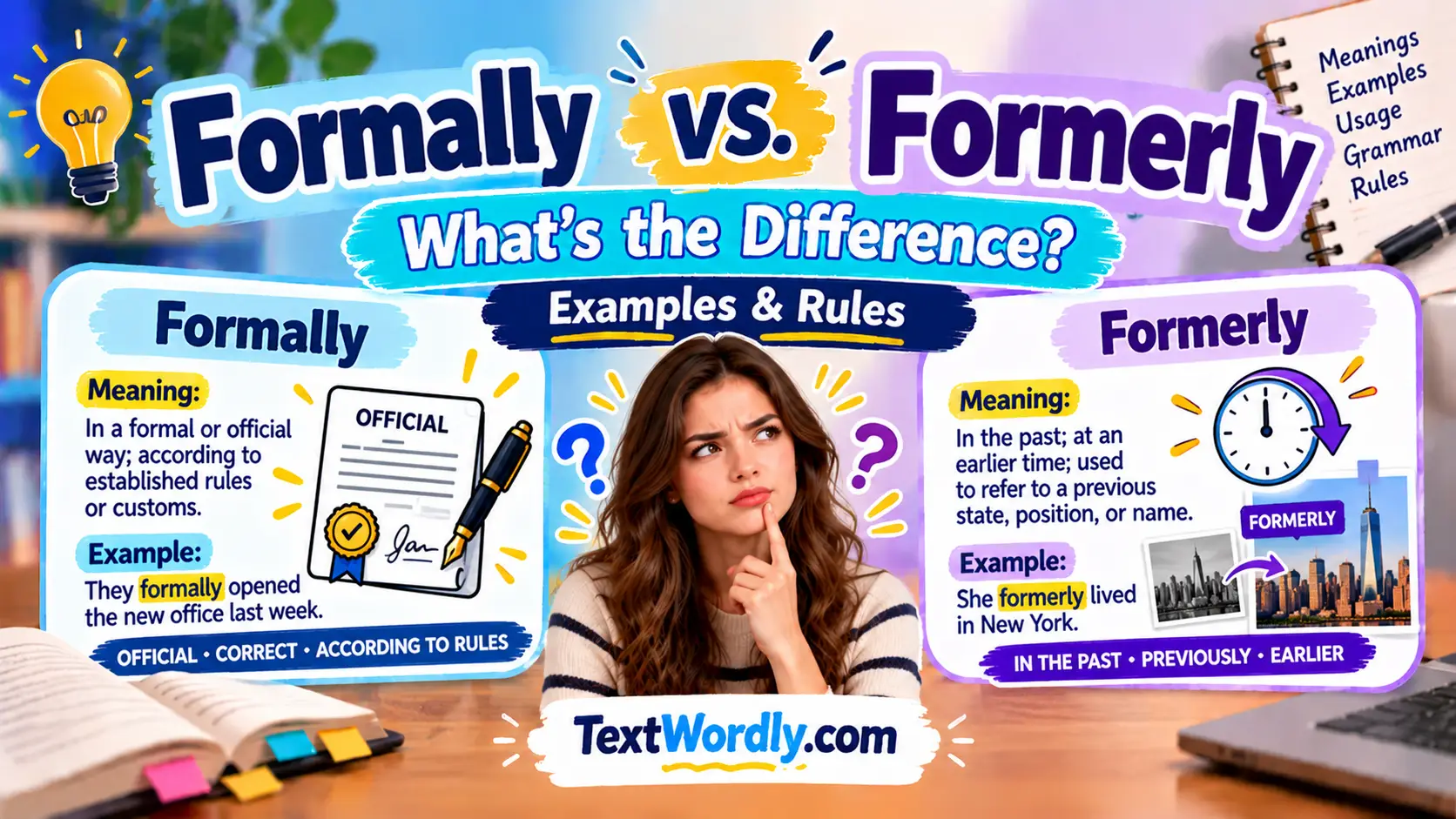
Formally and formerly look and sound similar, but they mean different things. Formally means in an official, proper, or conventional way. Formerly means previously or at an earlier time.
For example, a company may formally announce a new CEO, while that CEO may have formerly worked for another organization.
Both words are adverbs, but they answer different questions. Formally usually explains how something happens, while formerly tells us when something was true.
Understanding formally vs. formerly helps you avoid spelling mistakes in professional emails, academic writing, business documents, and everyday communication.
Quick Answer: Formally vs. Formerly
- 🎩 Formally: In an official, proper, or established manner.
- ⏳ Formerly: Previously, earlier, or at some time in the past.
Examples:
- “The committee formally approved the proposal.”
- “She was formerly the department manager.”
- “Guests were formally introduced at the ceremony.”
- “The building was formerly a school.”
Memory trick: Formally = formal. Formerly = former.
TL;DR
| Word | Meaning | Example |
|---|---|---|
| Formally | Officially or according to procedure | The agreement was formally approved. |
| Formally | In a conventional manner | Everyone dressed formally. |
| Formally | In terms of structure or form | The argument is formally valid. |
| Formerly | Previously | She formerly worked in finance. |
| Formerly | At an earlier time | The building was formerly a hospital. |
Bottom line: Use formally for official actions or formal behavior. Use formerly for previous names, roles, locations, or conditions.
Formally vs. Formerly: Quick Difference
The main difference between formally and formerly is whether you are describing manner or time.
Formally describes how something happens. It often means officially, according to established procedures, or in a conventional manner.
Formerly describes an earlier time or condition. It tells readers that something was true in the past.
Compare:
- “The principal formally welcomed the students.”
- “The principal formerly worked as a teacher.”
The first sentence describes an official welcome. The second describes a previous occupation.
| Feature | Formally | Formerly |
|---|---|---|
| Official actions | Yes | No |
| Formal behavior | Yes | No |
| Previous positions | No | Yes |
| Earlier names | No | Yes |
| Past conditions | No | Yes |
| Part of speech | Adverb | Adverb |
| Main question | How? | When? |
Quick rule: If you mean officially, choose formally. If you mean previously, choose formerly.
What Does Formally Mean?
Formally is an adverb derived from the adjective formal.
It can describe an official action, behavior that follows established conventions, or something considered according to its structure.
Formally Meaning Officially
“The committee formally approved the proposal.”
The approval followed an official procedure.
Formally Meaning According to Convention
“Guests were formally introduced at the reception.”
The introductions followed recognized social customs.
Formally Meaning in a Formal Style
“Everyone dressed formally for the ceremony.”
The guests wore clothing appropriate for a formal occasion.
Formally Meaning in Terms of Structure
“The argument is formally valid.”
This means the argument’s logical structure is valid, regardless of whether its premises are true.
Important: Formally does not always mean legally. An agreement can be formally signed without that fact alone establishing its legal enforceability.
What Does Formerly Mean?
Formerly is an adverb derived from the adjective former.
It means previously, earlier, or at an earlier time.
The word is especially useful when describing an identity, role, name, location, or condition that has changed.
Formerly Meaning Previously
“She formerly worked as a journalist.”
She worked as a journalist in the past.
Formerly Describing an Earlier Role
“He was formerly the director of operations.”
He held that position earlier.
Formerly Describing a Previous Name
“The restaurant was formerly called The Garden Cafe.”
The restaurant previously had that name.
Formerly Describing an Earlier Use
“The building was formerly a public library.”
The building served as a library in the past.
Key takeaway: Formerly describes a previous state, role, identity, or condition.
Formally vs. Formerly Comparison Chart
These examples show how the two words work in different situations.
| Situation | Correct word | Example |
|---|---|---|
| Official announcement | Formally | The company formally announced the merger. |
| Previous employment | Formerly | She formerly worked at the bank. |
| Official approval | Formally | The proposal was formally approved. |
| Previous building use | Formerly | The building was formerly a theater. |
| Proper introduction | Formally | They were formally introduced. |
| Previous business name | Formerly | The company was formerly known as BrightTech. |
| Structured analysis | Formally | The proof is formally correct. |
| Earlier residence | Formerly | The family formerly lived in Boston. |
Compare These Sentences
“The manager formally introduced the new employee.”
This describes the manner of introduction.
“The manager formerly worked in accounting.”
This describes a previous job.
Remember: Formally relates to how something is done. Formerly relates to when something was true.
How to Pronounce Formally and Formerly
Formally and formerly have similar pronunciations, but they are not necessarily identical.
In careful American English, the middle syllable provides the clearest distinction.
American English Pronunciation
| Word | IPA | Easy pronunciation |
|---|---|---|
| Formally | /ˈfɔr.mə.li/ | FOR-muh-lee |
| Formerly | /ˈfɔr.mɚ.li/ | FOR-mer-lee |
Both words usually have three syllables, with stress on the first syllable.
Pronunciation Difference
Formally contains a reduced vowel in the middle syllable.
Formerly contains the -er sound associated with former in American English.
In rapid speech, these differences may become less noticeable.
Practice Sentences
- “The committee formally approved the plan.”
- “The committee chair formerly worked in finance.”
Pronunciation tip: Practice saying formal and former before adding -ly.
How to Use Formally in a Sentence
Use formally for official procedures, established conventions, and formal styles.
Business Examples
- “The company formally announced its expansion.”
- “The manager formally approved the request.”
- “Employees were formally notified of the changes.”
- “The agreement was formally signed.”
- “The organization formally adopted the policy.”
Academic Examples
- “The student formally submitted the application.”
- “The university formally recognized the achievement.”
- “The researcher formally presented the hypothesis.”
- “The committee formally accepted the proposal.”
- “The proof was formally verified.”
Social Examples
- “The guests were formally introduced.”
- “Everyone dressed formally for the ceremony.”
Writing tip: Common phrases include formally announce, formally approve, formally recognize, and formally introduce.
How to Use Formerly in a Sentence
Use formerly when describing previous jobs, names, places, or conditions.
Previous Jobs and Positions
- “She formerly worked as a nurse.”
- “He was formerly the company’s president.”
- “The director formerly taught at a university.”
- “She was formerly employed by a technology firm.”
Previous Names
- “The company was formerly known as Green Valley Foods.”
- “The street was formerly called Market Road.”
- “The organization was formerly named Community First.”
Previous Uses and Conditions
- “The building was formerly a school.”
- “The warehouse was formerly a factory.”
- “The neighborhood was formerly an industrial area.”
Earlier Locations
- “The family formerly lived in Seattle.”
- “The business was formerly based in Denver.”
Writing tip: Formerly known as is especially common when discussing renamed companies, places, and organizations.
Formal vs. Former: Understanding the Root Words
The easiest way to distinguish these adverbs is to examine their root words.
Formal → Formally
Formal is an adjective describing something official, conventional, or following established rules.
Examples:
- “The event requires formal clothing.”
- “The organization issued a formal statement.”
- “The manager made a formal request.”
Adding -ly creates the adverb formally.
Example: “The request was formally submitted.”
Former → Formerly
Former is an adjective meaning previous or earlier.
Examples:
- “She is a former employee.”
- “He is the former president.”
- “They visited their former home.”
Adding -ly creates the adverb formerly.
Example: “She was formerly the president.”
Word Family Comparison
| Root word | Adverb | Meaning |
|---|---|---|
| Formal | Formally | In a formal manner |
| Former | Formerly | At an earlier time |
Memory rule: Formal → Formally. Former → Formerly.
Formally vs. Formerly in Business Writing
Both words frequently appear in professional communication, but they serve different purposes.
Formally in Business Communication
Use formally for official decisions, announcements, approvals, and procedures.
Examples:
- “The board formally approved the budget.”
- “The company formally announced the appointment.”
- “The employee was formally informed of the decision.”
Formerly in Business Communication
Use formerly for previous positions, company names, or organizational structures.
Examples:
- “The executive was formerly the finance director.”
- “The company was formerly known as NorthStar Solutions.”
- “The department was formerly part of the operations division.”
Business Writing Comparison
| Sentence | Meaning |
|---|---|
| The CEO was formally introduced. | The introduction was official. |
| The CEO was formerly a manager. | The CEO held that role in the past. |
| The policy was formally adopted. | The adoption followed an official process. |
| The company was formerly independent. | It had a different status earlier. |
Professional tip: Use formally for official procedures and formerly for historical information.
Formally vs. Formerly in Academic Writing
Academic writing often requires precise distinctions between procedures, logical structure, and historical information.
Formally in Academic Writing
Use formally when describing structured or officially recognized actions.
Examples:
- “The hypothesis was formally tested.”
- “The university formally approved the study.”
- “The theory was formally presented at the conference.”
Formerly in Academic Writing
Use formerly when describing historical facts, earlier classifications, or previous institutional names.
Examples:
- “The region was formerly part of a larger territory.”
- “The institution was formerly known as Central College.”
- “The researcher formerly worked in molecular biology.”
Important Distinction
“The university formally changed its name.”
This describes an official name-change procedure.
“The university was formerly called Central College.”
This identifies the university’s previous name.
Academic writing tip: Use formerly for historical context and formally for procedures or structure.
Formally vs. Officially vs. Formerly vs. Previously
These four adverbs have related meanings, but they are not always interchangeable.
Formally vs. Officially
Formally emphasizes established procedures, recognized conventions, or formal manner.
Officially emphasizes authority, recognized status, or authorized action.
Examples:
- “The committee formally voted on the proposal.”
- “The results were officially announced.”
The meanings overlap, but the emphasis can differ.
Formerly vs. Previously
Formerly and previously both refer to the past.
However, formerly is especially natural for earlier identities, roles, and continuing conditions that have changed.
Examples:
- “She was formerly the director.”
- “She had previously emailed the report.”
Previously is more flexible when describing individual past events.
Quick Comparison
| Word | Main meaning | Example |
|---|---|---|
| Formally | In a formal manner | The proposal was formally approved. |
| Officially | With official authority or recognition | The decision was officially announced. |
| Formerly | At an earlier time | The building was formerly a school. |
| Previously | Before the present or another time | She previously worked in finance. |
Key takeaway: Formally and officially describe manner or status. Formerly and previously describe time.
Formerly Known As vs. Formally Known As
One of the most common spelling mistakes involves formerly known as and formally known as.
Both phrases can be grammatical, but they mean different things.
Formerly Known As
Formerly known as means that someone or something had a different name in the past.
Examples:
- “The company was formerly known as Sunrise Media.”
- “The venue was formerly known as The Grand Hall.”
- “The artist was formerly known as DJ Nova.”
Formally Known As
Formally known as can describe something identified by a formal or official designation.
Example:
“The plant is formally known as Helianthus annuus.”
In scientific writing, scientifically known as may be clearer.
Common Mistake
❌ “The company was formally known as BrightTech.”
✅ “The company was formerly known as BrightTech.”
Use the second sentence if BrightTech was the company’s previous name.
Quick Comparison
| Phrase | Meaning |
|---|---|
| Formerly known as | Previously had another name |
| Formally known as | Identified by a formal designation |
Memory tip: Formerly = previous name. Formally = formal designation.
Where to Place Formally and Formerly in a Sentence
Both words are adverbs, so their placement can change depending on the sentence.
Formally Before the Main Verb
“The committee formally approved the proposal.”
This is a natural and common structure.
Formally After an Auxiliary Verb
“The proposal was formally approved.”
This structure is common in passive sentences.
Formerly Before a Main Verb
“She formerly worked in finance.”
This is grammatical, although “She used to work in finance” may sound more conversational.
Formerly After a Form of Be
“He was formerly the director.”
This is a natural way to describe a previous position.
Formerly Known As
“The company was formerly known as BrightTech.”
This is a standard phrase for previous names.
Placement Comparison
| Natural sentence | Main meaning |
|---|---|
| She formally accepted the offer. | Official acceptance |
| She was formerly employed there. | Previous employment |
| The policy was formally adopted. | Official adoption |
| The building was formerly a school. | Previous use |
Writing tip: Place the adverb near the action or condition it modifies to keep the sentence clear.
Common Formally vs. Formerly Mistakes
Because these words look and sound similar, writers sometimes choose the wrong one.
Mistake 1: Previous Employment
❌ “She formally worked as a teacher.”
✅ “She formerly worked as a teacher.”
Why: The sentence describes a previous job.
Mistake 2: Official Announcement
❌ “The company formerly announced the merger.”
✅ “The company formally announced the merger.”
Why: The intended meaning is an official announcement.
Mistake 3: Previous Building Use
❌ “The building was formally a hospital.”
✅ “The building was formerly a hospital.”
Why: The building served as a hospital in the past.
Mistake 4: Official Approval
❌ “The board formerly approved the proposal.”
✅ “The board formally approved the proposal.”
Why: The intended meaning is official approval.
Mistake 5: Previous Name
❌ “The restaurant was formally known as The Blue Room.”
✅ “The restaurant was formerly known as The Blue Room.”
Why: The restaurant previously had that name.
Mistake 6: Formal Clothing
❌ “Everyone dressed formerly for the event.”
✅ “Everyone dressed formally for the event.”
Why: The sentence describes clothing style.
Editing tip: Replace the word with officially or previously to identify the intended meaning.
Easy Memory Tricks for Formally vs. Formerly
These spelling tricks make the difference easier to remember.
Formally = Formal
Formally comes from formal.
Think of official ceremonies, proper behavior, and recognized procedures.
Formal → Formally → Official or proper manner
Example: “The decision was formally approved.”
Formerly = Former
Formerly comes from former.
Think of a former employee, former name, or former location.
Former → Formerly → Previously
Example: “She was formerly the director.”
The How vs. When Test
Ask what the word explains.
- How was the decision announced? Formally.
- When did she hold the position? Formerly.
The Replacement Test
Try substituting a simpler word.
- Formally → officially or in a formal way.
- Formerly → previously or in the past.
Memory Sentence
“The formerly independent organization was formally recognized by the government.”
The first word refers to a previous condition. The second refers to official recognition.
Best memory trick: Formally = formal. Formerly = former.
Formally vs. Formerly Practice Quiz
Choose the correct word for each sentence.
Questions
1. The company ______ announced its new policy.
A. Formally
B. Formerly
2. She was ______ the director of marketing.
A. Formally
B. Formerly
3. The building was ______ a public library.
A. Formally
B. Formerly
4. The committee ______ approved the proposal.
A. Formally
B. Formerly
5. The organization was ______ known as Community First.
A. Formally
B. Formerly
6. Guests were ______ introduced at the reception.
A. Formally
B. Formerly
Answers With Explanations
1. A — Formally: The announcement was official.
2. B — Formerly: The person held that position in the past.
3. B — Formerly: The building previously served as a library.
4. A — Formally: The committee gave official approval.
5. B — Formerly: The organization previously had another name.
6. A — Formally: The introductions followed formal social conventions.
Copyable Answer Key: 1-A | 2-B | 3-B | 4-A | 5-B | 6-A
Frequently Asked Questions
What is the main difference between formally and formerly?
Formally means in an official, proper, or conventional manner. Formerly means previously or at an earlier time.
Is it formally known as or formerly known as?
Use formerly known as when referring to a previous name. Formally known as can describe an official designation, but it does not mean previously named.
Does formally mean officially?
Often, yes. Formally can mean officially or according to established procedures. However, officially emphasizes recognized authority, while formally may emphasize the manner or procedure.
Does formerly mean previously?
Yes. Formerly means previously or at an earlier time, especially when discussing previous names, roles, or conditions.
Is it formally worked or formerly worked?
Use formerly worked when referring to a previous job. For example, “She formerly worked at a hospital.”
Are formally and formerly pronounced the same?
Not necessarily. Their pronunciations are similar, but formerly generally contains an -er sound that distinguishes it from formally in careful American English.
Can formally and formerly be used in the same sentence?
Yes. For example: “The formerly private institution was formally recognized as a public university.” Each word has a different meaning.
How can I remember formally vs. formerly?
Remember formally = formal or official and formerly = former or previous. Their root words provide the easiest spelling clue.
Conclusion
The difference between formally vs. formerly becomes clear when you focus on whether the sentence describes manner or time.
Use formally when something happens officially, according to established procedures, or in a proper and conventional way.
Use formerly when describing a previous name, position, location, or condition.
Although these words look and sound similar, they are not interchangeable.
Final memory rule: Formally = officially or in a formal way. Formerly = previously or in the past.
Remember this distinction to write more confidently in professional emails, academic assignments, business reports, and everyday communication.