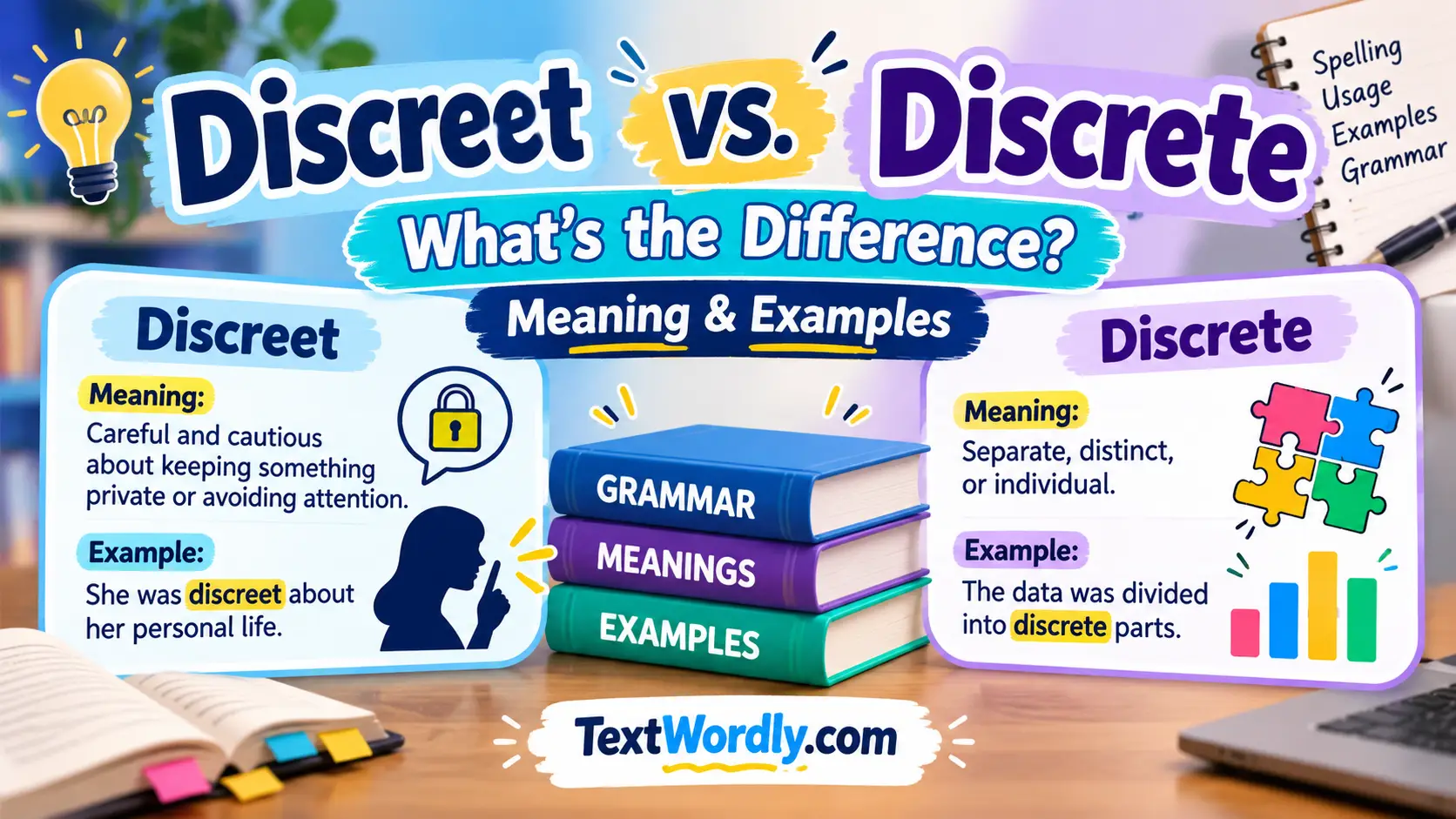
Discreet and discrete sound exactly alike, but they have different meanings. Discreet means careful, tactful, or unlikely to attract attention. Discrete means separate, distinct, or individually identifiable.
For example, someone who handles a private conversation carefully is discreet. A researcher who divides information into separate categories works with discrete groups.
Both words are adjectives, and both are pronounced dih-SKREET. Their spelling is the main clue to their different meanings.
The easiest memory trick is that discreet has two E’s together, while discrete has its E’s separated by a T.
This guide explains discreet vs. discrete through definitions, pronunciation, spelling rules, practical examples, comparison tables, and a short quiz.
Quick Answer: Discreet vs. Discrete
- 🤫 Discreet: Careful, tactful, private, or unobtrusive.
- 🧩 Discrete: Separate, distinct, or individually identifiable.
Examples:
- “Please be discreet about the surprise party.”
- “The research included three discrete groups.”
- “She gave him a discreet warning.”
- “The project has four discrete stages.”
Memory trick: Discreet = tactful. Discrete = separate.
TL;DR
| Word | Meaning | Example |
|---|---|---|
| Discreet | Tactful, careful, or unobtrusive | She was discreet about the matter. |
| Discrete | Separate or distinct | The data were divided into discrete groups. |
| Discreetly | Tactfully or without attracting attention | He discreetly left the room. |
| Discretely | Separately or in distinct parts | The events were analyzed discretely. |
Bottom line: Use discreet for tact or subtlety and discrete for separation.
Discreet vs. Discrete: Quick Difference
The main difference between discreet and discrete is the quality each word describes.
Discreet refers to careful behavior, good judgment, privacy, or subtlety. It often describes how someone acts or communicates.
Discrete refers to things that can be distinguished from one another. It commonly describes groups, categories, stages, events, and mathematical values.
Quick Comparison
| Feature | Discreet | Discrete |
|---|---|---|
| Meaning | Tactful or unobtrusive | Separate or distinct |
| Part of speech | Adjective | Adjective |
| Pronunciation | dih-SKREET | dih-SKREET |
| Spelling | -eet | -ete |
| Related adverb | Discreetly | Discretely |
| Example | A discreet conversation | Discrete categories |
Simple rule: If you mean careful or tactful, choose discreet. If you mean separate or distinct, choose discrete.
What Does Discreet Mean?
Discreet is an adjective describing someone or something that is careful, tactful, unobtrusive, or unlikely to attract unnecessary attention.
A discreet person uses good judgment, particularly when dealing with private information or sensitive situations.
However, the word does not always involve secrecy. It can also describe an understated appearance or subtle action.
Common Uses of Discreet
- Discreet person: Someone who handles sensitive matters tactfully.
- Discreet conversation: A private or carefully conducted discussion.
- Discreet inquiry: A question asked without attracting attention.
- Discreet appearance: An understated or subtle look.
- Discreet assistance: Help provided without unnecessary publicity.
Examples
- “She was discreet about her friend’s personal situation.”
- “The manager handled the complaint in a discreet manner.”
- “Please remain discreet about the announcement.”
- “He made a discreet phone call.”
- “The hotel offered discreet service.”
Important: Being discreet means showing tact or avoiding unnecessary attention, not necessarily hiding the truth.
What Does Discrete Mean?
Discrete is an adjective meaning separate, distinct, or individually identifiable.
It describes things that can be recognized as separate units, even when they belong to the same larger system.
The word frequently appears in academic writing, mathematics, statistics, science, technology, and research.
Common Uses of Discrete
- Discrete groups: Separate groups.
- Discrete categories: Distinct classifications.
- Discrete events: Individually identifiable occurrences.
- Discrete stages: Separate phases of a process.
- Discrete variables: Variables with separate possible values.
Examples
- “The experiment included three discrete groups.”
- “The project was divided into four discrete stages.”
- “Researchers recorded several discrete events.”
- “The system processes information in discrete units.”
- “The survey results were organized into discrete categories.”
Key takeaway: Discrete emphasizes distinctness or separation, not secrecy or privacy.
Discreet vs. Discrete Comparison Chart
Because these words are pronounced identically, their meaning must determine the correct spelling.
The following table shows how they differ in everyday and technical contexts.
| Situation | Correct word | Example |
|---|---|---|
| Private conversation | Discreet | She requested a discreet conversation. |
| Separate groups | Discrete | The study used discrete groups. |
| Subtle jewelry | Discreet | She wore discreet earrings. |
| Distinct project phases | Discrete | The project has discrete stages. |
| Tactful warning | Discreet | He gave a discreet warning. |
| Statistical values | Discrete | The variable has discrete values. |
| Avoiding attention | Discreet | They made a discreet exit. |
| Individual events | Discrete | The system recorded discrete events. |
Remember: Discreet describes tact or subtlety; discrete describes distinctness.
How to Pronounce Discreet and Discrete
Discreet and discrete are homophones. This means they sound the same despite having different spellings and meanings.
Both words contain two syllables, with stress on the second syllable.
Pronunciation Guide
| Word | IPA | Easy pronunciation |
|---|---|---|
| Discreet | /dɪˈskriːt/ | dih-SKREET |
| Discrete | /dɪˈskriːt/ | dih-SKREET |
Pronunciation Examples
- “Please be discreet.”
- “The categories are discrete.”
Both sentences use the same pronunciation.
Why Pronunciation Matters
Unlike some commonly confused words, you cannot identify discreet or discrete by listening to the final sound.
Instead, consider the meaning of the sentence.
Pronunciation tip: These words sound alike, so context and spelling are essential.
Discreet vs. Secretive vs. Subtle
Discreet, secretive, and subtle have overlapping meanings, but they are not interchangeable.
Discreet usually suggests tact, good judgment, or an effort to avoid unnecessary attention.
Secretive describes someone who deliberately keeps information hidden. It can suggest excessive secrecy or unwillingness to share information.
Subtle describes something that is not obvious, strong, or immediately noticeable.
Comparison Table
| Word | Main meaning | Example |
|---|---|---|
| Discreet | Tactful or unobtrusive | She made a discreet inquiry. |
| Secretive | Inclined to conceal information | He was secretive about his plans. |
| Subtle | Not immediately obvious | She noticed a subtle change. |
Practical Difference
A discreet employee protects sensitive information appropriately.
A secretive employee may seem unwilling to share information, even when sharing would be reasonable.
A subtle gesture may be difficult to notice.
Important: Discreet often has a positive meaning because it suggests tact and good judgment.
Discrete vs. Separate vs. Distinct
Discrete, separate, and distinct all involve differences between things, but each emphasizes something slightly different.
Discrete describes individually identifiable units or parts.
Separate emphasizes that things are apart, divided, or treated independently.
Distinct emphasizes that something is clearly recognizable as different from something else.
Comparison Table
| Word | Main emphasis | Example |
|---|---|---|
| Discrete | Individually identifiable units | The system has discrete components. |
| Separate | Being apart or divided | The teams work in separate rooms. |
| Distinct | Clearly different | The samples had distinct colors. |
Can Discrete Things Be Connected?
Yes. Discrete does not necessarily mean completely unrelated or disconnected.
For example, a training course may contain five discrete modules. Each module is identifiable as a separate unit, but all five belong to the same course.
Key takeaway: Discrete things can be part of a larger connected system while remaining individually distinguishable.
How to Use Discreet in a Sentence
Use discreet when describing careful behavior, privacy, subtlety, or an effort to avoid unwanted attention.
The word appears naturally in everyday conversations, workplace communication, hospitality, and professional situations.
Everyday Examples
- “Please be discreet about the surprise party.”
- “She gave her friend a discreet warning.”
- “He made a discreet gesture.”
- “The couple preferred a discreet celebration.”
- “She chose a discreet necklace.”
Professional Examples
- “The manager handled the complaint discreetly.”
- “The employee remained discreet about confidential information.”
- “The company offered discreet customer assistance.”
- “The assistant arranged a discreet meeting.”
- “The counselor was discreet when discussing the student’s concerns.”
Writing tip: Use discreet when you could reasonably describe the behavior as tactful, careful, or unobtrusive.
How to Use Discrete in a Sentence
Use discrete when referring to separate, distinct, or individually identifiable things.
It is especially useful in research, education, technology, mathematics, and formal communication.
Everyday Examples
- “The project contains three discrete tasks.”
- “The company operates in two discrete markets.”
- “The process has several discrete stages.”
- “The report identifies four discrete problems.”
- “The course is divided into discrete modules.”
Academic and Technical Examples
- “The experiment involved five discrete groups.”
- “The variable takes discrete values.”
- “The system records discrete events.”
- “The researchers identified discrete categories.”
- “The model represents time in discrete steps.”
Usage reminder: Discrete does not mean private, tactful, or unobtrusive.
Discreetly vs. Discretely: What’s the Difference?
The adverbs discreetly and discretely follow the same distinction as their related adjectives.
Discreetly means in a tactful, careful, or unobtrusive manner.
Discretely means separately or as distinct units, particularly in technical writing.
Discreetly Examples
- “She discreetly left the meeting.”
- “He discreetly informed the manager.”
- “The assistant discreetly offered help.”
Discretely Examples
- “The researchers analyzed the groups discretely.”
- “The system processes each event discretely.”
- “The measurements were recorded discretely.”
Quick Comparison
| Adverb | Meaning | Example |
|---|---|---|
| Discreetly | Tactfully or unobtrusively | She spoke discreetly. |
| Discretely | Separately or in distinct units | The system processed events discretely. |
Memory trick: Discreetly = tactfully. Discretely = separately.
Discretion, Indiscreet, and Discreteness
Understanding related words makes it easier to use discreet and discrete correctly.
Discretion
Discretion can mean careful judgment, especially when handling sensitive information. It can also refer to the freedom to make decisions.
Example: “The manager handled the issue with discretion.”
Indiscreet
Indiscreet describes someone who shows poor judgment, particularly by revealing information or behaving without enough tact.
Example: “His indiscreet comment embarrassed his colleague.”
Indiscretion
Indiscretion is an act of poor judgment or a failure to behave tactfully.
Example: “She apologized for her indiscretion.”
Discreteness
Discreteness is the quality of being separate or individually distinguishable.
Example: “The discreteness of the categories helped the researchers organize the data.”
Word Family Comparison
| Word | Meaning |
|---|---|
| Discreet | Tactful or unobtrusive |
| Discreetly | In a tactful manner |
| Discretion | Careful judgment or decision-making freedom |
| Indiscreet | Lacking tact or good judgment |
| Indiscretion | An act of poor judgment |
| Discrete | Separate or distinct |
| Discretely | Separately or in distinct units |
| Discreteness | Quality of being separate or distinct |
Important: Discretion and discreteness are different words with different meanings.
Discrete vs. Continuous in Mathematics
In mathematics and statistics, discrete has a precise technical meaning.
A discrete variable takes values from a finite or countably infinite set of possible values.
A continuous variable can take any value within a specified interval.
Examples of Discrete Variables
- Number of students in a classroom
- Number of books on a shelf
- Number of cars in a parking lot
- Number of emails received
- Number of goals scored
These are common examples of discrete variables because their possible values are separate counts.
Examples of Continuous Variables
- Height
- Weight
- Temperature
- Distance
- Time duration
These quantities are commonly modeled as continuous because they can vary across an interval.
Discrete vs. Continuous Table
| Discrete | Continuous |
|---|---|
| Separate possible values | Values throughout an interval |
| Number of students | Student height |
| Number of books | Book weight |
| Number of vehicles | Travel distance |
| Number of messages | Time spent reading |
Do Discrete Values Have to Be Whole Numbers?
No. Although counts are common examples, discrete values do not always have to be whole numbers.
For example, a variable restricted to 0, 0.5, and 1 is discrete because it has three distinct possible values.
Key takeaway: Discrete means separate possible values, not necessarily whole numbers.
Common Phrases With Discreet and Discrete
Learning common word combinations helps you recognize the correct spelling without memorizing complicated rules.
Common Phrases With Discreet
- Discreet conversation: A tactful or private discussion.
- Discreet inquiry: A question asked without attracting attention.
- Discreet service: Unobtrusive assistance.
- Discreet packaging: Packaging that does not draw attention to its contents.
- Discreet appearance: An understated look.
- Discreet warning: A subtle or tactful warning.
Common Phrases With Discrete
- Discrete data: Data with separate possible values.
- Discrete variable: A variable with distinct possible values.
- Discrete groups: Individually identifiable groups.
- Discrete categories: Separate classifications.
- Discrete events: Individually distinguishable occurrences.
- Discrete stages: Distinct phases of a process.
Quick Decision Test
Ask yourself:
Can I replace the word with “tactful” or “unobtrusive”?
If yes, choose discreet.
Can I replace the word with “separate” or “distinct”?
If yes, choose discrete.
Common Discreet vs. Discrete Mistakes
Because discreet and discrete sound alike, writers sometimes choose the wrong spelling.
These examples show common mistakes and their corrections.
Mistake 1: Using Discrete for Privacy
❌ “Please be discrete about the surprise.”
✅ “Please be discreet about the surprise.”
Mistake 2: Using Discreet for Separate Groups
❌ “The study included three discreet groups.”
✅ “The study included three discrete groups.”
Mistake 3: Confusing the Adverbs
❌ “She discretely left the room.”
✅ “She discreetly left the room.”
Mistake 4: Incorrect Technical Usage
❌ “The variable takes discreet values.”
✅ “The variable takes discrete values.”
Mistake 5: Confusing Related Nouns
❌ “The manager handled the issue with discreteness.”
✅ “The manager handled the issue with discretion.”
Mistake 6: Using Discreet for Distinct Stages
❌ “The process contains four discreet stages.”
✅ “The process contains four discrete stages.”
Final checking rule: Discreet = tactful. Discrete = separate.
Easy Memory Tricks for Discreet vs. Discrete
The spelling difference becomes easier to remember when you focus on the placement of the letter E.
Discreet: Two E’s Together
In discreet, the two E’s stand side by side.
Imagine two friends keeping a private conversation between them.
Discreet → EE together → Privacy
Discrete: E’s Separated
In discrete, the two E’s are separated by the letter T.
Imagine the E’s as two separate units.
Discrete → E-T-E → Separation
Discreet = Tactful
Think of someone who carefully handles a sensitive situation without attracting unnecessary attention.
Discrete = Distinct
Think of separate categories, independent tasks, or individually identifiable values.
Perfect Memory Sentence
“The discreet researcher organized the information into discrete categories.”
Remember: Discreet protects privacy; discrete describes separation.
Discreet vs. Discrete Practice Quiz
Choose the correct word or word form to complete each sentence.
Questions
1. Please be ______ about the surprise party.
A. Discreet
B. Discrete
2. The study involved three ______ groups.
A. Discreet
B. Discrete
3. She ______ informed the manager about the problem.
A. Discreetly
B. Discretely
4. The number of students is a ______ variable.
A. Discreet
B. Discrete
5. The assistant handled the sensitive matter with ______.
A. Discretion
B. Discreteness
6. The project was divided into four ______ stages.
A. Discreet
B. Discrete
Answers With Explanations
1. A — Discreet: Means careful or tactful when handling private information.
2. B — Discrete: Describes separate or distinct groups.
3. A — Discreetly: Means tactfully or without attracting unnecessary attention.
4. B — Discrete: Describes a variable with separate, countable possible values.
5. A — Discretion: Means careful judgment or tact.
6. B — Discrete: Describes distinct stages of a process.
Copyable Answer Key: 1-A | 2-B | 3-A | 4-B | 5-A | 6-B
FAQs About Discreet vs. Discrete
What is the difference between discreet and discrete?
Discreet means careful, tactful, or unobtrusive. Discrete means separate, distinct, or individually identifiable.
Are discreet and discrete pronounced the same?
Yes. Both words are pronounced dih-SKREET in standard American English. They are homophones.
Is it discreet or discrete about a secret?
Use discreet when describing someone who handles private or sensitive information carefully.
What does discrete mean in mathematics?
In mathematics, discrete describes separate, distinguishable values or structures rather than a continuous range.
What is the adverb of discreet?
The adverb is discreetly, meaning tactfully, carefully, or without attracting unnecessary attention.
What is the adverb of discrete?
The adverb is discretely, meaning separately or in distinct units.
Is discretion related to discreet?
Yes. Discretion is related to discreet and can mean careful judgment, tact, or freedom to make decisions.
How can I remember discreet vs. discrete?
Remember that discreet has two E’s together, while discrete has its E’s separated by T. Think privacy for discreet and separation for discrete.
Conclusion
The difference between discreet vs. discrete becomes simple when you focus on meaning instead of pronunciation.
Use discreet when describing tactful behavior, careful communication, privacy, or subtlety.
Use discrete when describing separate groups, distinct categories, individual events, or mathematical values.
Although both words are pronounced the same, they are not interchangeable.
The easiest memory trick is: Discreet has two E’s together; discrete has its E’s separated.
By remembering this rule and practicing the examples, you can confidently use both words in everyday conversations, academic writing, and professional communication.