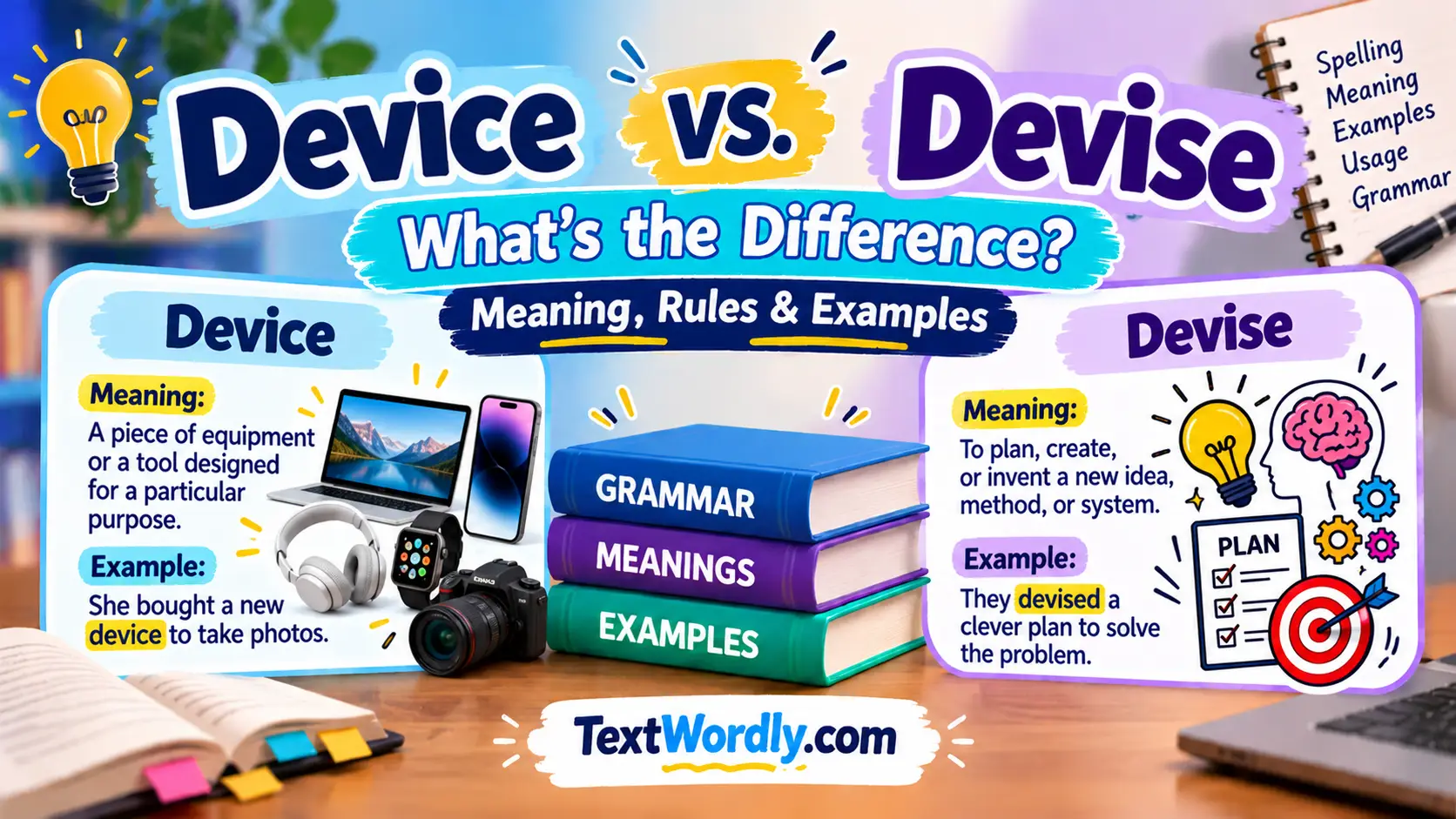
Device and devise look almost identical, but they have different meanings and grammatical functions. A device is usually a noun meaning a tool, instrument, or technique. Devise is usually a verb meaning to invent, develop, or carefully plan something.
For example, a smartphone is an electronic device, while an engineer might devise a new system to improve its performance.
The words also sound slightly different. Device ends with an S sound, while devise ends with a Z sound.
Although the basic distinction is straightforward, there are other important uses to understand. A device can be a literary technique rather than a physical object, and devise has a specialized meaning in legal English.
This guide explains device vs. devise with clear definitions, grammar rules, pronunciation tips, everyday examples, and simple memory tricks.
Quick Answer: Device vs. Devise
- 📱 Device (noun): A tool, machine, instrument, or technique designed for a particular purpose.
- 💡 Devise (verb): To invent, create, develop, or carefully plan something.
Examples:
- “This electronic device measures temperature.”
- “The engineers will devise a better solution.”
- “Metaphor is a common literary device.”
- “The team devised a new marketing strategy.”
Easy memory trick: Device = thing or technique. Devise = action.
TL;DR
| Word | Meaning | Grammar | Example |
|---|---|---|---|
| Device | Tool, mechanism, or technique | Noun | This device saves time. |
| Devise | Invent, develop, or plan | Verb | We need to devise a plan. |
| Devise (legal) | Transfer real property by will; also a testamentary gift of real property | Verb or noun | The will included a devise of land. |
Remember: In everyday English, device is a noun and devise is a verb.
Device vs. Devise: Quick Difference
The easiest way to distinguish device from devise is to identify what the word does in a sentence.
Use device when naming an object, mechanism, or technique. Use devise when describing the action of developing a plan, method, or solution.
Main Differences
| Feature | Device | Devise |
|---|---|---|
| Common meaning | Tool or technique | Invent or plan |
| Part of speech | Noun | Verb |
| Pronunciation | dih-VICE | dih-VIZE |
| Final sound | /s/ | /z/ |
| Related forms | Devices | Devises, devised, devising |
| Example | A medical device | Devise a solution |
Quick rule: If the word names something, choose device. If it describes creating or planning something, choose devise.
What Does Device Mean?
Device is a noun referring to a tool, instrument, mechanism, or technique used to accomplish a particular purpose.
Many devices are physical objects, such as smartphones, medical monitors, and mechanical tools.
However, a device can also be a method used to produce a particular effect, especially in writing, storytelling, or communication.
Common Types of Devices
- Electronic device: Smartphone, tablet, or computer.
- Medical device: Hearing aid or blood pressure monitor.
- Safety device: Smoke detector or protective mechanism.
- Tracking device: Equipment used to monitor movement or location.
- Mechanical device: A mechanism that performs a specific function.
- Literary device: A writing technique, such as metaphor or foreshadowing.
Device Sentence Examples
- “My smartphone is an electronic device.”
- “The doctor used a medical device.”
- “This safety device helps prevent accidents.”
- “The company developed a portable device.”
- “Foreshadowing is a literary device.”
Important: A device does not have to be electronic or even physical.
What Does Devise Mean?
Devise is most commonly a verb meaning to invent, develop, formulate, or carefully plan something.
It often describes thoughtful problem-solving or creative planning.
People frequently devise plans, strategies, solutions, methods, systems, and approaches.
Common Uses of Devise
Devise a plan: Develop a plan to achieve a goal.
Devise a strategy: Create an organized approach.
Devise a solution: Find or develop a way to solve a problem.
Devise a method: Create a procedure for completing a task.
Devise Sentence Examples
- “The team will devise a new strategy.”
- “Scientists hope to devise a better testing method.”
- “She devised a creative solution.”
- “The manager asked employees to devise a plan.”
- “Researchers are devising ways to reduce waste.”
Grammar tip: In its everyday meaning, devise usually takes a direct object identifying what is being planned or invented.
Device vs. Devise Comparison Chart
Although these words share similar spellings, they serve different purposes in everyday English.
This comparison shows which word belongs in common situations.
| Situation | Correct word | Example |
|---|---|---|
| Smartphone | Device | My device needs charging. |
| Creating a plan | Devise | We need to devise a plan. |
| Medical equipment | Device | The device monitors blood pressure. |
| Developing a solution | Devise | They devised a solution. |
| Literary technique | Device | Irony is a literary device. |
| Planning a strategy | Devise | She will devise a strategy. |
| Safety equipment | Device | The device improves safety. |
| Inventing a method | Devise | Researchers devised a method. |
Key takeaway: Device identifies a thing or technique; devise usually describes an action.
How to Pronounce Device and Devise
Device and devise sound similar, but their final consonants are different.
Both words have two syllables, with the stress on the second syllable.
Pronunciation Guide
| Word | IPA | Easy pronunciation |
|---|---|---|
| Device | /dɪˈvaɪs/ | dih-VICE |
| Devise | /dɪˈvaɪz/ | dih-VIZE |
Device Ends With an S Sound
The word device ends with the unvoiced /s/ sound, like the ending of ice.
Example: “This device is useful.”
Devise Ends With a Z Sound
The word devise ends with the voiced /z/ sound, like the ending of rise.
Example: “We must devise a solution.”
Pronunciation Memory Trick
- Device → Ice → /s/
- Devise → Rise → /z/
Important: The singular words are not pronounced identically, even though they sound very similar.
Device as a Noun vs. Devise as a Verb
The main grammar distinction is simple: device is a noun, while devise is usually a verb.
A noun names a thing, concept, or technique. A verb expresses an action.
Device as a Noun
- “The device is expensive.”
- “This device measures temperature.”
- “Several devices are connected to the network.”
Devise as a Verb
- “They will devise a plan.”
- “She devised a better method.”
- “We are devising a new approach.”
Grammar Comparison
| Device: noun | Devise: verb |
|---|---|
| A device | To devise |
| Two devices | She devises |
| The device works | He devised |
| This device helps | They are devising |
Grammar exception: In specialized legal English, devise can also function as a noun. Its everyday use, however, is overwhelmingly verbal.
How to Use Device in a Sentence
Use device when referring to a tool, instrument, mechanism, or technique.
The word commonly appears in technology articles, medical information, product descriptions, instruction manuals, and discussions about writing.
Device Sentence Examples
- “The electronic device stopped working.”
- “She purchased a new device for her home.”
- “The medical device measures oxygen levels.”
- “This device helps people communicate.”
- “The tracking device was installed yesterday.”
- “Many smart devices connect to the internet.”
- “The technician repaired the damaged device.”
- “A safety device protects the equipment.”
- “The company introduced a portable device.”
- “Repetition is a useful rhetorical device.”
Writing tip: The plural of device is devices, not devises.
How to Use Devise in a Sentence
Use devise when describing the action of creating, inventing, developing, or planning something.
This verb is especially useful in academic, scientific, business, and professional writing.
Devise Sentence Examples
- “We need to devise a new plan.”
- “The team devised an effective strategy.”
- “Scientists are trying to devise better testing methods.”
- “She hopes to devise a creative solution.”
- “The manager devised a training program.”
- “They must devise a way to reduce costs.”
- “Engineers devised a more efficient system.”
- “The students devised a clever experiment.”
- “The company will devise a marketing campaign.”
- “Researchers are devising new approaches to the problem.”
Usage tip: Devise often suggests careful thought or creativity rather than simply making something without planning.
Devices vs. Devises: What’s the Difference?
Devices and devises are easy to confuse because they sound alike in standard American English.
However, they have different meanings and grammatical functions.
Devices: Plural Noun
Devices is the plural of device. It refers to multiple tools, mechanisms, or techniques.
Example: “Several electronic devices are connected to the network.”
Devises: Verb Form
Devises is the third-person singular present-tense form of devise.
Example: “She devises creative solutions.”
Comparison Table
| Word | Grammar | Example |
|---|---|---|
| Devices | Plural noun | These devices are expensive. |
| Devises | Verb | He devises new strategies. |
Pronunciation Note
Both words are commonly pronounced /dɪˈvaɪsɪz/ in American English.
Memory trick: Devices are things; devises describes what someone does.
Devised vs. Devising: Verb Forms
Because devise is a verb, it changes form according to tense and sentence structure.
The main forms are devise, devises, devised, and devising.
Verb Forms Table
| Form | Usage | Example |
|---|---|---|
| Devise | Base form | We need to devise a plan. |
| Devises | Third-person singular | She devises solutions. |
| Devised | Past tense | They devised a method. |
| Devising | Present participle | He is devising a strategy. |
Spelling Rules
For the past tense, add -d to devise:
Devise → Devised
For the present participle, remove the final e before adding -ing:
Devise → Devising
Common Errors
❌ “The team deviced a solution.”
✅ “The team devised a solution.”
❌ “She is deviseing a plan.”
✅ “She is devising a plan.”
Remember: Devised and devising come from the verb devise, not the noun device.
Literary Devices and Rhetorical Devices
A device does not always mean a physical object.
In literature, communication, and storytelling, a device is a technique used to create a particular effect.
What Is a Literary Device?
A literary device is a technique writers use to communicate ideas, create imagery, or influence how readers experience a story.
Common Literary Devices
| Device | Meaning | Example |
|---|---|---|
| Metaphor | Direct comparison | Time is a thief. |
| Simile | Comparison using like or as | She ran like the wind. |
| Personification | Giving human qualities to nonhuman things | The wind whispered. |
| Foreshadowing | Hinting at future events | A warning suggests coming danger. |
| Irony | Contrast between expectation and reality | A fire station catches fire. |
What Is a Rhetorical Device?
A rhetorical device is a language technique used to persuade, emphasize, or create an effect.
Example: “Who wouldn’t want a safer neighborhood?”
This rhetorical question can emphasize a point without requiring a literal answer.
Important: Literary and rhetorical devices are techniques, not electronic equipment.
Legal Meaning of Devise
In legal English, devise has a specialized meaning involving the transfer of property through a will.
Traditionally, to devise property means to transfer real property, such as land, by will.
The word can also function as a noun referring to a testamentary gift of real property.
Devise as a Legal Verb
“The property owner devised the land to her daughter.”
Here, devised refers to a transfer provided for in a will.
Devise as a Legal Noun
“The will included a devise of the family property.”
Here, devise refers to the gift or provision itself.
Legal Usage Comparison
| Term | Meaning |
|---|---|
| Devise (verb) | Transfer property through a will |
| Devise (noun) | Testamentary gift or provision |
| Devisee | Person receiving property through a devise |
| Devisor | Person making the devise |
Legal note: The exact scope of these terms can vary by jurisdiction and statute. Modern legal usage sometimes extends beyond the traditional real-property distinction.
For ordinary writing, the main rule remains: device is a noun, and devise is a verb.
Common Phrases and Idioms With Device and Devise
Both words appear in common expressions, but their meanings remain distinct.
Common Phrases With Device
- Electronic device: Equipment using electronic components.
- Medical device: Equipment used for medical purposes.
- Safety device: Equipment designed to improve safety.
- Literary device: Technique used in writing.
- Rhetorical device: Technique used for persuasion or emphasis.
- Left to your own devices: Allowed to act independently without guidance or supervision.
What Does “Left to Your Own Devices” Mean?
The idiom left to your own devices means being allowed to decide what to do without supervision or assistance.
Example: “Left to their own devices, the children invented a new game.”
The expression does not refer to smartphones or electronic gadgets.
Common Phrases With Devise
- Devise a plan
- Devise a strategy
- Devise a solution
- Devise a method
- Devise an approach
- Devise a system
Example: “The team devised a new strategy after reviewing the results.”
Common Device vs. Devise Mistakes
Writers sometimes confuse these words because their spellings differ by only one letter.
The following examples show common errors and how to correct them.
Mistake 1: Using Devise for Equipment
❌ “My electronic devise is broken.”
✅ “My electronic device is broken.”
Mistake 2: Using Device for an Action
❌ “We need to device a solution.”
✅ “We need to devise a solution.”
Mistake 3: Confusing Plural Forms
❌ “Several smart devises are connected.”
✅ “Several smart devices are connected.”
Mistake 4: Confusing Verb Forms
❌ “She devices new marketing strategies.”
✅ “She devises new marketing strategies.”
Mistake 5: Incorrect Past Tense
❌ “The engineers deviced a method.”
✅ “The engineers devised a method.”
Mistake 6: Incorrect Present Participle
❌ “They are deviseing a new system.”
✅ “They are devising a new system.”
Final checking rule: If you mean a thing or technique, use device. If you mean to plan or invent, use devise.
Easy Memory Tricks for Device vs. Devise
You can remember the difference with two simple letter associations.
Device = C for Computer
Device contains the letter C, just like computer.
A computer is a device.
Device → C → Computer
Devise = S for Strategy
Devise contains the letter S, just like strategy.
You can devise a strategy.
Devise → S → Strategy
Device = Noun
A device is something you use, such as a phone, monitor, tool, or writing technique.
Devise = Verb
To devise means to invent, develop, or carefully plan something.
Perfect Memory Sentence
“The engineer used a device to devise a better solution.”
Final rule: Device = thing or technique. Devise = planning or inventing.
Device vs. Devise Practice Quiz
Test your understanding by choosing the correct word or word form.
Questions
1. My electronic ______ stopped working.
A. Device
B. Devise
2. We need to ______ a new strategy.
A. Device
B. Devise
3. The company introduced several smart ______.
A. Devices
B. Devises
4. She ______ creative solutions to difficult problems.
A. Devices
B. Devises
5. The engineers ______ a better testing method.
A. Deviced
B. Devised
6. Metaphor is a common literary ______.
A. Device
B. Devise
Answers With Explanations
1. A — Device: Refers to an electronic object.
2. B — Devise: Means to develop or create a strategy.
3. A — Devices: Plural noun referring to multiple pieces of equipment.
4. B — Devises: Third-person singular verb describing the action of creating solutions.
5. B — Devised: Correct past-tense form of devise.
6. A — Device: Refers to a technique used in writing.
Copyable Answer Key: 1-A | 2-B | 3-A | 4-B | 5-B | 6-A
FAQs About Device vs. Devise
What is the difference between device and devise?
Device is a noun meaning a tool, instrument, mechanism, or technique. Devise is usually a verb meaning to invent, develop, or carefully plan something.
Is it device or devise a plan?
The correct expression is devise a plan because devise means to create or develop a plan.
How do you pronounce device and devise?
Device is pronounced dih-VICE, ending with an S sound. Devise is pronounced dih-VIZE, ending with a Z sound.
What is the plural of device?
The plural of device is devices. For example, “Several electronic devices are connected.”
What is the past tense of devise?
The past tense of devise is devised. For example, “The team devised a new strategy.”
Are devices and devises pronounced the same?
Yes. In standard American English, devices and devises are pronounced alike, even though their grammatical functions differ.
What does left to your own devices mean?
Left to your own devices means being allowed to act independently without supervision or assistance.
Can devise be a noun?
Yes. In specialized legal English, devise can be a noun referring to a gift or provision made through a will, traditionally involving real property.
Conclusion
The difference between device vs. devise becomes easy to understand when you focus on meaning and grammar.
Use device for a tool, mechanism, instrument, or technique. Use devise when describing the action of inventing, developing, or carefully planning something.
Remember that device ends with an S sound, while devise ends with a Z sound. Also, the plural noun devices and the verb devises are pronounced alike.
The easiest memory trick is: Device has C for computer; devise has S for strategy.
With these definitions, examples, pronunciation rules, and practice exercises, you can confidently choose the correct word in everyday and professional American English.