Learn the difference between lay and lie, their verb forms, common mistakes, tense changes, examples, and a simple way to remember each form.
Lay vs lie is a common English usage topic. These words can be confused because their spelling, pronunciation, or grammatical behavior is similar. The easiest solution is to learn each word’s role and then apply a short context test.
Lay vs Lie: The Core Difference
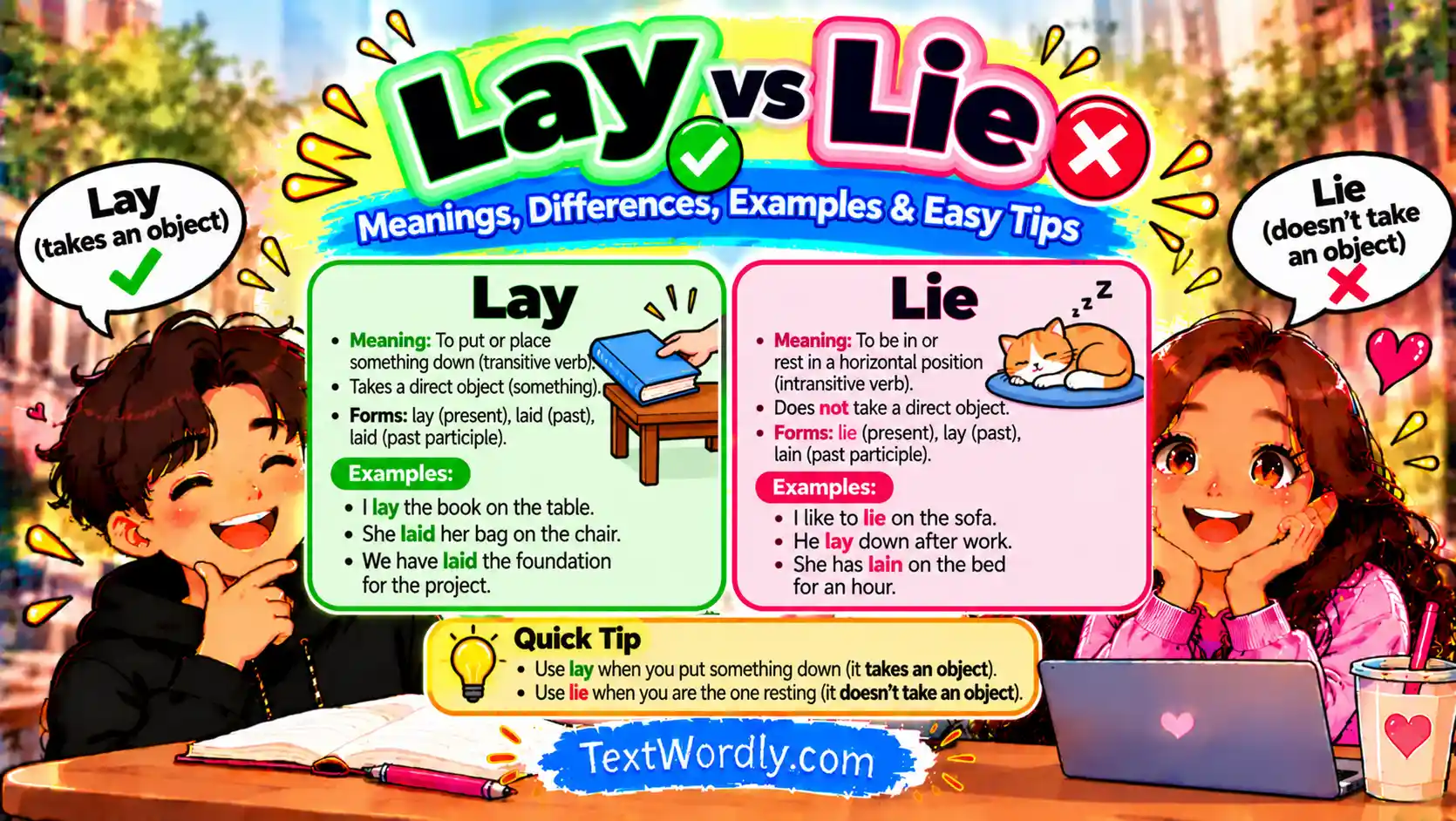
Lay is normally a transitive verb, so it takes a direct object. You lay something down. Lie is normally intransitive, so the person or thing lies down without a direct object.
| Verb | Present | Past | Past participle |
|---|---|---|---|
| Lay | lay | laid | laid |
| Lie | lie | lay | lain |
Lay Examples
- Lay the book on the table.
- She laid the keys beside the phone.
- The worker has laid the papers on the desk.
Lie Examples
- I need to lie down.
- He lay on the sofa yesterday.
- She has lain there for an hour.
Lay vs Lie: Why the Past Tense Is Confusing
The biggest problem is that the past tense of lie is lay. This makes sentences such as “Yesterday I lay down” look like the verb lay. Check whether an object follows the verb to identify the intended meaning.
Lay vs Lie Memory Test
Think of lay as an action you do to something: lay the book down. Think of lie as a position you take yourself: lie down. Then remember that lie changes to lay in the past tense.
Definitions and Word Roles
Start by identifying what each word means and how it functions in a sentence. Meaning should come before spelling or pronunciation. This makes the rule easier to apply in both casual and formal writing.
Common Mistakes
- Choosing a word only because it sounds right.
- Ignoring the noun or verb that follows.
- Applying a rule without checking context.
- Confusing American and British English conventions.
- Using a familiar form without proofreading the complete sentence.
How to Remember the Difference
Use a replacement test. Read the complete sentence and ask what the word is supposed to mean. Then replace it with a simple word or phrase with the same function. If the sentence changes meaning, choose the other form.
Quick Comparison
| Question | What to check |
|---|---|
| What does the word mean? | Read the surrounding sentence. |
| What grammatical role does it have? | Check whether it acts as a noun, verb, adjective, or adverb. |
| Is the usage regional? | Check American vs British English conventions. |
| Still unsure? | Use a reliable dictionary. |
Examples in Everyday English
Clear examples are useful because grammar rules become easier to remember when connected to normal situations. Read the examples aloud, then create one sentence of your own using each form.
- The writer checked the sentence before publishing.
- The student used the correct word in an email.
- The editor explained why the original form was confusing.
- The reader used context to understand the meaning.
- The final sentence was clear and natural.
- The teacher gave another example to make the rule easier.
American English Usage
This guide follows standard American English where regional spelling or usage matters. Some English forms differ across countries, so a form that is normal in British English may not be the preferred form in American writing. When the audience is American, follow the American convention consistently.
Practice: Choose the Correct Word
Test yourself before checking a dictionary. Identify the meaning first, choose the word, and then read the sentence again. This habit improves accuracy more effectively than memorizing isolated spellings.
- Read the sentence once for meaning.
- Identify the grammatical role.
- Apply the specific rule.
- Check the final sentence for natural usage.
Related Text Wordly Guides
Your vs You’re · Bring vs Take · Good vs Well · Affect vs Effect · Has vs Have
Trusted Dictionary and Writing Resources
Merriam-Webster · Cambridge Dictionary · Oxford Learner’s Dictionaries · Britannica Dictionary · Grammarly Writing Resources
Frequently Asked Questions
Why are these words confusing?
Similar spelling, pronunciation, or related meanings can make the forms easy to mix up.
What is the fastest way to choose the correct word?
Identify the intended meaning and grammatical role before choosing the spelling.
Does American English matter?
Yes. Some spelling and usage conventions differ between American and British English.
Should I check a dictionary?
Yes. A reputable dictionary can confirm meaning, pronunciation, usage notes, and regional conventions.
Lay vs Lie: Detailed Verb Forms
The present forms are the key starting point. Lay normally needs an object: you lay something somewhere. Lie normally does not take a direct object: a person or thing lies in a position. The confusion grows because the past tense of lie is lay.
| Meaning | Present | Past | Example |
|---|---|---|---|
| Put something down | lay | laid | She laid the folder on the desk. |
| Rest or recline | lie | lay | She lay on the sofa. |
Future and Perfect Forms
The future form of lie is “will lie,” while its present participle is “lying.” Its past participle is “lain.” Lay has “laid” as both its past tense and past participle. These forms explain why a sentence can look confusing even when the grammar is correct.
- I will lie down after work.
- The papers will be laid on the table.
- He has lain awake for hours.
- They have laid the foundation.
Lay vs Lie with Objects
A quick object test can help. In “Lay the phone on the desk,” phone receives the action. In “Lie on the bed,” there is no direct object after lie. Ask what is being placed or moved. If something receives the action, lay is often the correct present form.
Common Lay vs Lie Errors
A common mistake is using “lay” for the present meaning of reclining, as in “I am going to lay down.” In standard usage, “I am going to lie down” is the traditional form. Another mistake is changing the past tense of lie incorrectly. Remember: yesterday I lay down, but today I lie down.
Lay vs Lie: Final Review
Remember the simplest present-tense contrast: you lay something down, but you lie down. Lay takes an object, while lie normally does not. Then remember the unusual past form: the past of lie is lay.
Examples: “Lay the book here,” “I lie down after lunch,” and “Yesterday I lay down early.” Regular practice with these three patterns helps prevent most errors.
Lay vs Lie: Editing Checklist
When proofreading, look for a direct object after the verb. If you are placing something somewhere, the present verb is usually lay. If you are describing your own resting position, use lie. Then check the tense carefully because the past of lie is lay, while the past of lay is laid.
Keep these examples nearby: “Lay the phone down,” “I lie down,” “Yesterday I lay down,” and “She laid the phone down.” These patterns cover many common situations.
These verb forms are worth practicing because tense changes can hide the original distinction. Check both the object and the tense before deciding which form belongs in the sentence.
Lay vs Lie: Quick Decision Rule
If you put something somewhere, use lay in the present tense. If you rest or recline, use lie. For past tense, remember that lie becomes lay, while lay becomes laid. This tense check prevents many common errors.
Conclusion
Understanding lay vs lie helps you avoid common English usage errors. Focus on meaning, grammar, context, and regional style rather than relying only on pronunciation. With regular practice, the correct form becomes easier to recognize and use naturally.