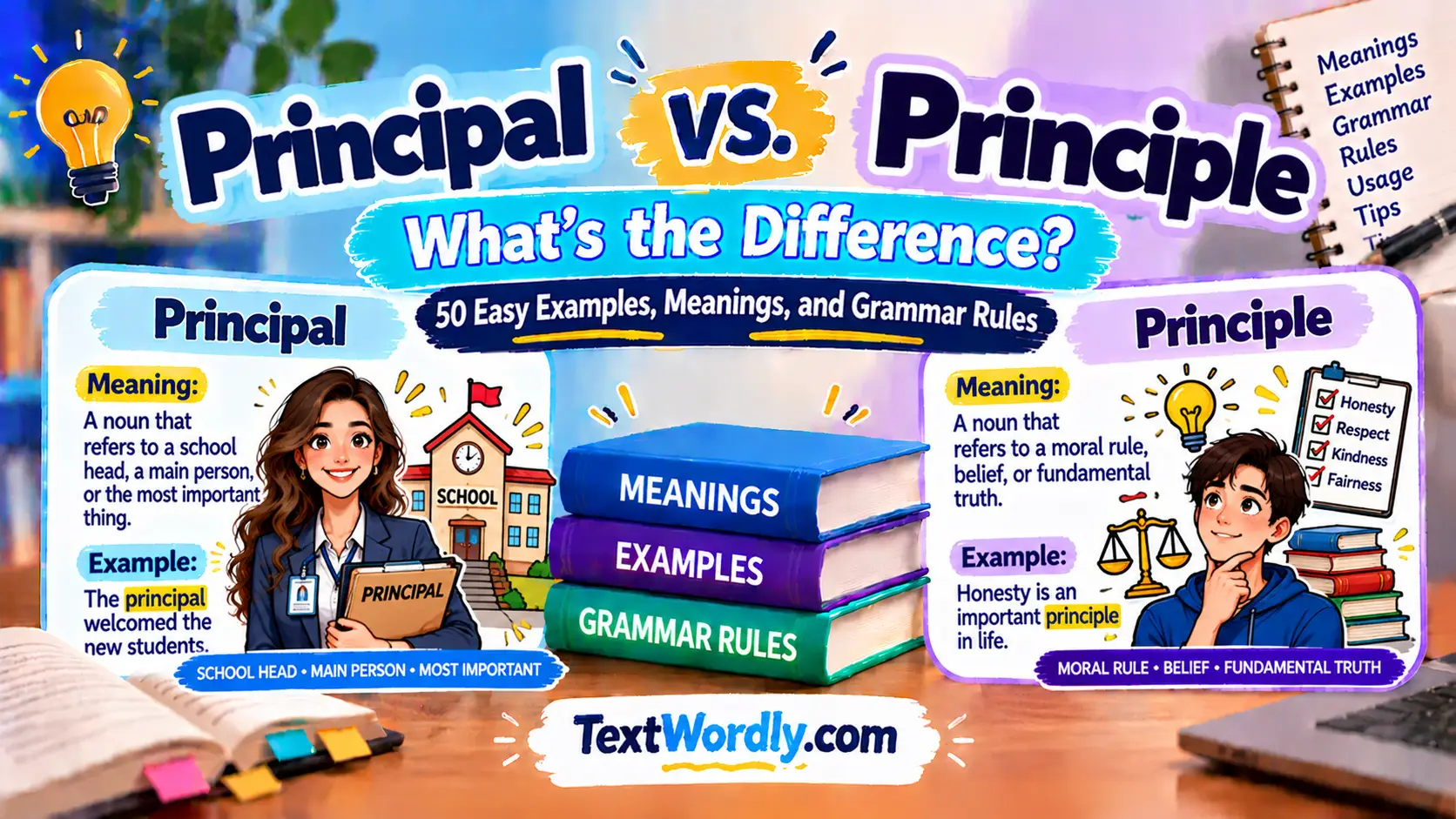
principal vs principle: Principal and principle sound exactly alike, but they mean different things. Principal refers to a school leader, something main or most important, or the underlying amount of money in a loan or investment. Principle refers to a rule, belief, or fundamental truth.
Compare these sentences:
- “The principal welcomed the students.” — A school leader.
- “Honesty is an important principle.” — A guiding belief.
Both words are pronounced PRIN-suh-puhl, so spelling depends on meaning rather than sound.
This guide provides 50 practical examples, easy grammar rules, common mistakes, memory tricks, and a short quiz to help you choose the correct word.
Principal vs Principle: Quick Answer
The easiest distinction is principal = person, primary, or money and principle = rule or belief.
| Word | Part of speech | Meaning | Example |
|---|---|---|---|
| Principal | Noun | School leader or underlying financial amount | The principal called a meeting. |
| Principal | Adjective | Main or most important | Our principal concern is safety. |
| Principle | Noun | Rule, belief, or fundamental truth | Fairness is a guiding principle. |
Quick memory trick: The school principal can be your pal. Also, principal and primary both begin with pri.
What Does Principal Mean?
Principal has several meanings, depending on context.
As a noun, it commonly identifies the person in charge of a school. In finance, it means the original amount invested or the underlying amount borrowed or still owed.
As an adjective, it means chief, main, or most important.
For example:
“The principal addressed the school assembly.”
“The principal reason for the delay was heavy traffic.”
“She made an extra payment toward her mortgage principal.”
In business and law, principal can also refer to a person or organization represented by an agent.
The key is to look at the surrounding sentence.
What Does Principle Mean?
Principle is a noun meaning a basic rule, belief, standard, or truth.
A moral principle guides how someone behaves. A scientific principle helps explain how something works. An organizational principle provides a standard for decisions.
For example:
“Honesty is one of her strongest principles.”
“The experiment demonstrates a basic scientific principle.”
“The organization follows the principle of equal treatment.”
Unlike principal, principle is not normally used as an adjective in contemporary English.
Its plural form is principles, as in ethical principles or scientific principles.
Principal vs Principle: Key Differences
The following comparison highlights the most important differences.
| Feature | Principal | Principle |
|---|---|---|
| Pronunciation | /ˈprɪnsəpəl/ | /ˈprɪnsəpəl/ |
| Grammar | Noun or adjective | Noun |
| School context | School leader | Educational rule or belief |
| Financial context | Underlying amount | Financial concept or rule |
| Moral context | Not normally a moral belief | Guiding belief |
| Common phrase | Principal reason | Guiding principle |
| Plural noun | Principals | Principles |
A Simple Replacement Test
Replace principal with main when it functions as an adjective.
“The principal goal is safety” becomes “The main goal is safety.”
Replace principle with rule or belief.
“She follows that principle” becomes “She follows that rule.”
If the replacement preserves the meaning, you have probably chosen the correct spelling.
50 Principal vs Principle Examples in Sentences
These 50 numbered examples show both words in natural American English.
School and Education
- The school principal greeted students at the entrance.
- Our principal announced the new attendance policy.
- The principal met with concerned parents.
- The students thanked their principal for the improvements.
- The principal visited every classroom.
- Fairness is an important educational principle.
- The teacher explained the principle of equal opportunity.
- Respect is a guiding principle in our classroom.
- The principal organized a meeting for teachers.
- Students studied a basic scientific principle.
Ethics and Personal Values
- Honesty is one of her strongest principles.
- He refused the offer on principle.
- Kindness is a principle worth practicing.
- She refuses to compromise her principles.
- The organization follows clear ethical principles.
- His principal concern was public safety.
- The principal reason for her decision was fairness.
- Their shared principles strengthened their friendship.
- The principal goal was to help the community.
- He believes in the principle of treating others equally.
Business and Professional Writing
- The company’s principal objective is customer satisfaction.
- Trust is an important business principle.
- The principal investor attended the meeting.
- Clear communication is a management principle.
- The company’s principal office is downtown.
- The business operates according to established principles.
- Their principal concern was employee safety.
- The manager explained the principle behind the policy.
- The principal supplier changed its delivery schedule.
- Transparency is one of the firm’s core principles.
Finance and Loans
- She made an extra payment toward the loan principal.
- The mortgage principal decreased after several payments.
- The original principal was $20,000.
- The interest calculation depends partly on the principal.
- He hopes to repay the remaining principal early.
- Diversification is a common investing principle.
- The investment principal was $5,000.
- The statement showed the outstanding principal.
- The lender explained how payments reduce the principal.
- The advisor discussed basic financial principles.
Science, Law, and Everyday Life
- The experiment illustrated a scientific principle.
- The students learned the principle of energy conservation.
- The principal cause of the problem was poor planning.
- Conservation is an important environmental principle.
- Her principal responsibility is managing the project.
- The agent signed the agreement on behalf of the principal.
- The principal entrance is on the north side.
- Teamwork is a guiding principle of the organization.
- The principal purpose of the meeting was to review progress.
- The engineer applied a fundamental design principle.
What to notice: Principal identifies a person, an underlying amount, or something primary. Principle names a rule, value, or foundational concept.
When to Use Principal Correctly
Use principal in three especially common situations.
A School Leader
“The principal spoke to the graduating class.”
The Main or Most Important Thing
“The principal reason for the change was safety.”
Here, principal is an adjective. You can usually replace it with main.
An Underlying Financial Amount
“The borrower paid $500 toward the principal.”
Here, principal is a noun.
Grammar tip: When principal means main, it normally appears before the noun it modifies, as in principal concern or principal objective.
When to Use Principle Correctly
Use principle when describing a guiding rule, moral belief, or fundamental concept.
Moral Principles
“She believes in the principle of honesty.”
Scientific Principles
“The lesson explained the principle of conservation of energy.”
Organizational Principles
“Fairness is one of the company’s guiding principles.”
First Principles
The expression first principles refers to basic truths or assumptions used as a starting point for reasoning.
For example:
“The engineers reconsidered the design from first principles.”
Remember: If you can replace the word with rule, belief, or fundamental concept, you probably need principle.
Principal vs Principle in School and Academic Writing
School-related sentences can use either word, but for different reasons.
Principal names the school leader. Principle names a rule, belief, or concept.
Compare:
“The principal introduced the new policy.”
“The policy was based on the principle of fairness.”
Academic writing also uses principle to describe scientific and theoretical concepts.
For example:
“The research examines the principle of natural selection.”
A common mistake is writing school principle when referring to the head of a school. The correct expression is school principal.
Principal vs Principle in Finance and Loans
In finance, principal refers to an underlying amount of money. It is different from interest, which is generally the cost of borrowing.
Two terms are especially useful:
- Original principal: The amount initially borrowed.
- Outstanding principal: The underlying amount still owed.
Simple Loan Example
ILLUSTRATIVE LOAN CALCULATION
Original Principal
$10,000
Principal Repaid
$2,500
Remaining Principal
$7,500
Assumes the entire $2,500 was applied to principal, without additional borrowing or capitalized interest or fees.
A financial principle, by contrast, is a rule or concept, such as diversification or budgeting.
Thus, loan principal refers to money, while financial principle refers to an idea.
Principal in Business and Legal Writing
In business and law, principal has an additional meaning. It can refer to a person or organization that authorizes another party, called an agent, to act on its behalf.
For example:
“The real estate agent acted on behalf of the principal.”
Here, principal identifies the party being represented.
In business, principal can also describe a leading person, major investor, or something of primary importance.
“The principal investor reviewed the agreement.”
“The principal objective was to reduce operating costs.”
Principle, meanwhile, refers to an underlying rule or standard:
“The company follows the principle of transparency.”
The difference is between a person or primary concern and a guiding rule.
Principal vs Principle Pronunciation
Principal and principle are homophones. They sound the same in standard American English.
| Word | Pronunciation | Approximate Sound |
|---|---|---|
| Principal | /ˈprɪnsəpəl/ | PRIN-suh-puhl |
| Principle | /ˈprɪnsəpəl/ | PRIN-suh-puhl |
Both words have three syllables, with stress on the first.
Because pronunciation cannot distinguish them, you must rely on the sentence’s meaning.
For example:
“The principal explained the principle.”
Although both words sound identical, the first identifies a person and the second identifies a rule or concept.
Writing tip: When proofreading, check the meaning instead of reading the sentence aloud.
Principals vs Principles: Plural Forms
Both words have regular plural forms, but their meanings remain different.
Principals is the plural of principal when used as a countable noun.
Principles is the plural of principle.
| Singular | Plural | Meaning |
|---|---|---|
| Principal | Principals | School leaders or other people/entities called principals |
| Principle | Principles | Rules, beliefs, or fundamental truths |
Examples
“Several school principals attended the conference.”
“The organization follows strong ethical principles.”
“Both principals agreed to the transaction.”
“The students discussed scientific principles.”
Important: When principal functions as an adjective, it does not become plural.
Correct: “The principal reasons were cost and safety.”
Incorrect: “The principals reasons were cost and safety.”
Common Principal vs Principle Mistakes
The most frequent mistakes involve school leaders, moral beliefs, and financial amounts.
| Incorrect Sentence | Correct Sentence |
|---|---|
| The school principle called my parents. | The school principal called my parents. |
| Honesty is an important principal. | Honesty is an important principle. |
| The principle reason was cost. | The principal reason was cost. |
| She repaid the loan principle. | She repaid the loan principal. |
| He refused on principal. | He refused on principle. |
| They follow ethical principals. | They follow ethical principles. |
| The principals of physics are important. | The principles of physics are important. |
Three Quick Checks
- Does the word mean a school leader, an underlying amount of money, or main? Choose principal.
- Does it mean a rule, belief, or fundamental truth? Choose principle.
- Does the sentence refer to several people or several rules? Choose principals or principles accordingly.
These checks are more dependable than memorizing spelling alone.
Memory Tricks and Common Expressions
The easiest memory trick is:
The principal is your pal.
The word principal ends with pal, which can remind you of a school leader.
Another useful association is:
Principal = Primary.
Both begin with pri, helping you remember that principal can mean main or most important.
For principle, think rule or belief.
Common Expressions
| Expression | Meaning |
|---|---|
| Principal reason | Main reason |
| Principal concern | Most important concern |
| Principal balance | Underlying amount owed |
| Guiding principle | Rule or belief that directs decisions |
| Moral principle | Standard of right and wrong |
| Scientific principle | Fundamental scientific rule or concept |
| In principle | Generally accepted, subject to details |
| On principle | Because of a personal belief or standard |
In Principle vs On Principle
These two expressions deserve special attention.
In principle means generally or theoretically accepted, even if details are unresolved.
“We agreed to the plan in principle.”
On principle means acting because of a personal belief or moral standard.
“She refused the payment on principle.”
Neither expression uses principal.
Principal vs Principle Practice Quiz
Choose the correct word for each sentence.
Question 1: The school ______ welcomed the new students.
A. principal B. principle
Question 2: Honesty is an important moral ______.
A. principal B. principle
Question 3: The ______ reason for the delay was bad weather.
A. principal B. principle
Question 4: She paid an extra $500 toward her loan ______.
A. principal B. principle
Question 5: The scientist explained a basic ______ of physics.
A. principal B. principle
Question 6: He refused to lie because it went against his ______.
A. principals B. principles
Answer Key With Explanations
| Question | Correct Answer | Explanation |
|---|---|---|
| 1 | A — Principal | Refers to the person who leads a school. |
| 2 | B — Principle | Refers to a moral belief or rule. |
| 3 | A — Principal | Means main or most important. |
| 4 | A — Principal | Refers to the underlying loan amount. |
| 5 | B — Principle | Refers to a fundamental scientific concept. |
| 6 | B — Principles | Refers to personal beliefs or standards. |
If you answered all six correctly, you understand the main difference. If not, review the comparison table and try again.
Principal vs Principle FAQs
1. What is the difference between principal and principle?
Principal means a school leader, something main or most important, or an underlying amount of money. Principle means a rule, belief, or fundamental truth.
2. Is it school principal or school principle?
The correct expression is school principal. It refers to the person who leads a school.
3. Is it moral principal or moral principle?
The correct phrase is moral principle because it describes a belief or standard about right and wrong.
4. Is it principal amount or principle amount?
Use principal amount when referring to the underlying amount borrowed or invested, excluding interest.
5. Is it principal reason or principle reason?
The correct expression is principal reason because principal is an adjective meaning main or most important.
6. Do principal and principle sound the same?
Yes. They are homophones in standard American English. Both are pronounced /ˈprɪnsəpəl/.
7. What is the difference between in principle and on principle?
In principle means generally accepted or agreed to, although details may remain unresolved. On principle means acting because of a belief or moral standard.
8. How can I remember principal vs principle?
Remember the principal is your pal and principal means primary. Use principle when referring to a rule, belief, or fundamental truth.
Final Takeaway
The difference between principal and principle is based on meaning, not pronunciation.
Principal refers to a school leader, something main or most important, or an underlying amount of money.
Principle refers to a rule, belief, or fundamental truth.
When you’re unsure, ask whether the sentence is about a person, money, something primary, or an underlying rule. That simple check will usually lead you to the correct spelling.