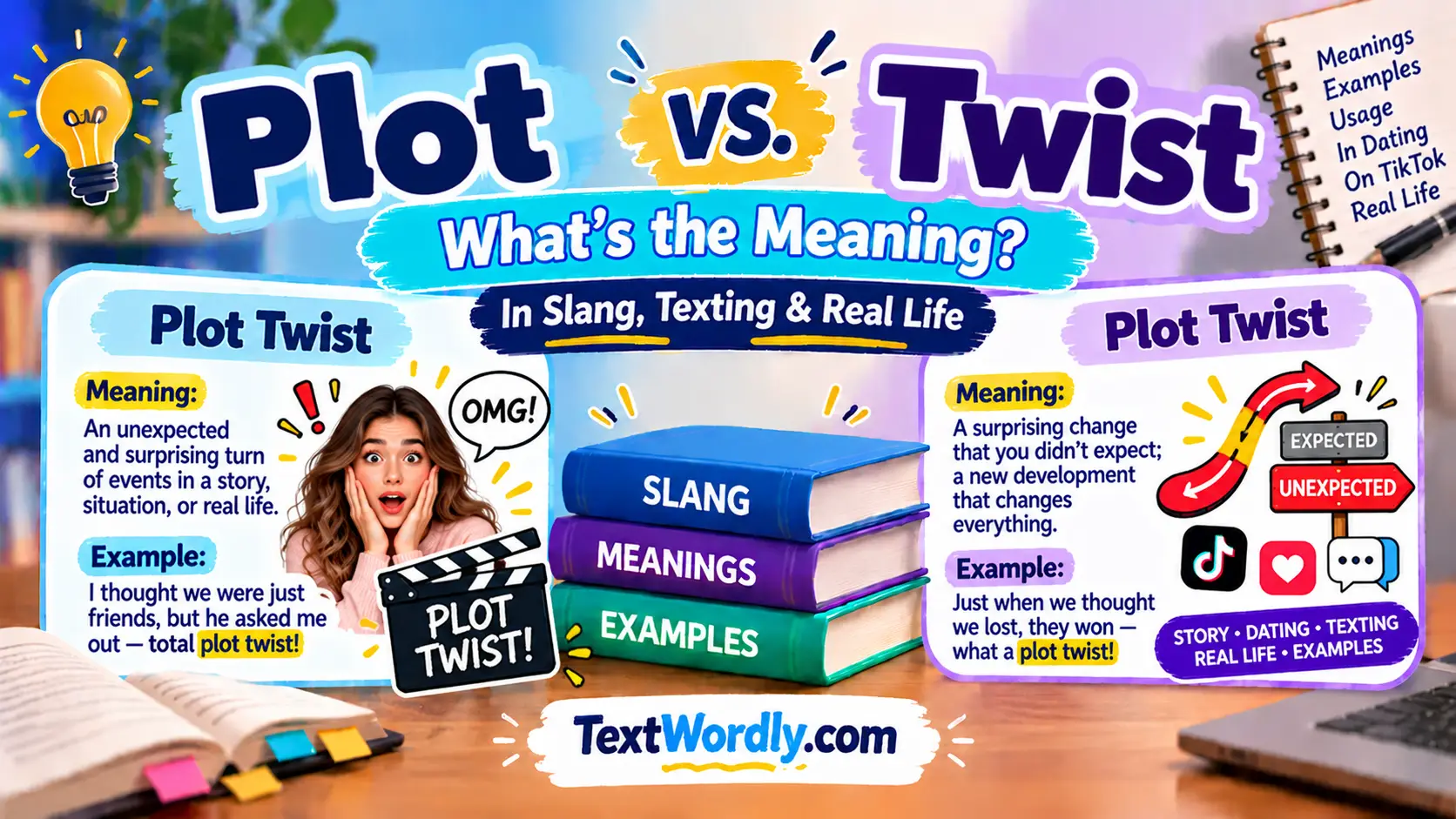
Plot twist meaning slang: Have you ever seen someone post “Plot twist: My crush likes me back!” or heard a friend say, “Well, that’s a plot twist!”?
In slang, plot twist means an unexpected change, surprising revelation, or sudden reversal that makes a situation turn out differently from what people expected.
The phrase originally comes from books and movies, where a surprising development changes the direction or meaning of a story. On TikTok, Instagram, and in everyday conversations, people use it more playfully to describe unexpected life events.
For example:
- “Plot twist: I actually passed the exam!”
- “We used to be rivals. Plot twist: We’re best friends now.”
- “Plot twist: My dream job found me.”
A plot twist can be exciting, disappointing, funny, or completely unexpected. Here’s how to understand and use this popular expression naturally.
Plot Twist Meaning in Slang: Quick Answer
A plot twist is an unexpected development that changes how a situation unfolds.
In everyday slang, it describes something surprising that happens in someone’s life.
For example:
“I was planning to leave my hometown, but plot twist, I got my dream job here.”
The speaker’s plans changed unexpectedly.
| Expression | Meaning |
|---|---|
| Plot twist | An unexpected change |
| What a plot twist! | That’s surprising! |
| Plot twist: | Here’s what unexpectedly happened |
| Biggest plot twist | A particularly surprising development |
| Didn’t see that coming | I wasn’t expecting that |
Simple meaning: Plot twist = something happens that you didn’t expect.
What Does Plot Twist Mean on TikTok?
On TikTok, plot twist often introduces surprising personal updates, unexpected outcomes, or funny changes in someone’s life.
Creators frequently begin captions with “Plot twist:” before revealing what happened.
For example:
“Plot twist: The person who rejected me in high school just asked me out.”
The unexpected reversal makes the story interesting.
Common TikTok uses include relationship updates, unexpected achievements, changes in plans, and humorous before-and-after stories.
Not every TikTok plot twist is dramatic. Sometimes people exaggerate ordinary surprises for comedic effect.
The phrase is not exclusive to TikTok or Gen Z. It comes from established storytelling vocabulary.
What Does Plot Twist Mean in Texting?
In texting, plot twist introduces surprising news or reacts to an unexpected situation.
It often appears at the beginning of a message.
Example Conversation
Alex: “Did you get rejected for that job?”
Mia: “Plot twist: They offered me a better position!”
Mia’s outcome was different from what Alex expected.
Another Example
Sam: “I thought you hated that restaurant.”
Chris: “Plot twist, it’s my favorite place now.”
Chris has unexpectedly changed their opinion.
People also reply with “What a plot twist!” when someone shares surprising information.
The phrase works best in casual conversations because it gives an ordinary update a storytelling style.
What Does “Plot Twist:” Mean in Captions?
When someone begins a social media caption with “Plot twist:”, they are preparing readers for an unexpected development.
For example:
“Plot twist: The quietest student in our class became a famous singer.”
The caption highlights how differently things turned out.
Why People Use It
The expression creates curiosity because readers expect something surprising to follow.
It can also make small everyday changes sound dramatic.
For example:
“Plot twist: I actually enjoy waking up early now.”
The speaker is humorously presenting a change in personal preference as a major story development.
The colon is common in captions, but it isn’t required in casual messages.
What Does “What a Plot Twist!” Mean?
“What a plot twist!” means something happened that the speaker didn’t expect.
It is similar to saying:
- “I didn’t see that coming!”
- “That’s unexpected!”
- “What a surprise!”
- “Things really changed!”
Example
Friend: “Remember those two people who couldn’t stand each other? They’re engaged.”
You: “What a plot twist!”
Your response expresses surprise at the unexpected relationship.
Depending on the context, the phrase can sound excited, amused, shocked, or sarcastic.
It doesn’t automatically mean something good or bad happened.
Plot Twist Meaning in Relationships
In relationships, a plot twist describes an unexpected romantic or personal development.
For example:
“Plot twist: My childhood best friend is now my husband.”
The relationship developed differently from what the speaker originally expected.
Other situations might include discovering mutual feelings, reconnecting with someone, or realizing a friendship works better than a romance.
Relationship Conversation
Emma: “Are you still dating that guy?”
Olivia: “Plot twist: We realized we’re better as friends.”
The outcome differs from what Emma expected.
A relationship plot twist can be positive, negative, or emotionally complicated.
The expression emphasizes the unexpected change rather than judging the relationship.
Is Plot Twist Positive or Negative?
Plot twist is a neutral expression. Its emotional meaning depends on the situation.
A plot twist can be exciting, disappointing, funny, or surprising.
| Type | Example | Tone |
|---|---|---|
| Positive | “Plot twist: I got the scholarship!” | Excited |
| Negative | “Plot twist: Our flight was canceled.” | Disappointed |
| Funny | “Plot twist: My dog ate the invitation.” | Amused |
| Romantic | “Plot twist: We’re dating now.” | Surprised |
| Sarcastic | “Plot twist: The printer broke again.” | Frustrated |
The phrase describes an unexpected development, not whether that development is desirable.
Pay attention to the surrounding context and the speaker’s tone.
Plot Twist Meaning in Movies and Stories
In storytelling, a plot twist is an unexpected development that changes the audience’s understanding of events or redirects the story.
For example, a mystery might reveal that a trusted character has secretly been helping the villain.
That revelation changes how earlier scenes are understood.
Can a Plot Twist Happen in the Middle?
Yes. A plot twist can occur at the beginning, middle, or end of a story.
It doesn’t have to be the final revelation.
Storytelling vs Internet Slang
In fiction, a plot twist usually has a meaningful effect on the narrative.
In internet slang, people use the phrase more loosely for unexpected everyday experiences.
That’s why a canceled picnic might jokingly be called a plot twist even though it isn’t a dramatic story reversal.
Plot Twist vs Surprise: What’s the Difference?
A surprise is anything unexpected.
A plot twist is an unexpected development that changes how a story or situation unfolds.
Example of a Surprise
“Someone brought cupcakes to the office.”
This may be unexpected, but it doesn’t necessarily change the situation.
Example of a Plot Twist
“The employee who planned to resign was unexpectedly promoted to manager.”
This changes the direction of the person’s story.
| Surprise | Plot Twist |
|---|---|
| Something unexpected | An unexpected development or reversal |
| May have little lasting effect | Often changes expectations or direction |
| Can be a small event | Usually suggests a meaningful change |
| Example: An unexpected gift | Example: A rival becomes an ally |
In casual slang, people sometimes call even small surprises plot twists for humor.
Plot Twist vs Irony, Cliffhanger, and Spoiler
These storytelling terms are related, but they have different meanings.
| Term | Meaning |
|---|---|
| Plot twist | An unexpected story development |
| Irony | A contrast involving expectations, reality, or intended meaning |
| Cliffhanger | An unresolved moment that creates suspense |
| Spoiler | Information that reveals important story details |
| Foreshadowing | Earlier hints about later events |
Plot Twist vs Spoiler
A plot twist is something that happens in the story.
A spoiler is information revealed before someone discovers it through the story.
Plot Twist vs Cliffhanger
A plot twist surprises the audience.
A cliffhanger leaves an important question unanswered.
Plot Twist vs Irony
Irony involves a contrast between what is expected and what happens, or between what is said and what is meant.
An ironic event can involve a plot twist, but the terms aren’t interchangeable.
20 Plot Twist Slang Examples in Sentences
These original examples show how the phrase works in everyday situations.
Social Media
- “Plot twist: My video went viral overnight.”
- “I expected bad news, but plot twist, everything worked out.”
- “That ending was the biggest plot twist.”
- “Plot twist: The challenge was easier than I expected.”
- “Nobody saw that plot twist coming.”
Relationships
- “Plot twist: My best friend introduced me to my future husband.”
- “They started dating after years of arguing. What a plot twist!”
- “Plot twist: My crush asked me out first.”
- “Their rivalry turned into a friendship. That’s a plot twist.”
- “Plot twist: We both decided we were better as friends.”
School and Work
- “Plot twist: I passed the exam I thought I failed.”
- “The internship turned into a full-time job. What a plot twist!”
- “Plot twist: Our teacher canceled the surprise test.”
- “I applied for one role, but plot twist, they offered me another.”
- “Plot twist: The hardest assignment became my favorite.”
Everyday Life
- “Plot twist: It started raining during our picnic.”
- “I thought the package was lost, but plot twist, it arrived early.”
- “Plot twist: My parents planned the surprise party.”
- “The quiet weekend became a road trip. What a plot twist!”
- “Plot twist: I ended up loving the city I wanted to leave.”
These examples show both meaningful reversals and the looser, humorous use of the phrase.
Funny and Sarcastic Uses of Plot Twist
People sometimes say “plot twist” sarcastically when the outcome was actually predictable.
For example:
“Plot twist: The meeting that should have been an email lasted two hours.”
The speaker isn’t genuinely surprised. They’re joking about a familiar frustration.
Another example:
“Plot twist: I stayed up too late and now I’m tired.”
The result is obvious, which creates the humor.
Why Sarcastic Usage Works
The phrase normally promises something unexpected.
Using it for an obvious outcome creates a playful contrast.
This type of humor is common in captions, group chats, and casual conversations.
However, sarcasm may be harder to recognize in text without context.
How to Use Plot Twist Naturally
Use plot twist when revealing something unexpected or reacting to a surprising development.
Introducing Good News
“Plot twist: I got accepted!”
Sharing a Change of Plans
“Plot twist: We’re moving next month.”
Reacting to Someone
“Wow, what a plot twist!”
Making a Joke
“Plot twist: I was the one who forgot the meeting.”
When to Avoid It
Avoid using humorous language when someone is sharing distressing or sensitive news unless you know it’s appropriate.
In formal writing, expressions such as unexpected development, surprising outcome, or sudden reversal may be clearer.
How to Respond to a Plot Twist
The best response depends on whether the news is positive, funny, or upsetting.
Excited Responses
- “No way! That’s amazing!”
- “I didn’t see that coming!”
- “That’s such a good plot twist!”
Funny Responses
- “The writers really surprised us.”
- “This season of your life is getting interesting.”
- “I need the next episode!”
Supportive Responses
- “That’s a big change. How are you feeling?”
- “I wasn’t expecting that. Are you okay?”
If someone shares serious news, respond to their feelings rather than treating the situation as entertainment.
Plot Twist Pronunciation and Common Mistakes
Plot twist is pronounced PLOT TWIST.
The phrase combines two English words:
Plot: The connected events of a story.
Twist: An unexpected change or turn.
Together, they describe a surprising development.
Common Mistakes
Mistake 1: Assuming every surprise is a plot twist.
In storytelling, a plot twist usually changes the direction or understanding of events.
Mistake 2: Assuming plot twists are always negative.
They can be positive, funny, romantic, or disappointing.
Mistake 3: Confusing a plot twist with a spoiler.
A plot twist is a story event. A spoiler reveals important information before someone experiences the story.
Mistake 4: Assuming TikTok invented the phrase.
Plot twist is an established storytelling expression that has been adapted for casual online communication.
Plot Twist Meaning Slang FAQs
1. What does plot twist mean in slang?
Plot twist means an unexpected development, surprising revelation, or sudden reversal that changes how a situation unfolds.
2. What does plot twist mean on TikTok?
On TikTok, people use plot twist to introduce surprising personal updates, unexpected results, and humorous changes in their lives.
3. What does plot twist mean in texting?
In texting, it introduces unexpected news or expresses surprise about a situation.
4. What does “What a plot twist!” mean?
It means something happened that the speaker didn’t expect.
5. Is a plot twist always negative?
No. Plot twists can be positive, negative, funny, romantic, or emotionally complicated.
6. What does plot twist mean in relationships?
It describes an unexpected development in a friendship, dating situation, or romantic relationship.
7. Is plot twist a Gen Z slang phrase?
The phrase existed long before Gen Z. Its playful use in online captions and conversations extends its traditional storytelling meaning.
8. What is the difference between a plot twist and a spoiler?
A plot twist is an unexpected development in a story. A spoiler reveals important story information before someone discovers it themselves.
Final Takeaway
In modern slang, plot twist means something unexpected happens that changes the direction of a situation.
People use it on TikTok, in text messages, and in everyday conversations to describe surprising outcomes.
Remember:
- Plot twist: An unexpected development.
- “Plot twist:” Introduces surprising news.
- “What a plot twist!” Expresses surprise.
- Biggest plot twist: A particularly unexpected change.
The phrase can describe serious reversals or make small everyday surprises sound like dramatic moments in a movie.
Reliable References