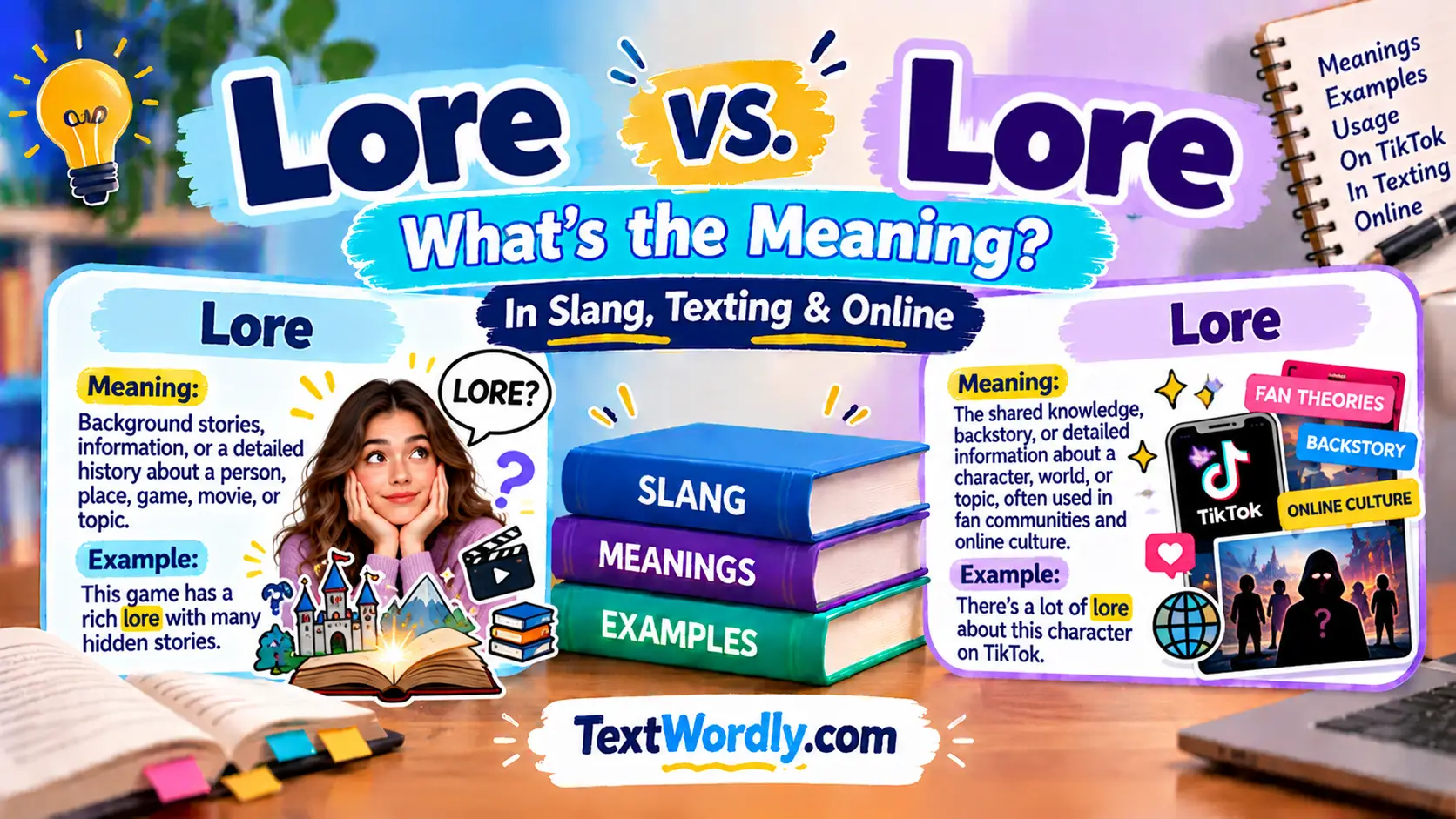
Lore meaning slang:Have you ever seen someone comment, “I need the lore,” or heard a friend say, “You don’t know my full lore”?
These expressions are common in online conversations, especially when people discuss surprising personal experiences or complicated relationships.
In slang, lore means the background story, personal history, or context that helps explain a person, relationship, event, or inside joke.
For example:
- “What’s the lore behind your friendship?”
- “My childhood lore is embarrassing.”
- “She just dropped some unexpected lore.”
- “New lore unlocked!”
The word originally referred to traditional knowledge and stories. Today, people also use it humorously to describe their own lives as though they were characters in a fictional universe.
Here’s what lore means on TikTok, in text messages, gaming, and everyday conversations.
Lore Meaning in Slang: Quick Answer
Lore means the backstory or important background information behind someone or something.
When someone asks for the lore, they want to understand what happened before the current situation.
For example:
“Why don’t those two friends talk anymore? I need the lore.”
The speaker wants to know the history behind their disagreement.
| Expression | Simple Meaning |
|---|---|
| Lore | Background story or history |
| Personal lore | Someone’s life experiences |
| Deep lore | Lesser-known background details |
| Lore drop | Revealing surprising information |
| New lore unlocked | Discovering a new detail |
| I need the lore | Tell me the backstory |
Easy way to remember: Lore is the story behind the story.
What Does Lore Mean on TikTok?
On TikTok, lore often describes personal experiences, surprising facts, or background details that help explain someone’s life.
For example, a creator might say:
“Random lore about me: I once accidentally joined the wrong school trip.”
This introduces an unusual memory.
Other common expressions include “lore drop,” “personal lore,” and “new lore unlocked.”
People also use the word in captions about childhood memories, friendships, and awkward experiences.
The joke is that ordinary people have complicated histories, just like characters in movies or video games.
However, lore is not a word invented by TikTok or Gen Z. Its playful internet usage builds on an established English meaning.
What Does “What’s the Lore?” Mean?
“What’s the lore?” means “What’s the backstory?” or “What’s the history behind this?”
People ask this when they hear something interesting but don’t know the context.
Example Conversation
Alex: “I haven’t spoken to Jordan in three years.”
Mia: “Wait, what’s the lore?”
Mia wants to understand what happened between them.
What Does “I Need the Lore” Mean?
This expression has almost the same meaning.
For example:
Sam: “Our group chat used to have a completely different name.”
Chris: “I need the lore behind that.”
Chris wants to hear the story.
These expressions are usually playful, but they can also show genuine curiosity.
What Does Personal Lore Mean?
Personal lore refers to someone’s memories, experiences, relationships, and important events from their past.
It might include childhood stories, unusual achievements, old friendships, or embarrassing moments.
For example:
“My personal lore includes accidentally meeting my favorite singer at an airport.”
The speaker considers that experience part of their personal history.
Personal lore doesn’t have to be dramatic or secret.
Even a small detail can become interesting when it explains someone’s personality or habits.
For example, someone who always avoids roller coasters might have a childhood experience that explains why.
In casual conversation, that experience could be described as part of their lore.
What Does Deep Lore Mean?
Deep lore means detailed, obscure, or lesser-known background information.
In everyday slang, it often refers to stories that only close friends or longtime acquaintances know.
For example:
“You need the deep lore to understand why everyone calls him Captain.”
The nickname probably has an unusual history.
Lore vs Deep Lore
| Lore | Deep Lore |
|---|---|
| General background information | Lesser-known details |
| Usually easy to summarize | May require a longer explanation |
| How two friends met | The complicated origin of their inside jokes |
Someone asking for deep lore wants more than the basic story.
They want the details that make the situation meaningful, surprising, or funny.
What Does Lore Drop Mean?
A lore drop happens when someone reveals an interesting or unexpected piece of background information.
For example:
“She casually mentioned that she used to be a professional dancer. Huge lore drop!”
The speaker has discovered something surprising about her past.
Lore Drop vs Lore Dump
These expressions overlap but have slightly different meanings.
Lore drop: Revealing a noteworthy piece of information.
Lore dump: Sharing a large amount of backstory at once.
For example:
“He gave us a twenty-minute lore dump about his old band.”
A lore drop can be brief. A lore dump emphasizes how much information someone shares.
Neither expression necessarily means the information was secret.
What Does “New Lore Unlocked” Mean?
“New lore unlocked” is a playful reaction to discovering something new about a person or situation.
It borrows the language of video games, where players unlock new information, achievements, or content.
Example Conversation
Taylor: “I used to compete in dance competitions.”
Jamie: “New lore unlocked!”
Jamie has learned an unexpected detail about Taylor.
The expression can also describe new developments.
For example:
“Our friend just revealed how she met her husband. New lore unlocked.”
People usually say it humorously, as though another chapter of someone’s personal story has become available.
Lore Meaning in Text Messages
In text messages, lore usually refers to the background information needed to understand a conversation.
It’s especially common in group chats and discussions about friendships.
Example 1: Friendship History
Emma: “We haven’t invited Noah since last summer.”
Liam: “What’s the lore there?”
Liam wants to know why.
Example 2: Surprising Fact
Ava: “I used to work at a circus.”
Ben: “That’s unexpected lore!”
Ben is surprised by Ava’s history.
Example 3: Inside Joke
Ryan: “Why does everyone call you Professor?”
Zoe: “There’s a lot of lore behind that nickname.”
Zoe suggests there’s an interesting explanation.
The expression works best in informal conversations.
Lore Meaning in Gaming and Anime
In video games, anime, and fantasy stories, lore refers to background history, mythology, worldbuilding, and character information.
For example:
“The game’s lore explains why the two kingdoms are enemies.”
This means the fictional world’s history provides context.
Lore vs Plot
Plot refers to the main events happening in a story.
Lore refers to the background knowledge that helps explain the world and its characters.
A fantasy game might have extensive lore about ancient civilizations, even if those civilizations barely appear in the main plot.
In anime, character lore can include family history, important past events, and the origins of special abilities.
Not every piece of lore needs to appear directly in the main storyline.
Lore vs Canon: What’s the Difference?
Lore and canon are related but different.
Lore describes background stories and information.
Canon identifies details established within a particular fictional continuity.
| Lore | Canon |
|---|---|
| Background history and worldbuilding | Established story information |
| Explains the fictional world | Identifies what counts within a continuity |
| Can include fan-created ideas | Depends on the relevant storyline |
| Example: History of an ancient kingdom | Example: The story confirms the kingdom existed |
Lore can be canon when it is established within the story.
However, fans can also invent unofficial lore.
Memory tip: Lore explains the background. Canon tells you what is established.
Lore Meaning in Relationships and Friendships
In friendships and relationships, lore means the shared history behind people’s connections.
For example:
“Our friendship lore goes back to middle school.”
This means the friendship has a long history.
Another example:
“There’s complicated lore behind their breakup.”
This suggests the relationship has a background that may help explain what happened.
Relationship lore can include happy memories, funny misunderstandings, or difficult experiences.
It isn’t automatically negative.
Someone might also ask:
“What’s the lore behind how you two met?”
They simply want to hear the story.
When discussing another person’s relationship history, remember that curiosity doesn’t automatically give someone permission to share private details.
20 Lore Slang Examples in Sentences
These original examples show how lore appears in different situations.
Social Media
- “I need the lore behind this video.”
- “She just dropped some unexpected lore.”
- “New lore unlocked about my favorite creator.”
- “The comments are asking for the full lore.”
- “That old photo has interesting lore.”
Friends and Relationships
- “Our friendship lore started in seventh grade.”
- “There’s a lot of lore behind their breakup.”
- “You don’t know the full lore of our group chat.”
- “That nickname has hilarious lore.”
- “Their relationship lore is surprisingly complicated.”
Personal Experiences
- “My childhood lore includes some embarrassing stories.”
- “That terrible haircut is part of my personal lore.”
- “I revealed unexpected lore at dinner.”
- “My family has unusual holiday lore.”
- “Only my closest friends know my deep lore.”
Gaming and Entertainment
- “The game’s lore explains the ancient war.”
- “I enjoy discovering hidden lore in fantasy games.”
- “The anime reveals important character lore.”
- “That movie has more lore than I expected.”
- “The sequel expands the original game’s lore.”
These examples show that lore can describe both real-life history and fictional worldbuilding.
Lore vs Backstory, Tea, and Gossip
Several expressions overlap with lore, but their meanings are different.
| Expression | Meaning | Example |
|---|---|---|
| Lore | Background history or context | “What’s the lore?” |
| Backstory | Earlier events that explain the present | “Tell me your backstory.” |
| Tea | Interesting or revealing information, often gossip | “What’s the tea?” |
| Gossip | Informal talk about other people’s personal affairs | “They’re spreading gossip.” |
| Context | Information needed to understand something | “I need more context.” |
Lore vs Tea
Lore focuses on history.
Tea often focuses on interesting, dramatic, or revealing information.
“Tell me the lore behind your friendship” asks about its history.
“Spill the tea about the argument” asks for details about the conflict.
Lore doesn’t have to involve drama or gossip.
How to Use Lore Naturally
Using lore is simple when you remember that it means background information.
Asking for a Story
“Wait, what’s the lore?”
Use this when someone mentions an interesting situation without explaining it.
Sharing Personal History
“Here’s some random lore about me.”
Use this before sharing an unexpected memory.
Reacting to New Information
“New lore unlocked!”
Use this when someone reveals something surprising.
Discussing Fiction
“The game’s lore is fascinating.”
Use this when talking about a fictional world’s background.
Responding When Someone Asks for Lore
You might say:
- “It’s a long story.”
- “Okay, here’s what happened.”
- “There’s actually a funny backstory.”
- “I’ll give you the short version.”
In formal writing, background, history, or context may be clearer than slang.
Lore Pronunciation and Common Mistakes
Lore is pronounced lor, rhyming with more in common American English.
IPA: /lɔːr/
The word is a noun, and its plural form, lores, is uncommon in everyday slang.
Common Mistakes
Mistake 1: Assuming lore always means a secret.
Lore can be public, familiar, or widely known.
Mistake 2: Confusing lore with gossip.
Lore describes background history, while gossip focuses on discussion about other people’s affairs.
Mistake 3: Treating lore and canon as synonyms.
Lore provides background. Canon identifies established story information.
Mistake 4: Assuming TikTok invented the word.
Lore is an established English word. Its modern internet usage is a playful extension.
Lore Meaning Slang FAQs
1. What does lore mean in Gen Z slang?
Lore means someone’s background story, personal history, or interesting context. People often use it humorously in online conversations.
2. What does lore mean on TikTok?
On TikTok, lore often refers to personal experiences, surprising facts, and background stories that explain someone’s life or situation.
3. What does “I need the lore” mean?
It means the speaker wants the full backstory or explanation behind something.
4. What does personal lore mean?
Personal lore refers to someone’s memories, experiences, relationships, and important events from their past.
5. What does deep lore mean?
Deep lore means detailed or lesser-known background information that may require extra explanation.
6. What does lore drop mean?
A lore drop happens when someone reveals interesting or unexpected background information.
7. Is lore the same as gossip?
No. Lore focuses on background history, while gossip usually involves informal discussion about other people’s personal affairs.
8. What is the difference between lore and canon?
Lore refers to background stories and worldbuilding. Canon refers to information established within a particular fictional continuity.
Final Takeaway
In modern slang, lore means the backstory, personal history, or context behind someone or something.
People use it on TikTok, in text messages, and in everyday conversations to make ordinary experiences sound like parts of a larger story.
Remember:
- I need the lore: Tell me the backstory.
- Personal lore: Someone’s life history.
- Deep lore: Detailed or lesser-known information.
- Lore drop: Revealing an interesting background detail.
- New lore unlocked: Discovering something new about someone.
Whether you’re discussing a friendship, a TikTok video, or a fictional universe, lore helps explain the story behind what you see.
Reliable References