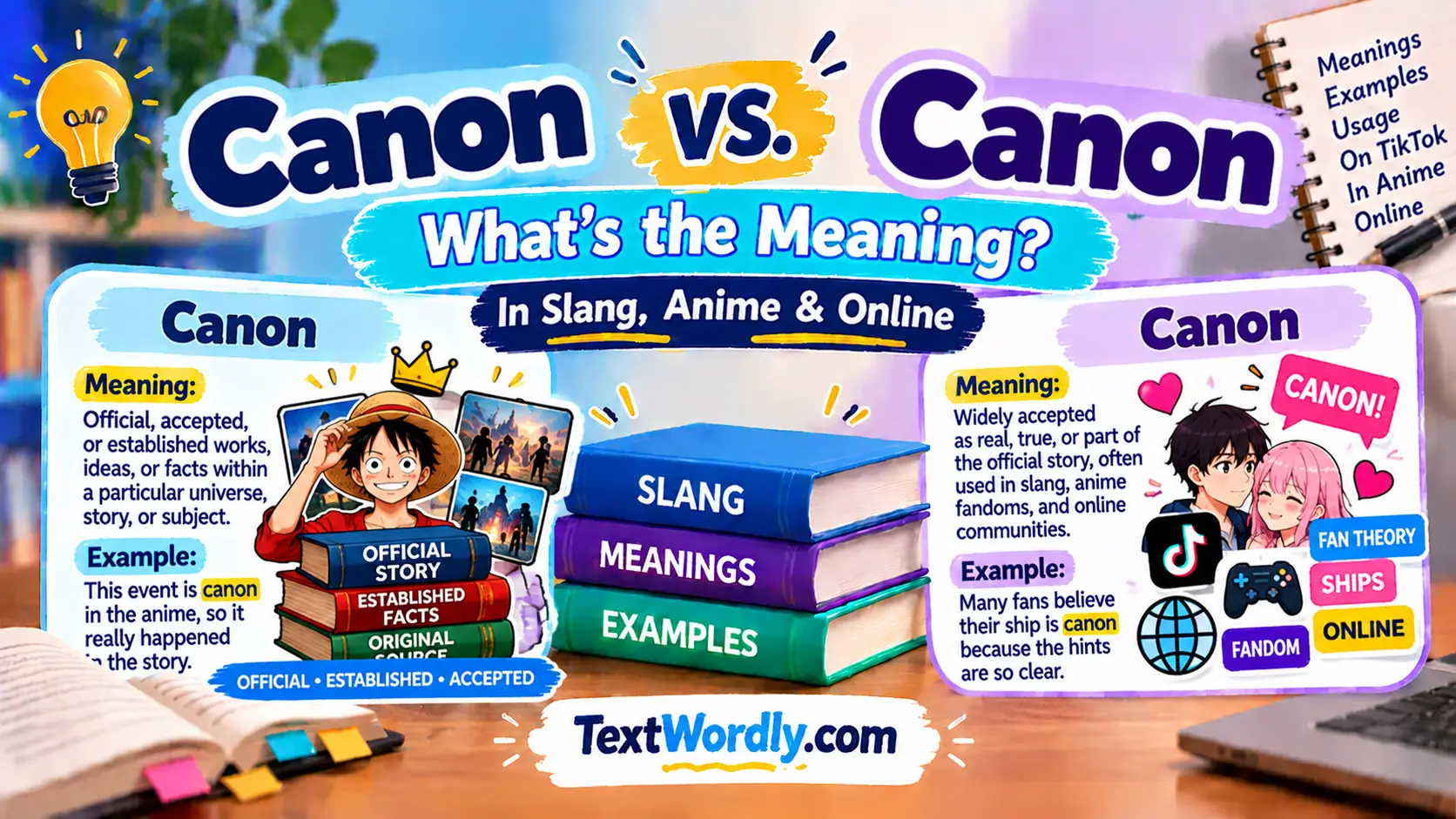
Canon meaning slang: Have you ever seen someone comment “It’s canon!” under a video or say “It’s a canon event. I can’t interfere” on TikTok?
If you’re unfamiliar with fandom language, these expressions can sound confusing.
In slang, canon means something officially established or accepted as part of a fictional story. People use it when discussing characters, relationships, events, and storylines in anime, movies, books, and video games.
On social media, canon event also has a playful meaning. It describes a memorable or seemingly inevitable life experience, often one that teaches someone a lesson.
For example:
- “Their relationship is finally canon.”
- “That episode isn’t canon.”
- “My terrible haircut was a canon event.”
This guide explains what canon means in slang, how people use it on TikTok, and the differences between canon, non-canon, headcanon, and fanon.
Canon Meaning in Slang: Quick Answer
Canon refers to events, characters, relationships, or details recognized as established within a particular fictional storyline.
When someone says “That’s canon,” they usually mean the information is part of the recognized story rather than a fan’s imagination.
However, what counts as canon can depend on the franchise, adaptation, or timeline.
| Term | Simple Meaning |
|---|---|
| Canon | Established within a fictional continuity |
| Non-canon | Outside that particular continuity |
| Headcanon | A fan’s personal interpretation |
| Fanon | An interpretation widely shared by fans |
| Canon event | A significant story event or, jokingly, a defining life experience |
Quick example: “The show confirmed they’re siblings, so it’s canon.”
What Does “It’s Canon” Mean?
When someone says “It’s canon,” they mean a detail has been established within the relevant fictional story.
For example:
Alex: “Are those characters officially dating?”
Mia: “Yes! It’s canon now.”
Mia means the relationship has been confirmed in the story.
People also use the expression jokingly outside fiction.
For example:
“Everyone knows you’re the funniest person in our group. It’s canon.”
Here, the speaker humorously treats an opinion as an established fact.
Common Expressions
- It’s canon: It’s established in the story.
- That’s not canon: That detail isn’t part of the recognized continuity.
- Make it canon: Establish the idea in the story.
- Canonically: According to the established story.
The key is understanding whether someone is discussing fiction seriously or joking about everyday life.
What Does Canon Event Mean on TikTok?
On TikTok, a canon event often means an embarrassing, memorable, or important experience that someone jokingly treats as necessary for personal growth.
For example:
“My first terrible haircut was a canon event.”
The speaker means the haircut became a memorable part of their personal history.
Another common expression is:
“It’s a canon event. I can’t interfere.”
People use this when they see someone approaching a predictable mistake or awkward experience.
Examples of Canon Events
- Having an embarrassing fashion phase.
- Going through a difficult first breakup.
- Making an impulsive decision.
- Experiencing an awkward first date.
- Discovering an important personal interest.
These experiences are not literally predetermined. The phrase is usually a humorous way of describing life’s memorable turning points.
Where Did the Canon Event Meme Come From?
The popular canon event meme is strongly associated with the 2023 animated film Spider-Man: Across the Spider-Verse.
In the movie, Miguel O’Hara presents canon events as significant experiences that recur across different Spider-People’s stories.
His explanation suggests that disrupting certain events could threaten the stability of their universes.
However, the film also raises questions about his understanding of these events. His explanation should not be treated as an unquestioned rule.
How the Meme Changed Online
Internet users adapted the phrase to describe ordinary experiences.
For example:
A friend sees someone choosing a hairstyle they’ll probably regret.
They joke:
“It’s a canon event. I can’t interfere.”
The humor comes from treating a small personal decision as though it were an essential part of a superhero storyline.
What Does Canon Mean in Anime and Manga?
In anime and manga communities, canon refers to story material recognized within a particular continuity.
For example:
“That character’s transformation is canon.”
This means the transformation is established in the relevant storyline.
Canon vs Anime Filler
Fans often use filler to describe episodes or storylines that do not directly advance the main adapted plot.
However, filler and non-canon are not always interchangeable.
An anime-original storyline might not appear in the manga but could still belong to the anime’s own continuity.
Manga Canon vs Anime Canon
A franchise may have different continuities across its manga, anime, movies, or other adaptations.
Therefore, an event can be established in one version without appearing in another.
Important: Always consider which version of the story someone means when they call something canon.
Canon vs Non-Canon: What’s the Difference?
Canon means established within a specified fictional continuity.
Non-canon means outside that continuity.
For example:
“The main series confirms the character’s origin story.”
That information is canon to the main series.
“The promotional crossover shows a different origin that doesn’t count in the main timeline.”
That version may be non-canon to the main storyline.
| Canon | Non-Canon |
|---|---|
| Established in the relevant continuity | Outside that continuity |
| Can influence later story events | May not affect the main storyline |
| Example: Confirmed character history | Example: Unrelated parody storyline |
A work can be officially released while remaining outside the main continuity.
What Does Headcanon Mean?
Headcanon is a fan’s personal interpretation or belief about a fictional character or story that has not necessarily been confirmed.
For example:
“My headcanon is that the villain secretly loves gardening.”
The fan imagines this detail, but it may never appear in the story.
Headcanon Example
Fan 1: “Why does that character always avoid parties?”
Fan 2: “My headcanon is that they’re shy.”
This is an interpretation, not an established fact.
Can Headcanon Become Canon?
Yes. A creator might later establish a detail that fans previously imagined.
However, until the relevant story confirms it, a headcanon remains a personal interpretation.
Headcanons are common in fan fiction, artwork, and online discussions because they let fans explore characters creatively.
Canon vs Fanon vs Headcanon
These three fandom terms describe different levels of story acceptance.
| Term | Meaning | Example |
|---|---|---|
| Canon | Established in the recognized story | Two characters are confirmed siblings |
| Headcanon | An individual’s interpretation | A fan imagines one character loves painting |
| Fanon | An interpretation widely shared by fans | Many fans imagine a character as the group’s unofficial parent |
What Is Fanon?
Fanon combines fan and canon.
It describes ideas widely accepted or repeated within a fandom without necessarily being established in the original story.
A headcanon can become fanon when many fans adopt it.
However, popularity does not make an idea canon.
For example, thousands of fans may support a romantic pairing, but that does not mean the story has confirmed the relationship.
What Does Canon Mean in Relationships and Shipping?
In fandom culture, shipping means supporting or imagining a romantic relationship between characters.
A canon ship is a relationship established within the relevant storyline.
For example:
“After the finale, their relationship is finally canon.”
This means the story confirmed the relationship.
Canon Ship vs Non-Canon Ship
Canon ship: A relationship established in the story.
Non-canon ship: A pairing fans support or imagine without confirmation in the relevant continuity.
Example Conversation
Jamie: “Are those two characters actually together?”
Riley: “Not officially. It’s just a popular fan ship.”
This distinction helps fans separate personal preferences from established story details.
Canon Meaning in Gaming, Movies, and Books
The word canon is also common in video games, movies, comics, and novels.
In games with multiple endings, a sequel may establish one outcome as the basis for its storyline.
For example:
“The sequel follows the canon ending.”
This means the sequel treats that ending as part of its established history.
Multiple Official Timelines
Some franchises contain alternate universes, reboots, and separate adaptations.
An event may be canon in one timeline but not another.
For example, a character might have different backstories in two official adaptations.
Both versions can be valid within their respective continuities.
Key lesson: Canon does not always mean there is only one officially recognized version of a story.
Canon vs Lore, Continuity, and Retcon
These terms often appear together in fandom discussions.
| Term | Meaning |
|---|---|
| Canon | Established story material |
| Lore | Background history, traditions, and worldbuilding |
| Continuity | The connected history and consistency of story events |
| Retcon | A later revision or reinterpretation of established information |
Canon vs Lore
Canon identifies what is established within a storyline.
Lore refers to the background information that explains the fictional world.
Canon vs Continuity
Continuity concerns how events and details connect consistently across a story.
What Is a Retcon?
A retcon, short for retroactive continuity, occurs when later storytelling changes or reinterprets previously established information.
For example, a sequel might reveal a different explanation for a character’s origin.
20 Canon Slang Examples in Sentences
These original examples show how canon and related expressions appear in everyday conversations.
Anime and Movies
- “That character’s backstory is canon.”
- “The movie isn’t canon to the main series.”
- “Fans are debating whether the episode is canon.”
- “That transformation became canon in the latest chapter.”
- “The spin-off follows a separate canon.”
Fandom and Relationships
- “Their relationship is finally canon.”
- “That ship is popular, but it isn’t canon.”
- “My headcanon is that the villain loves cats.”
- “That personality trait is fanon, not canon.”
- “The finale made their friendship canon.”
Gaming and Fiction
- “The sequel follows the canon ending.”
- “The games have different canon timelines.”
- “That bonus story isn’t canon to the main plot.”
- “The new update confirmed a canon detail.”
- “This comic belongs to another canon continuity.”
TikTok and Everyday Slang
- “My embarrassing haircut was a canon event.”
- “That awkward first date was my canon event.”
- “It’s a canon event. I can’t interfere.”
- “Meeting my best friend was a canon event.”
- “Everyone has at least one unforgettable canon event.”
The first examples focus on fictional continuity, while the final examples show the playful internet meaning.
Is Canon the Same as Official?
Canon and official are related, but they are not identical.
Official generally means a work was produced, authorized, or published by the relevant creator or rights holder.
Canon means its details count within a specified storyline.
For example, an official parody episode may not belong to the main continuity.
Similarly, an officially released alternate-universe comic may have its own canon.
Who Decides What Is Canon?
Depending on the franchise, creators, publishers, rights holders, or the structure of the story may determine which material belongs to a particular continuity.
Sometimes the status is deliberately unclear or debated.
When someone asks whether an event is canon, a useful follow-up question is:
“Canon to which version of the story?”
Common Mistakes When Using Canon
Understanding a few common mistakes can prevent confusion.
Mistake 1: Treating Fan Theories as Canon
A popular theory is not automatically established.
Better wording:
“That’s a fan theory, not confirmed canon.”
Mistake 2: Assuming Every Official Work Is Canon to the Main Story
Official spin-offs can belong to separate timelines.
Better wording:
“The spin-off is official, but it follows a different continuity.”
Mistake 3: Confusing Canon and Headcanon
Headcanon is a personal interpretation. Canon is established story information.
Mistake 4: Taking Canon Event Memes Literally
Calling a breakup or bad haircut a canon event is usually a joke.
Real-life mistakes are not predetermined, and the meme is not a reason to ignore someone who genuinely needs help.
Canon Pronunciation, Spelling, and Memory Tips
Canon is pronounced KAN-uhn in American English.
IPA: /ˈkæn.ən/
Canon vs Cannon
These words sound alike but have different meanings.
| Word | Meaning | Example |
|---|---|---|
| Canon | Accepted story material | “That scene is canon.” |
| Cannon | A large weapon | “The ship fired its cannon.” |
What Does Canonically Mean?
Canonically means according to the established fictional storyline.
Example:
“Canonically, the character is twenty years old.”
This means the character’s age is established in the relevant story.
Easy Memory Trick
Think of canon as the story’s established facts.
Think of headcanon as an idea in a fan’s head.
Think of fanon as an idea shared by many fans.
Canon Meaning Slang FAQs
1. What does canon mean in slang?
Canon means something established or recognized as part of a fictional storyline. Online, it can also be used jokingly to describe personal experiences.
2. What does canon mean on TikTok?
On TikTok, canon event often describes a memorable, embarrassing, or seemingly inevitable life experience.
3. What does canon mean in anime?
In anime, canon refers to events, characters, or details recognized within a particular storyline or continuity.
4. What does “It’s canon” mean?
It means a story detail is established or confirmed. In casual jokes, it can mean something is treated as an undeniable fact.
5. What is a canon event?
A canon event is a significant event in a fictional storyline. In slang, it often refers to a defining or embarrassing personal experience.
6. What is the difference between canon and headcanon?
Canon is established in the story. Headcanon is a fan’s personal interpretation that has not necessarily been confirmed.
7. What does non-canon mean?
Non-canon means something does not belong to the particular official storyline or continuity being discussed.
8. Is canon the same as fanon?
No. Canon is established story information, while fanon refers to interpretations widely shared by fans without necessarily being confirmed.
Final Takeaway
Canon means something established within a fictional storyline. It is commonly used in anime, gaming, movies, books, and online fandoms.
On TikTok, canon event also describes a memorable life experience, often humorously.
The easiest way to remember the difference is:
- Canon: Established story details.
- Non-canon: Outside the relevant continuity.
- Headcanon: A fan’s personal interpretation.
- Fanon: A widely shared fan interpretation.
- Canon event: An important fictional event or a jokingly defining life experience.
Understanding these terms helps you follow online conversations without confusing fan opinions with established story information.