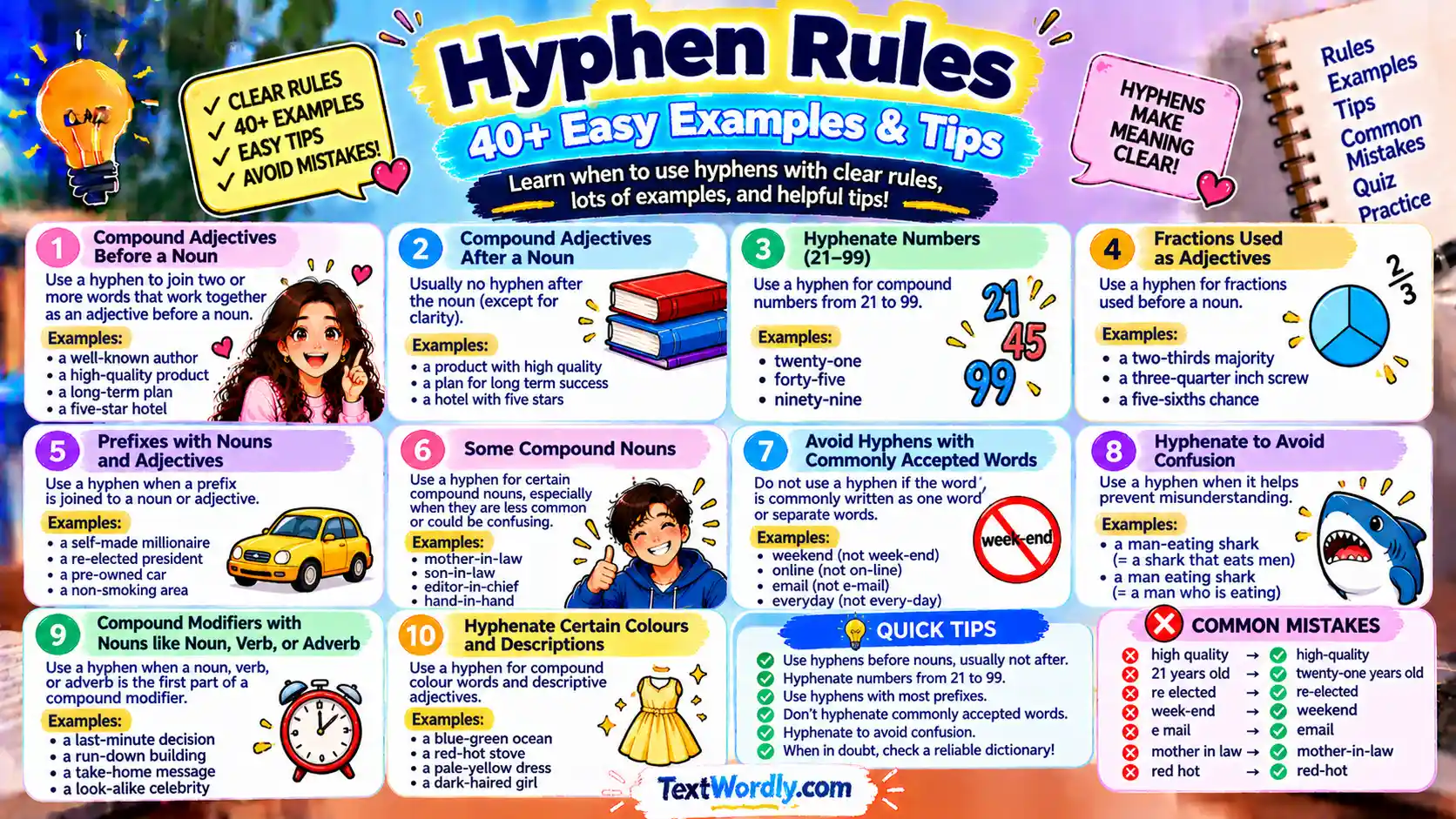
Hyphen Rules: Have you ever wondered whether to write well-known or well known, full-time or full time, or twenty-five or twenty five? These small punctuation differences can be confusing, even for experienced writers.
A hyphen (-) is a punctuation mark that connects words or parts of words. It helps clarify compound adjectives, numbers, ages, fractions, and certain prefixes. However, adding a hyphen everywhere can make your writing incorrect.
Understanding the most important hyphen rules will help you write clearer emails, essays, blog posts, and professional documents.
This guide explains when to use hyphens, when to avoid them, and how to recognize common mistakes with easy examples and practical grammar tips.
QUICK ANSWER
Use a hyphen (-) when words or word parts need to be connected according to grammar, clarity, or established spelling. Common examples include a well-known author, twenty-five, a five-year-old child, and self-employed.
| Compound adjective | A high-quality product |
| Compound number | Thirty-five |
| Age before a noun | A six-year-old child |
| Prefix | Self-aware |
| Written fraction | One-third |
Copy the hyphen symbol Copy –
TL;DR
- Compound adjectives: Often use hyphens before nouns.
- Compound nouns: May be open, closed, or hyphenated.
- Numbers: Hyphenate spelled-out numbers from twenty-one through ninety-nine.
- Ages: Write a five-year-old child, but the child is five years old.
- Prefixes: Some require hyphens; others do not.
- -ly adverbs: Usually do not need hyphens.
- Dashes: En dashes and em dashes have different functions from hyphens.
1. What Is a Hyphen in English Grammar?
A hyphen (-) is a short punctuation mark that joins words or word elements.
It helps readers understand that certain words belong together.
Common Hyphen Examples ✍️
- Well-known
- Part-time
- Twenty-one
- Mother-in-law
- Self-employed
Consider the phrase a small-business owner. The hyphen makes it clear that the person owns a small business.
Without the hyphen, a small business owner could also describe a physically small person who owns a business.
Hyphens therefore help prevent ambiguity, but they are not required in every compound expression.
2. When Should You Use a Hyphen?
Use a hyphen when grammar, established spelling, or clarity requires connected words.
| Situation | Example |
|---|---|
| Compound adjective | A high-quality camera |
| Compound noun | Mother-in-law |
| Compound number | Twenty-seven |
| Age modifier | A seven-year-old student |
| Prefix | Ex-president |
| Written fraction | One-third |
A Simple Hyphen Decision Guide
What are you writing?Two or more words describing a nounA spelled-out compound numberAn age expressionA word with a prefixA compound noun or unfamiliar word
Check whether the words form one modifier before a noun. Example: a well-written report. Familiar open compounds and -ly adverbs may not need hyphens.
This decision process is more reliable than automatically hyphenating every two-word phrase.
3. Hyphen Rules for Compound Adjectives
A compound adjective consists of words that work together to describe a noun.
Many compound adjectives need hyphens before the noun.
Examples 📚
- A well-known writer
- A long-term plan
- A five-minute break
- A high-quality product
- A family-owned restaurant
Before and After a Noun
| Before the Noun | After the Noun |
|---|---|
| A full-time employee | She works full time. |
| An up-to-date report | The report is up to date. |
| A well-known author | The author is well known. |
However, not all compounds lose their hyphens after the noun, and not every modifier before a noun needs one.
For example, high school students is normally written without a hyphen because high school is an established open compound.
Always consider the expression’s meaning and conventional spelling.
4. Hyphen Rules for Compound Nouns
A compound noun combines words to name one person, place, object, or idea.
Compound nouns can appear in three forms.
| Type | Example |
|---|---|
| Hyphenated | Mother-in-law |
| Closed | Notebook |
| Open | Ice cream |
Hyphenated Compound Nouns
- Mother-in-law
- Editor-in-chief
- Runner-up
- Check-in
Closed Compound Nouns
- Classroom
- Notebook
- Sunflower
Open Compound Nouns
- Ice cream
- Post office
- High school
There is no single rule that predicts every compound noun’s spelling.
Best practice: Use a reliable dictionary when you’re unsure whether a compound noun needs a hyphen.
5. Hyphen Rules for Prefixes
A prefix is a word part added to the beginning of another word.
Some prefixes require hyphens, while many form closed words.
Common Examples
| With Hyphen | Without Hyphen |
|---|---|
| Self-aware | Rewrite |
| Ex-president | Unhappy |
| Pre-Columbian | Preschool |
| Re-cover | Recover |
Hyphens can help distinguish meanings.
For example, re-cover can mean to cover something again, while recover usually means to regain something or return to health.
Hyphens may also separate prefixes from proper nouns, as in pre-Columbian.
Some spellings vary by dictionary or style guide. For instance, reenter and re-enter are both encountered, but many American editorial styles prefer reenter.
6. Hyphen Rules for Numbers
When writing compound numbers from twenty-one through ninety-nine in words, use hyphens.
Examples 🔢
- Twenty-one
- Thirty-five
- Forty-eight
- Sixty-seven
- Ninety-nine
In Sentences
Twenty-five students attended the event.
She purchased forty-two books.
The school has sixty-three classrooms.
The same principle applies within larger numbers.
Example: One hundred twenty-five.
Do not add unnecessary hyphens between hundred, thousand, and other number words when writing an ordinary number.
7. Hyphen Rules for Ages
Age expressions change depending on their position and function.
Before a Noun
Use hyphens when an age expression describes a noun.
Correct: A five-year-old child.
Correct: A twelve-year-old student.
After a Verb
Use the ordinary age phrase without hyphens.
Correct: The child is five years old.
Correct: My sister is twelve years old.
Age as a Noun
Correct: The six-year-old enjoys reading.
Quick Comparison
| Correct | Incorrect |
|---|---|
| A five-year-old boy | A five year old boy |
| She is five years old | She is five-years-old |
| A ten-year-old student | A ten year-old student |
Notice that year stays singular in a five-year-old child.
8. Hyphen Rules for Fractions and Measurements
Written fractions commonly use hyphens.
Fraction Examples
- One-half
- One-third
- Two-thirds
- Three-fourths
In Sentences
She ate one-third of the cake.
Two-thirds of the students attended.
Fractions written with numerals, such as 1/3, do not require a hyphen inside the fraction.
Measurement Modifiers
Use hyphens when a number and measurement form a compound adjective before a noun.
Correct: A five-mile walk.
Correct: A ten-minute break.
Correct: A three-hour meeting.
But ordinary measurement phrases are generally open.
Correct: The walk is five miles long.
Correct: The meeting lasted three hours.
9. When Should You Avoid Hyphens?
Adding unnecessary hyphens is a common writing mistake.
With Most -ly Adverbs
Correct: A highly skilled worker.
Incorrect: A highly-skilled worker.
With Very
Correct: A very important meeting.
Incorrect: A very-important meeting.
With Established Open Compounds
Correct: High school students.
Incorrect in the ordinary meaning: High-school students.
With Many Compounds After Nouns
Correct: The report is up to date.
Correct: She works full time.
Remember that established spellings sometimes override simple position-based rules.
10. Suspended Hyphens and Shared Compounds
A suspended hyphen appears when two compound expressions share a final element.
Examples
- Two- and three-day courses
- Full- and part-time employees
- Fifteen- and eighteen-year-olds
Full Version
We offer two-day and three-day courses.
Shortened Version
We offer two- and three-day courses.
Both versions can be correct.
The shortened version avoids repeating a shared word, but it may be harder to read.
For clear business or educational writing, spelling out both compounds is often the easier choice.
11. Hyphen vs En Dash vs Em Dash
Hyphens and dashes look similar, but they have different functions.
–
Hyphenwell-known Copy
–
En Dash10–20 Copy
—
Em DashWait—really? Copy
Hyphen
Joins words: a part-time job.
En Dash
Connects ranges: pages 10–20.
Em Dash
Creates a strong break: I tried—but failed.
Do not use a hyphen as a substitute for an em dash in carefully edited writing.
12. Line-Break Hyphenation and Special Hyphens
Hyphens can also affect how words appear across lines.
Line-Break Hyphenation
In printed or formatted text, a word may be divided at the end of a line using a hyphen.
Example: A long word may be split across two lines according to accepted word-division rules.
Avoid dividing words arbitrarily. Automatic hyphenation settings and dictionaries can help.
Nonbreaking Hyphen
A nonbreaking hyphen (‑) keeps connected parts of a hyphenated expression on the same line when the software supports it.
Soft Hyphen
A soft hyphen is a discretionary character that marks a possible line break. It is normally invisible unless the word breaks at that location.
These special characters are mostly relevant to word processing, publishing, and web typography.
13. Hyphen Rules in Academic and Professional Writing
Correct hyphenation improves clarity in essays, reports, resumes, and business documents.
Academic Writing 📚
The researchers conducted a five-year study.
Business Writing 💼
The company introduced a cost-effective solution.
Resume Writing 📝
She is a detail-oriented professional.
Technical Writing 💻
The application has a user-friendly interface.
Different style guides sometimes recommend different spellings for specific compounds.
For academic work, follow the required APA, MLA, Chicago, or institutional style guide.
For professional writing, use a consistent editorial style and check unfamiliar compounds in a trusted dictionary.
14. Common Hyphen Mistakes and Corrections
Here are common mistakes to avoid.
| Incorrect | Correct |
|---|---|
| A five year old child | A five-year-old child |
| She is five-years-old | She is five years old |
| A highly-skilled teacher | A highly skilled teacher |
| Twenty five students | Twenty-five students |
| A well – known writer | A well-known writer |
| A ten minute break | A ten-minute break |
Why These Mistakes Happen
Writers often assume that every descriptive phrase needs a hyphen or that hyphens are always removed after nouns.
Neither assumption is universally correct.
Check the grammatical function, conventional spelling, and meaning of the expression.
15. Real-Life Hyphen Examples and Quick Checklist
Hyphens appear in many everyday situations.
School 📚
The teacher assigned a five-page essay.
Workplace 💼
She accepted a full-time position.
Travel ✈️
We planned a three-day trip.
Family 👨👩👧
My mother-in-law is visiting this weekend.
Technology 💻
The website has a user-friendly design.
Shopping 🛍️
He purchased a high-quality backpack.
Quick Hyphen Proofreading Checklist
Review your sentence0 of 6 checkedDoes the expression form a compound modifier before a noun?Is the spelling established in a dictionary?Does the expression contain a spelled-out compound number?Is an age or measurement describing a noun?Does the phrase contain an -ly adverb that usually stays open?Would a hyphen improve clarity or introduce an error?
Reset checklist
This checklist can help you decide whether a hyphen is needed before publishing.
16. Hyphen Rules FAQs and Final Thoughts
Frequently Asked Questions
What is the main rule for using a hyphen?
Use a hyphen when words or word parts need to be connected according to grammar, clarity, or established spelling.
When should compound adjectives be hyphenated?
Many compound adjectives are hyphenated before nouns, as in a well-known writer. However, familiar open compounds and other exceptions exist.
Do you hyphenate twenty-five?
Yes. Spelled-out compound numbers from twenty-one through ninety-nine take hyphens.
Is five-year-old hyphenated?
Yes, when used before a noun or as a noun: a five-year-old child or the five-year-old. Write five years old in an ordinary age phrase.
Should highly skilled be hyphenated?
No. Write a highly skilled worker without a hyphen.
Is full-time always hyphenated?
No. Write a full-time employee, but commonly she works full time.
Do all prefixes require hyphens?
No. Some prefixes form closed words, such as rewrite, while others appear in hyphenated words, such as self-aware.
What is a suspended hyphen?
A suspended hyphen shows that two compounds share an element, as in two- and three-day courses.
What is the difference between a hyphen and an em dash?
A hyphen joins words. An em dash creates a strong sentence break or adds emphasis.
Can hyphenation rules change?
Yes. Compound spellings can evolve over time, and different dictionaries or style guides may recommend different forms.
Final Thoughts
Understanding hyphen rules helps you write more clearly, accurately, and confidently.
Use hyphens for compound adjectives, certain compound nouns, compound numbers, ages, fractions, measurements, and selected prefixes.
However, avoid adding unnecessary hyphens to established open compounds or phrases with -ly adverbs.
The most important principle is simple: Use a hyphen when it helps words express one clear meaning—and check a dictionary when the spelling is uncertain.