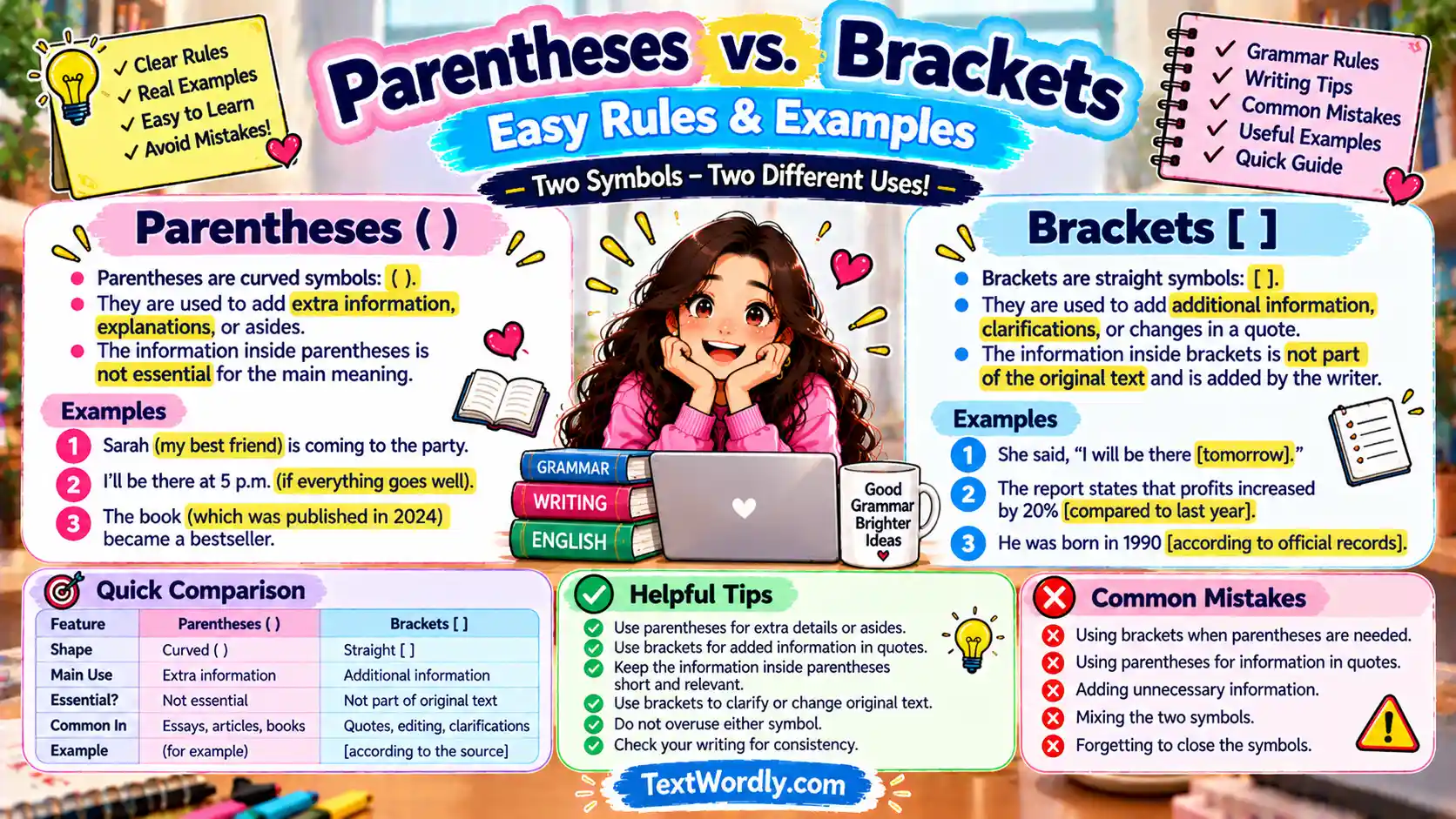
Parentheses vs Brackets: Have you ever stopped while writing because you weren’t sure whether to use parentheses ( ) or square brackets [ ]? These punctuation marks look similar, but they don’t always serve the same purpose.
Understanding parentheses vs brackets makes your sentences clearer, helps you edit quotations correctly, and prevents common grammar mistakes.
In everyday American English, parentheses usually add extra information to a sentence. Square brackets often identify explanations or changes added to quoted material.
However, both symbols have additional uses in mathematics, academic writing, and programming.
This guide explains the differences with simple rules, practical examples, and comparison tables.
QUICK ANSWER
Parentheses ( ) vs Brackets [ ]
Parentheses ( ) add extra details, explanations, or side comments.
Example: Emma (my younger sister) loves reading.
Square brackets [ ] often show words added or changed by an editor within a quotation.
Example: “She [Emma] loves reading.”
Main difference: Parentheses commonly add information to your own writing, while brackets often clarify someone else’s quoted words.
TL;DR
Use parentheses ( ) for optional information within your own sentences. Use square brackets [ ] for editorial explanations, substitutions, or corrections inside quotations. In mathematics and programming, these symbols have specialized meanings. Punctuation and nesting rules may also depend on the writing style.
1. What Are Parentheses?
Parentheses are curved punctuation marks written as ( ).
They enclose extra information that adds context without being essential to the main sentence.
Examples ✍️
- My brother (who lives in Chicago) is visiting.
- The meeting (originally planned for Monday) starts tomorrow.
- We visited Portland (Oregon) last summer.
If you remove the information inside parentheses, the sentence should usually remain understandable.
With parentheses: My brother (who lives in Chicago) is visiting.
Without parentheses: My brother is visiting.
The second sentence contains less information but still communicates the main idea.
2. What Are Square Brackets?
Square brackets are punctuation marks written as [ ].
In American English, they’re commonly used to show editorial additions, explanations, or substitutions in quoted material.
Example
Original statement:
“She finished the report.”
Edited quotation:
“[Maria] finished the report.”
The brackets show that the writer replaced she with Maria to clarify the reference.
Square brackets help readers distinguish the original speaker’s wording from information added by someone else.
They also have important uses outside quotations, including mathematics and programming.
3. Parentheses vs Brackets: Key Differences
The easiest way to understand the difference is to compare their common uses.
| Feature | Parentheses ( ) | Square Brackets [ ] |
|---|---|---|
| Shape | Curved | Square |
| Main writing purpose | Add side information | Mark editorial additions |
| Everyday sentences | Very common | Less common |
| Quotations | May appear in original wording | Often identify edited wording |
| Academic writing | Citations and explanations | Editorial clarifications |
| Mathematics | Grouping and open intervals | Grouping and closed endpoints |
| Programming | Function calls and expressions | Lists, indexing, and other syntax |
Simple Memory Trick 💡
Parentheses = Additional information.
Brackets = Editorial clarification.
This rule works for many everyday writing situations, although specialized contexts have exceptions.
4. When Should You Use Parentheses?
Use parentheses when you want to include helpful but nonessential information.
Common Uses
Extra details
The festival (held every July) attracts thousands of visitors.
Abbreviations
The World Health Organization (WHO) publishes health guidance.
Dates
Jane Austen (1775–1817) was an English novelist.
Side comments
I finally completed the assignment (after several revisions).
Parentheses can make writing more conversational.
However, too many parenthetical comments may interrupt the reader.
If a detail is important to your main point, consider placing it directly in the sentence instead.
5. When Should You Use Square Brackets?
Square brackets are especially helpful when editing quotations.
They indicate that certain words weren’t part of the original quotation or have been changed for clarity.
Common Uses
Identify a person
Original: “She submitted the report.”
Edited: “[Maria] submitted the report.”
Clarify a location
Original: “We moved there in June.”
Edited: “We moved there [to Boston] in June.”
Mark an original error
Original: “The company recieved its award.”
Quoted: “The company recieved [sic] its award.”
The Latin term sic indicates that an apparent error or unusual wording appears in the original source.
Brackets should clarify quoted material without changing its intended meaning.
6. Where Does Punctuation Go with Parentheses?
Punctuation placement depends on whether the parenthetical information is part of a larger sentence or stands alone.
Parentheses Within a Sentence
When parentheses contain information within a larger sentence, the sentence’s final period usually goes outside the closing parenthesis.
Correct: We visited Denver (Colorado).
Incorrect: We visited Denver (Colorado.)
Standalone Parenthetical Sentence
When a complete sentence appears independently inside parentheses, its final punctuation stays inside.
Correct: We visited Denver last summer. (It was our first trip.)
Question Marks Inside Parentheses
A question mark stays inside when it belongs specifically to the parenthetical question.
Example: The package arrived yesterday (or was it Monday?).
The surrounding sentence can still end with a period.
7. How Do Brackets Work in Quotations?
Brackets show readers when a writer has inserted or replaced words within quoted material.
Original vs Edited Quotation
| Original | Edited Quotation |
|---|---|
| “She completed the assignment.” | “[Maria] completed the assignment.” |
| “We moved there in June.” | “We moved there [to Boston] in June.” |
| “The company recieved its award.” | “The company recieved [sic] its award.” |
These are illustrative examples.
What About Capitalization?
Some editorial styles use brackets to show a changed initial letter.
For example:
Original: “the results were surprising.”
Edited: “[T]he results were surprising.”
However, not every style guide requires brackets for this change. APA Style permits certain changes to the capitalization of the first letter of a quotation without additional notation.
Always follow the citation style required for your assignment or publication.
8. Parentheses vs Brackets in Academic Writing
Academic writing uses both marks, but the rules vary across APA, MLA, and Chicago styles.
Parentheses in Academic Writing
Parentheses may contain citations, dates, abbreviations, or explanations.
For example, an APA-style parenthetical citation might look like this:
(Smith, 2024)
This is an illustrative citation, not a reference to an actual publication.
Brackets in Academic Writing
Square brackets can clarify information within direct quotations.
Example:
“The findings [from the second experiment] supported the hypothesis.”
Important Style Differences
- APA: Uses parenthetical citations and specific rules for modifying quotations.
- MLA: Commonly uses parenthetical citations with author and page information.
- Chicago: Uses footnotes or author-date citations, depending on the chosen system.
Consult the appropriate style guide instead of assuming one punctuation rule applies to every academic format.
9. Parentheses vs Brackets in Mathematics
In mathematics, parentheses and square brackets can group expressions or represent intervals.
Grouping Expressions
Parentheses:
\[ 3\times(2+4)=18 \]
Square brackets:
\[ 2\times[3+(4\times5)]=46 \]
Both help organize mathematical expressions.
Interval Notation
In standard interval notation, the symbols have distinct meanings.
| Notation | Meaning |
|---|---|
(2, 5) | Excludes 2 and 5 |
[2, 5] | Includes 2 and 5 |
(2, 5] | Excludes 2, includes 5 |
[2, 5) | Includes 2, excludes 5 |
Parentheses indicate excluded endpoints.
Square brackets indicate included endpoints.
These mathematical conventions are separate from ordinary English punctuation rules.
10. Parentheses vs Brackets in Programming
In programming, these symbols perform different functions depending on the language.
Parentheses in Python
Parentheses commonly appear in function calls and grouped expressions.
print("Hello")result = (3 + 5) * 2Square Brackets in Python
Square brackets can create lists and access items by index.
fruits = ["apple", "banana", "orange"]print(fruits[0])Here, fruits[0] accesses the first item, "apple".
Other programming languages may use these symbols differently.
Always follow the syntax rules of the language you’re using.
11. Can You Put Parentheses Inside Parentheses?
Yes, but nested parentheses can make a sentence difficult to read.
Some editorial styles recommend using square brackets for a second layer of parenthetical information.
Example
The conference (held in Portland [Oregon] last year) attracted many visitors.
Here, the square brackets appear inside parentheses.
However, brackets may also have a separate editorial meaning, especially in quotations.
Mathematics Example
\[ [5+(3\times2)]=11 \]
The parentheses group the multiplication, while the brackets enclose the larger expression.
Best Practice
When a sentence contains too many nested punctuation marks, rewrite it.
Complicated: The event (which started in May [after a delay]) was successful.
Clearer: The event started in May after a delay and was successful.
12. Parentheses vs Brackets vs Braces
English writing, mathematics, and programming use several types of grouping symbols.
| Symbol | Name | Common Uses |
|---|---|---|
( ) | Parentheses | Side information, grouping |
[ ] | Square brackets | Editorial changes, intervals |
{ } | Braces or curly brackets | Sets, programming structures |
Examples
Parentheses: The library (built in 1995) is downtown.
Square brackets: “He [the librarian] opened the door.”
Braces in mathematics:
\[ \{1,2,3,4\} \]
This notation represents a set containing four numbers.
American vs British English
In American English, parentheses generally refers to ( ), and brackets commonly means [ ].
In British English, brackets may refer to ( ), while [ ] are called square brackets.
13. Common Parentheses and Brackets Mistakes
Knowing the most frequent errors can help you choose the correct mark.
Mistake 1: Using Brackets for an Ordinary Side Note
Less appropriate: My sister [who lives nearby] is visiting.
Better: My sister (who lives nearby) is visiting.
Mistake 2: Using Parentheses for Editorial Changes
Less clear: “She (Maria) completed the task.”
Better: “[Maria] completed the task.”
Mistake 3: Misplacing the Period
Incorrect: We visited Austin (Texas.)
Correct: We visited Austin (Texas).
Mistake 4: Using [sic] Without a Clear Reason
Use [sic] when you need to identify an apparent error or unusual wording in the original source.
Mistake 5: Changing a Quotation’s Meaning
Never use bracketed additions to misrepresent what the original speaker said.
14. Real-Life Parentheses and Brackets Examples
These examples show how both punctuation marks appear in everyday situations.
Email ✉️
“Our meeting (originally scheduled for Tuesday) has moved to Friday.”
The parentheses add background information.
News Article 📰
“She [the mayor] announced the new policy.”
The brackets identify the person mentioned in the quotation.
School Assignment 📚
“The results (shown in Table 2) support the conclusion.”
The parentheses direct readers to additional information.
Edited Quotation
“He arrived there [in Philadelphia] before noon.”
The brackets clarify the location.
Mathematics
\[ (6+4)\times2=20 \]
The parentheses determine which operation happens first.
These examples demonstrate that the correct symbol depends on what the enclosed information is doing.
15. How to Choose Between Parentheses and Brackets
If you’re unsure which mark to use, identify the purpose of the information.
Quick Decision Guide
| Your Purpose | Usually Choose |
|---|---|
| Add an optional explanation | Parentheses |
| Explain an abbreviation | Parentheses |
| Include a parenthetical citation | Parentheses |
| Clarify a pronoun in a quotation | Square brackets |
| Show an editorial insertion | Square brackets |
| Identify an original quotation error | [sic] in brackets |
| Include interval endpoints | Square brackets |
| Exclude interval endpoints | Parentheses |
| Create a Python list | Square brackets |
Easy Rule to Remember 💡
Writing your own sentence? Parentheses are often the right choice.
Clarifying someone else’s quotation? Square brackets are usually appropriate.
Working with math or code? Follow the rules of that subject.
16. Parentheses vs Brackets FAQs and Final Thoughts
Frequently Asked Questions
Are parentheses and brackets the same thing?
No. In American English, parentheses are ( ), while brackets usually refers to [ ].
When should I use parentheses instead of brackets?
Use parentheses for optional information in your own sentence. Use brackets primarily for editorial additions or clarifications in quotations.
Can brackets be used outside quotations?
Yes. They also appear in mathematics, programming, specialized notation, and editorial comments.
What is the difference between parentheses and brackets in math?
Both can group expressions. In interval notation, parentheses exclude endpoints while square brackets include them.
Can I put brackets inside parentheses?
Yes. However, nesting conventions vary by style, and rewriting a complicated sentence is often clearer.
Where does the period go with parentheses?
When parenthetical information is part of a larger sentence, the final period usually goes outside. For an independent parenthetical sentence, it goes inside.
What does [sic] mean?
It indicates that an apparent error or unusual wording appears in the original quoted source.
Are braces the same as brackets?
No. Braces are { }, while square brackets are [ ].
Conclusion
Understanding parentheses vs brackets helps you write clearly and edit quotations accurately.
Use parentheses ( ) for extra information, explanations, and side comments.
Use square brackets [ ] to identify editorial additions or changes within quoted material.
Remember that academic writing, mathematics, and programming may follow different conventions.
The simplest way to choose the correct symbol is to ask why the information is being enclosed.