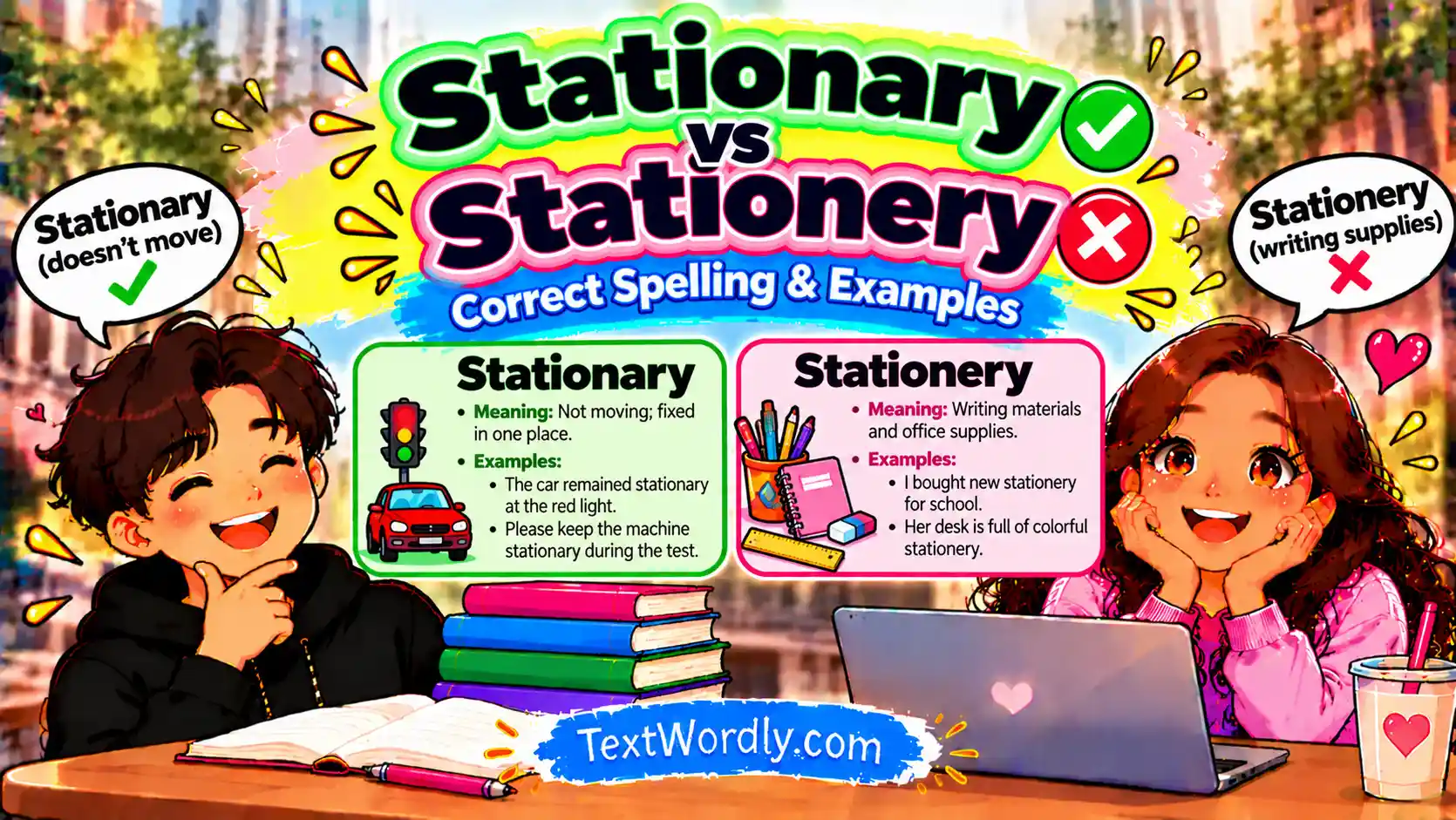
Learn the difference between stationary and stationery, their meanings, spelling clues, common mistakes, and clear examples for everyday English.
Stationary vs stationery is a common English usage topic. These words can be confused because their spelling, pronunciation, or grammatical behavior is similar. The easiest solution is to learn each word’s role and then apply a short context test.
Stationary vs Stationery: The Basic Difference
Stationary is an adjective meaning not moving or staying in one place. Stationery is a noun for writing materials such as paper, envelopes, and related office supplies.
| Word | Meaning | Example |
|---|---|---|
| Stationary | Not moving | The car remained stationary. |
| Stationery | Writing materials | She bought new stationery. |
Stationary vs Stationery Examples
- The bus stayed stationary during the delay.
- The office ordered new stationery.
- The cyclist kept the bicycle stationary.
- The company printed its logo on stationery.
Stationary vs Stationery Memory Trick
Think of the e in stationery as a clue for envelopes and other writing materials. Stationary with an a relates to staying in place.
Definitions and Word Roles
Start by identifying what each word means and how it functions in a sentence. Meaning should come before spelling or pronunciation. This makes the rule easier to apply in both casual and formal writing.
Common Mistakes
- Choosing a word only because it sounds right.
- Ignoring the noun or verb that follows.
- Applying a rule without checking context.
- Confusing American and British English conventions.
- Using a familiar form without proofreading the complete sentence.
How to Remember the Difference
Use a replacement test. Read the complete sentence and ask what the word is supposed to mean. Then replace it with a simple word or phrase with the same function. If the sentence changes meaning, choose the other form.
Quick Comparison
| Question | What to check |
|---|---|
| What does the word mean? | Read the surrounding sentence. |
| What grammatical role does it have? | Check whether it acts as a noun, verb, adjective, or adverb. |
| Is the usage regional? | Check American vs British English conventions. |
| Still unsure? | Use a reliable dictionary. |
Examples in Everyday English
Clear examples are useful because grammar rules become easier to remember when connected to normal situations. Read the examples aloud, then create one sentence of your own using each form.
- The writer checked the sentence before publishing.
- The student used the correct word in an email.
- The editor explained why the original form was confusing.
- The reader used context to understand the meaning.
- The final sentence was clear and natural.
- The teacher gave another example to make the rule easier.
American English Usage
This guide follows standard American English where regional spelling or usage matters. Some English forms differ across countries, so a form that is normal in British English may not be the preferred form in American writing. When the audience is American, follow the American convention consistently.
Practice: Choose the Correct Word
Test yourself before checking a dictionary. Identify the meaning first, choose the word, and then read the sentence again. This habit improves accuracy more effectively than memorizing isolated spellings.
- Read the sentence once for meaning.
- Identify the grammatical role.
- Apply the specific rule.
- Check the final sentence for natural usage.
Related Text Wordly Guides
Your vs You’re · Bring vs Take · Good vs Well · Affect vs Effect · Has vs Have
Trusted Dictionary and Writing Resources
Merriam-Webster · Cambridge Dictionary · Oxford Learner’s Dictionaries · Britannica Dictionary · Grammarly Writing Resources
Frequently Asked Questions
Why are these words confusing?
Similar spelling, pronunciation, or related meanings can make the forms easy to mix up.
What is the fastest way to choose the correct word?
Identify the intended meaning and grammatical role before choosing the spelling.
Does American English matter?
Yes. Some spelling and usage conventions differ between American and British English.
Should I check a dictionary?
Yes. A reputable dictionary can confirm meaning, pronunciation, usage notes, and regional conventions.
Stationary vs Stationery: Detailed Usage
These words are pronounced similarly in many varieties of English, but their meanings are completely different. Stationary describes something that is not moving. Stationery refers to writing materials, such as paper, envelopes, letterhead, and similar supplies.
Stationary in Sentences
- The vehicle remained stationary at the intersection.
- Keep the camera stationary during the shot.
- The object stayed stationary for several minutes.
- The bicycle was stationary beside the wall.
Stationery in Sentences
- The store sells personalized stationery.
- She ordered stationery for the office.
- The company printed its logo on stationery.
- He chose simple stationery for his letters.
Stationary vs Stationery Word Clues
A useful memory clue is the letter e in stationery. Think of envelopes, which are commonly used with stationery. Stationary with an a relates to staying in one place. The memory trick is not the definition itself, but it can make the spelling easier to recall.
Common Stationary vs Stationery Mistakes
Writers often use stationary when they mean writing supplies because the two forms sound alike. Another mistake is using stationery to describe something that has stopped moving. Read the noun around the word and ask whether the sentence concerns movement or writing materials.
Stationary vs Stationery in Professional Writing
In business writing, stationery commonly refers to branded paper, envelopes, and letterhead. Stationary is an adjective and may describe a vehicle, object, or person that remains in one position. Choosing the correct spelling makes emails, documents, and marketing copy look more polished.
Stationary vs Stationery: Final Review
Remember the core distinction: stationary means not moving, while stationery means writing materials. If the sentence involves movement or position, think stationary. If it involves paper, envelopes, letterhead, or office writing supplies, think stationery.
The envelope memory trick can help: stationery has an e. Read the complete sentence before choosing the spelling, especially when both words sound similar.
Stationary vs Stationery: Editing Checklist
During proofreading, ask whether the sentence is about movement or writing supplies. Movement and position point to stationary. Paper, envelopes, letterhead, and office supplies point to stationery. Because the words sound alike, spell-check alone may not catch a wrong choice.
Use the sentence context rather than pronunciation. The more you see these words in real sentences, the easier it becomes to remember their different meanings and spellings.
These words are common in business writing, school work, emails, and office communication. Learning the meaning first makes the spelling distinction much easier to retain.
Stationary vs Stationery: Quick Decision Rule
If something stays still, choose stationary. If you are talking about paper, envelopes, or writing supplies, choose stationery. This meaning-based test is faster and more reliable than trying to remember pronunciation.
For example, a car can remain stationary, while a company can order branded stationery. The surrounding noun usually makes the intended meaning obvious.
Remember the spelling clue: stationery contains an e, which can remind you of envelopes. Stationary contains an a and describes something that stays in one place. Use the meaning first and the memory clue second.
Once the meaning is clear, the spelling becomes much easier to remember. Use these forms consistently in emails, articles, school assignments, and business documents.
Conclusion
Understanding stationary vs stationery helps you avoid common English usage errors. Focus on meaning, grammar, context, and regional style rather than relying only on pronunciation. With regular practice, the correct form becomes easier to recognize and use naturally.