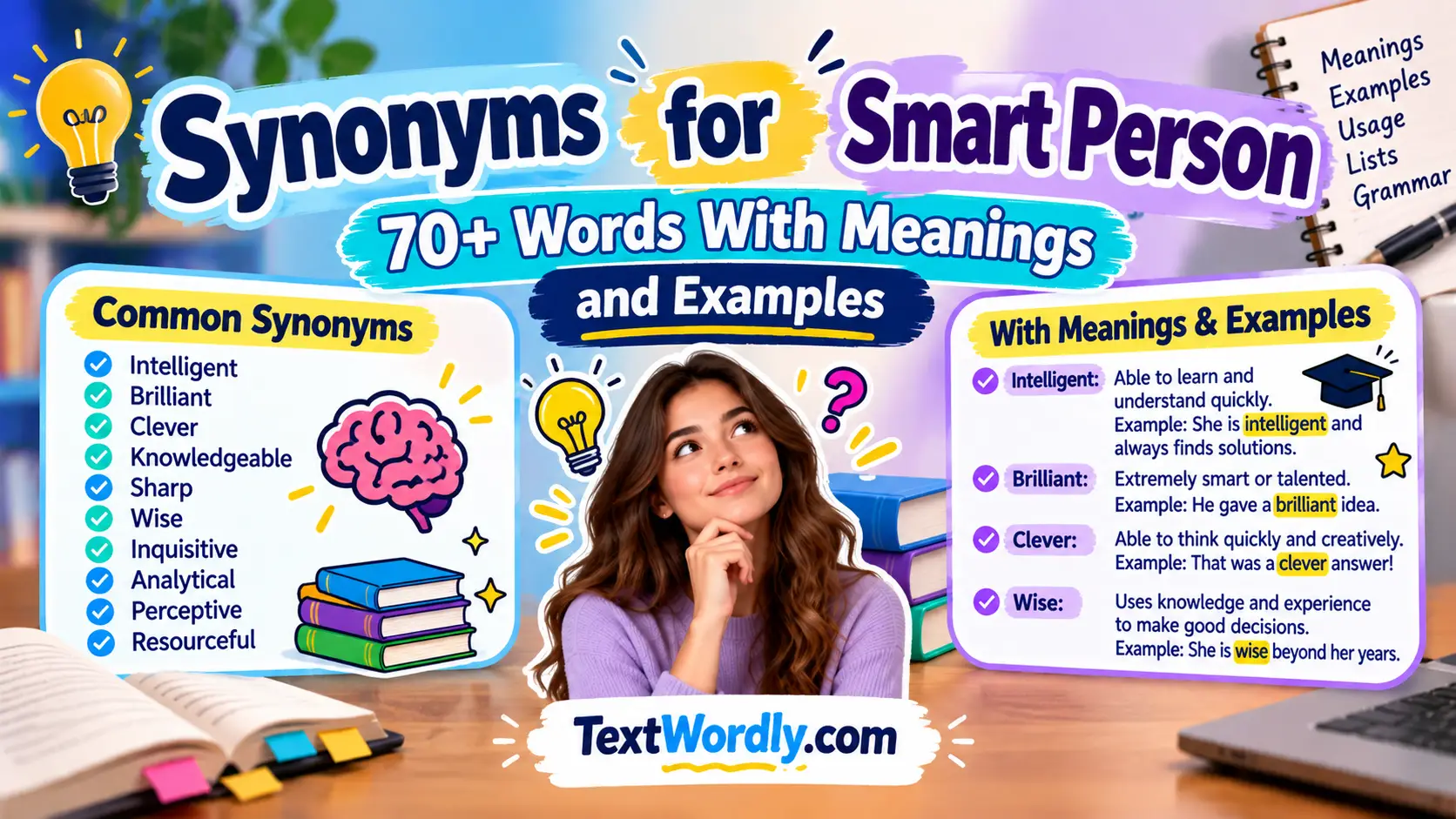
Looking for the best synonyms for smart person? You might want to praise an intelligent student, describe a brilliant coworker, or find a more interesting word for a clever character. English offers plenty of choices, including genius, brainiac, intellectual, brilliant, astute, sharp, and wise.
But these words aren’t interchangeable. A genius has exceptional ability, a quick-witted person responds cleverly, and a wise person makes sound decisions. This guide explains the differences, provides natural American English examples, and helps you choose the right word.
Quick Answer
The best synonyms for smart person include genius, intellectual, brainiac, whiz, brilliant thinker, bright individual, quick learner, sharp mind, astute person, and wise person. Use genius for exceptional intellectual ability, brainiac for informal praise, astute for practical insight, and wise for sound judgment.
TL;DR
- 🧠 Genius: Someone with extraordinary intellectual or creative ability.
- Brilliant: Exceptionally intelligent.
- Clever: Quick at finding effective solutions.
- Astute: Good at understanding situations and making judgments.
- Erudite: Highly knowledgeable through study.
- Wise: Makes sound decisions using knowledge and experience.
Best Synonyms for Smart Person
The best alternative depends on what makes someone smart. Some people learn quickly, others have deep knowledge, and others excel at solving difficult problems.
A useful distinction is between nouns, which directly name people, and adjectives, which describe their qualities.
| Word or phrase | Meaning | Best context |
|---|---|---|
| Genius | Person with extraordinary ability | Exceptional intelligence |
| Intellectual | Person interested in serious ideas | Academic discussions |
| Brainiac | Very intelligent person | Casual conversation |
| Whiz | Person exceptionally skilled at something | Specialized skills |
| Prodigy | Person with exceptional ability at an unusually young age | Young talent |
| Brilliant | Exceptionally intelligent | Strong praise |
| Bright | Quick to learn and understand | Education |
| Sharp | Mentally alert and quick | Everyday descriptions |
| Astute | Skilled at understanding situations | Professional writing |
| Wise | Shows sound judgment | Advice and decisions |
| Erudite | Deeply knowledgeable | Formal writing |
| Ingenious | Produces clever, original solutions | Creative thinking |
Example: “The brilliant engineer developed an ingenious solution to the problem.”
Common Words for a Smart Person
Everyday American English uses several familiar words to describe intelligence. These expressions sound natural in conversations, school assignments, and personal messages.
Words such as smart, bright, clever, and sharp are especially useful because readers understand them immediately.
- Smart: Intelligent and capable of good thinking.
- Intelligent: Able to learn, understand, and reason.
- Bright: Quick to understand new ideas.
- Clever: Good at finding effective solutions.
- Sharp: Mentally alert and quick-thinking.
- Brainy: Very intelligent, especially informally.
- Quick-witted: Fast at producing clever responses.
- Perceptive: Good at noticing and understanding details.
- Quick-thinking: Able to respond rapidly.
- Sharp-minded: Mentally alert and intelligent.
Examples in Sentences
- “Maya is a bright student who learns quickly.”
- “The new employee is sharp and asks thoughtful questions.”
- “That was a clever way to solve the puzzle.”
American English tip: Smart is a common everyday compliment. Intelligent is equally natural but can sound slightly more formal in some contexts.
Synonyms for a Very Smart Person
When someone’s intelligence is exceptional, stronger words may be appropriate. These expressions often suggest unusual ability, outstanding achievement, or remarkable thinking.
However, genius, prodigy, and savant have different meanings. They shouldn’t be used as interchangeable labels.
- Brilliant: Exceptionally intelligent.
- Genius: Someone with extraordinary intellectual or creative ability.
- Gifted: Having exceptional natural ability in an area.
- Prodigy: Someone who demonstrates exceptional ability unusually early.
- Savant: Someone with remarkable knowledge or skill in a particular area.
- Razor-sharp: Exceptionally quick and perceptive.
- Exceptionally intelligent: Far above ordinary intellectual ability.
- Prodigious: Remarkable in ability, achievement, or extent.
Genius vs. Prodigy vs. Savant
| Word | Main distinction | Example |
|---|---|---|
| Genius | Extraordinary intellectual or creative ability | “She is a mathematical genius.” |
| Prodigy | Exceptional achievement at a young age | “The child prodigy performed complex music.” |
| Savant | Exceptional knowledge or skill in a specialized area | “He is a chess savant.” |
Important: A gifted student isn’t automatically a genius, and a prodigy isn’t necessarily exceptional in every subject.
Formal Synonyms for Smart Person
Formal alternatives are useful in academic essays, professional descriptions, and advanced vocabulary exercises. They often communicate more specific qualities than the general word smart.
For example, erudite emphasizes learning, while perspicacious describes someone who understands subtle or difficult things.
- Astute: Quick to understand situations accurately.
- Erudite: Having extensive knowledge gained through study.
- Perspicacious: Able to understand things clearly and quickly.
- Sagacious: Showing wisdom and good judgment.
- Discerning: Able to recognize meaningful differences.
- Judicious: Showing careful and sensible judgment.
- Cerebral: Strongly focused on intellectual activity.
- Analytical: Skilled at examining information logically.
- Scholarly: Associated with serious academic study.
- Shrewd: Showing sharp practical judgment.
Examples
- “The astute negotiator recognized the hidden problem.”
- “Her erudite explanation impressed the audience.”
- “The perspicacious detective noticed a contradiction.”
Word-choice tip: Use erudite for extensive learning, astute for practical insight, and sagacious for wisdom.
Professional Words for a Smart Person
In professional writing, a specific compliment often communicates more than simply calling someone smart. Describe the ability the person demonstrates.
For instance, an employee might be analytical when examining data, resourceful when solving problems, or insightful when identifying important patterns.
- Insightful: Understands complex issues deeply.
- Analytical: Examines evidence and information logically.
- Astute: Recognizes important situations and opportunities.
- Resourceful: Finds effective solutions with available resources.
- Discerning: Makes careful distinctions.
- Perceptive: Notices details others overlook.
- Strategic: Plans effectively toward larger goals.
- Judicious: Exercises careful judgment.
- Knowledgeable: Possesses strong subject knowledge.
- Innovative: Develops useful new approaches.
Professional Sentence Examples
- “She is an insightful leader who understands customer needs.”
- “His analytical approach helped identify the error.”
- “The team appreciated her resourceful solution.”
Remember: Being strategic or resourceful doesn’t automatically prove high intelligence. These words praise particular strengths.
Words for Someone Who Thinks Quickly
A quick thinker understands information rapidly and responds effectively. This ability is often described using words connected to mental speed and alertness.
Some terms emphasize fast reasoning, while others suggest clever replies or the ability to notice important details.
- Quick-witted: Responds rapidly and cleverly.
- Sharp-minded: Mentally alert and intelligent.
- Quick-thinking: Makes decisions or responds rapidly.
- Bright: Learns and understands quickly.
- Keen: Mentally sharp or perceptive.
- Alert: Notices important changes.
- Mentally agile: Thinks flexibly and quickly.
- Razor-sharp: Extremely perceptive and quick.
- Quick on the uptake: Understands new information rapidly.
- Fast learner: Learns new skills or information quickly.
Examples
- “The quick-witted reporter answered immediately.”
- “Her sharp-minded observations impressed the team.”
- “The quick-thinking nurse recognized the emergency.”
Key difference: Quick-witted often suggests clever responses, while quick-thinking emphasizes responding rapidly and effectively.
Synonyms for a Wise Person
Being intelligent and being wise aren’t exactly the same. Intelligence involves understanding and reasoning, while wisdom emphasizes sound judgment.
A wise person may draw on experience, consider consequences, and make balanced decisions. These expressions are especially useful for describing mentors, advisers, and leaders.
- Wise: Shows good judgment.
- Sagacious: Demonstrates deep wisdom.
- Prudent: Avoids unnecessary risks.
- Judicious: Makes careful decisions.
- Sensible: Uses practical judgment.
- Discerning: Recognizes important differences.
- Levelheaded: Remains calm and reasonable.
- Clearheaded: Thinks logically and calmly.
- Thoughtful: Considers matters carefully.
- Sage: A person known for wisdom.
Examples
- “My grandmother always gives wise advice.”
- “The prudent investor avoided unnecessary risks.”
- “The levelheaded manager remained calm during the crisis.”
Important distinction: Someone may be highly intelligent but make poor decisions. Wise emphasizes judgment rather than intelligence alone.
Words for a Knowledgeable Person
A knowledgeable person has learned a great deal about a subject or several subjects. This is different from simply being quick at solving problems.
Some words emphasize academic study, while others describe specialized expertise or knowledge across multiple fields.
- Knowledgeable: Has extensive information about a subject.
- Learned: Highly educated or well-informed.
- Erudite: Possesses deep knowledge through study.
- Well-read: Has read extensively.
- Scholarly: Associated with serious academic learning.
- Well-informed: Understands relevant facts.
- Expert: Possesses advanced specialized knowledge or skill.
- Specialist: Focuses on a particular field.
- Polymath: Has extensive knowledge or expertise across several fields.
- Authority: A person recognized for expertise in a subject.
Examples
- “The knowledgeable guide explained the building’s history.”
- “She is a well-read student with wide interests.”
- “The scientist was a polymath who contributed to several fields.”
Memory trick: Intelligent describes mental ability; knowledgeable describes what someone knows; wise describes judgment.
Words for a Clever and Creative Person
Some people demonstrate intelligence through original ideas and unusual solutions. Words such as ingenious, inventive, and resourceful highlight creative problem-solving.
These qualities may overlap with intelligence, but they aren’t exact synonyms. Creativity emphasizes originality, while resourcefulness emphasizes making effective use of what is available.
- Ingenious: Produces clever, original solutions.
- Inventive: Creates new ideas or methods.
- Creative: Uses imagination effectively.
- Innovative: Introduces useful new approaches.
- Resourceful: Solves problems using available resources.
- Imaginative: Develops original ideas.
- Original: Thinks in distinctive ways.
- Enterprising: Shows initiative and practical creativity.
- Clever: Finds effective or unusual solutions.
- Visionary: Imagines ambitious future possibilities.
Examples
- “The ingenious mechanic repaired the device with simple tools.”
- “Her inventive design reduced waste.”
- “The resourceful team completed the project despite limited supplies.”
Usage tip: Choose ingenious when praising an especially clever solution, not simply any new idea.
Informal and Slang Words for Smart People
American English includes playful expressions for intelligent people. Some are friendly compliments, while others may sound teasing or sarcastic.
These terms are most suitable for informal conversations, social media, and casual storytelling. Avoid assuming that every expression is positive.
| Expression | Meaning | Tone |
|---|---|---|
| Brainiac | Very intelligent person | Playful |
| Brainy | Highly intelligent | Informal |
| Whiz | Person exceptionally skilled at something | Positive |
| Whiz kid | Young person with impressive ability | Positive |
| Smart cookie | Clever or capable person | Friendly |
| Smarty-pants | Person who shows off knowledge | Teasing |
| Know-it-all | Person who acts as if they know everything | Negative |
| Egghead | Intellectual person | Often teasing |
| Nerd | Person deeply interested in intellectual or specialized topics | Context-dependent |
| Einstein | Playful label for a genius | Compliment or sarcasm |
Examples
- “My sister is a math whiz.”
- “You’re one smart cookie!”
- “Don’t be such a smarty-pants.”
Tone warning: Calling someone a know-it-all usually criticizes their behavior rather than praising their intelligence.
One-Word Names for a Smart Person
Nouns can directly identify an intelligent person without requiring an additional word such as individual. They are useful when answering the question, “What do you call a smart person?”
However, these nouns emphasize different qualities. A scholar is associated with academic study, while a mastermind is someone who plans or directs something complex.
| Noun | Meaning | Example |
|---|---|---|
| Genius | Person with extraordinary ability | “She’s a genius.” |
| Intellectual | Person interested in serious ideas | “He’s an intellectual.” |
| Thinker | Person who thinks deeply | “She’s an original thinker.” |
| Prodigy | Person with exceptional early ability | “He’s a musical prodigy.” |
| Savant | Person with remarkable specialized skill | “She’s a chess savant.” |
| Polymath | Person knowledgeable in several fields | “He was a true polymath.” |
| Brainiac | Very intelligent person | “She’s a brainiac.” |
| Whiz | Person exceptionally skilled at something | “He’s a computer whiz.” |
| Scholar | Person devoted to academic study | “She’s a respected scholar.” |
| Mastermind | Person behind a complex plan | “He was the mastermind of the project.” |
Grammar tip: Say “She is brilliant” but “She is a genius.” Brilliant is an adjective; genius is a noun.
Positive Words to Describe a Smart Person
A meaningful compliment identifies what someone does well. Instead of simply saying “You’re smart,” you can praise their insight, creativity, reasoning, or judgment.
These expressions work well in personal messages, school feedback, recommendations, and workplace conversations.
- Brilliant: Exceptional intellectual ability.
- Bright: Quick understanding.
- Insightful: Deep understanding.
- Perceptive: Strong observation.
- Astute: Practical insight.
- Ingenious: Clever originality.
- Resourceful: Effective problem-solving.
- Quick-witted: Clever responses.
- Wise: Sound judgment.
- Discerning: Careful evaluation.
Better Compliment Examples
- Instead of “You’re smart,” say, “That was an insightful observation.”
- Instead of “She’s really smart,” say, “She’s an astute problem-solver.”
- Instead of “He’s smart at fixing things,” say, “He’s remarkably resourceful.”
Writing tip: Specific praise usually communicates more than repeating a general adjective.
Smart Person Synonyms for Creative Writing
Creative writers can reveal intelligence through a character’s decisions, dialogue, and observations. A carefully chosen synonym helps establish personality without lengthy explanations.
For example, a perceptive detective notices details, an astute negotiator understands motivations, and a wise mentor makes sound judgments.
| Character trait | Best word | Example |
|---|---|---|
| Learns quickly | Bright | “The bright apprentice mastered the technique.” |
| Solves difficult problems | Brilliant | “The brilliant detective uncovered the truth.” |
| Notices subtle clues | Perceptive | “The perceptive investigator noticed the inconsistency.” |
| Makes good decisions | Wise | “The wise mentor offered practical advice.” |
| Understands motives | Astute | “The astute negotiator sensed hesitation.” |
| Creates clever solutions | Ingenious | “The ingenious inventor redesigned the machine.” |
| Thinks quickly | Quick-witted | “The quick-witted reporter replied instantly.” |
| Has deep knowledge | Erudite | “The erudite historian explained the ancient text.” |
Weak vs. Strong Description
Basic: “The smart detective solved the mystery.”
More descriptive: “The perceptive detective noticed a detail everyone else had overlooked.”
The second sentence shows the character’s intelligence through a specific ability.
Smart Person Synonyms in Sentences
Learning words in context makes their meanings easier to remember. Sentence examples also demonstrate natural grammar and common American English usage.
Pay attention to whether each expression names a person, describes intelligence, or highlights a particular skill.
- Intelligent: “The intelligent student solved the difficult puzzle.”
- Brilliant: “She is a brilliant mathematician.”
- Clever: “He suggested a clever solution.”
- Bright: “The bright child learns quickly.”
- Sharp: “Our new manager is remarkably sharp.”
- Gifted: “The gifted musician mastered the piece.”
- Astute: “The astute lawyer noticed an important detail.”
- Wise: “Her wise advice prevented a mistake.”
- Perceptive: “The perceptive teacher noticed his confusion.”
- Resourceful: “The resourceful engineer repaired the equipment.”
- Ingenious: “They developed an ingenious design.”
- Knowledgeable: “The knowledgeable librarian recommended useful books.”
- Quick-witted: “His quick-witted response made everyone laugh.”
- Analytical: “The analytical researcher examined the evidence.”
- Erudite: “The erudite historian explained the ancient text.”
- Discerning: “The discerning editor recognized the stronger argument.”
Practice tip: Replace smart with a more precise word in your own sentences, then check whether the new word accurately describes the person.
Smart vs. Intelligent vs. Clever vs. Wise
These four words overlap, but they highlight different aspects of thinking. Understanding their meanings prevents awkward or misleading substitutions.
Smart and intelligent are broad descriptions. Clever often emphasizes effective or original thinking, while wise emphasizes good judgment.
| Word | Main meaning | Example |
|---|---|---|
| Smart | Intelligent and capable | “She’s smart.” |
| Intelligent | Understands and reasons well | “He’s intelligent.” |
| Clever | Finds effective solutions | “That was clever.” |
| Bright | Learns quickly | “She’s a bright student.” |
| Brilliant | Exceptionally intelligent | “He’s brilliant.” |
| Wise | Makes sound decisions | “She’s wise.” |
| Astute | Understands situations accurately | “He’s an astute manager.” |
| Shrewd | Makes sharp practical judgments | “She’s a shrewd investor.” |
Can Clever Have a Negative Meaning?
Yes. Clever is usually positive, but it can sometimes suggest trickiness or manipulation.
For example, “a clever solution” is positive, while “a clever trick” may describe something deceptive depending on the context.
Is Smart the Same as Wise?
Not exactly. A smart person may learn quickly and reason effectively. A wise person applies knowledge and judgment to make good decisions.
How to Choose the Right Smart Person Synonym
The best word depends on the ability you’re describing and the tone of your writing. A school report, workplace recommendation, and fictional story may require different expressions.
Avoid choosing advanced vocabulary simply to sound impressive. A familiar, accurate word is usually more effective than a complicated one used incorrectly.
Quick Word-Selection Guide
- General intelligence? Use intelligent.
- Exceptional intelligence? Use brilliant.
- Extraordinary ability? Use genius.
- Fast learning? Use bright.
- Quick thinking? Use sharp.
- Practical insight? Use astute.
- Deep knowledge? Use erudite.
- Knowledge across fields? Use polymath.
- Original solutions? Use ingenious.
- Good judgment? Use wise.
- Casual praise? Use brainy.
Common Grammar Mistakes
- ❌ “She is a brilliant.” → ✅ “She is brilliant.”
- ❌ “He is genius.” → ✅ “He is a genius.”
- ❌ “She is an intelligent.” → ✅ “She is intelligent.”
- ❌ “He is a clever.” → ✅ “He is clever.”
- ❌ “A knowledgeable person must be a genius.” → ✅ “Knowledge and exceptional intelligence are different qualities.”
Quick Vocabulary Practice
Choose the best word for each sentence.
- Someone who makes sound decisions is ______.
- A person with extraordinary intellectual ability may be called a ______.
- Someone who notices subtle details is ______.
- A person who develops clever, original solutions is ______.
- Someone who responds cleverly and quickly is ______.
Answer Key With Explanations:
- Wise — emphasizes sound judgment.
- Genius — describes extraordinary intellectual or creative ability.
- Perceptive — describes noticing and understanding details.
- Ingenious — emphasizes clever originality.
- Quick-witted — describes fast, clever responses.
FAQs About Synonyms for Smart Person
What is another word for a smart person?
Common alternatives include genius, intellectual, brainiac, whiz, brilliant thinker, bright individual, and astute person. Choose based on whether you want to emphasize intelligence, knowledge, or practical judgment.
What do you call someone who is extremely intelligent?
A highly intelligent person may be described as brilliant, exceptionally intelligent, or a genius. These are strong compliments and should reflect the person’s actual abilities.
What is a fancy word for smart?
Formal alternatives include astute, perspicacious, sagacious, erudite, and cerebral. They have different meanings: astute emphasizes insight, erudite emphasizes learning, and sagacious emphasizes wisdom.
What do you call someone who is smart in many subjects?
A polymath is someone with extensive knowledge or expertise across multiple fields. A well-rounded person may have broad abilities and interests, but isn’t necessarily a polymath.
What is a professional way to say someone is smart?
Use analytical, insightful, astute, perceptive, resourceful, or discerning, depending on the person’s demonstrated strengths. Specific descriptions work especially well in recommendations and performance reviews.
What is the difference between a genius and a prodigy?
A genius has extraordinary intellectual or creative ability. A prodigy demonstrates exceptional ability at an unusually young age.
Is brainiac a compliment?
Brainiac is often a playful compliment for a highly intelligent person. However, depending on the speaker’s tone, it can also sound teasing or sarcastic.
Is clever the same as intelligent?
Not exactly. Intelligent broadly describes the ability to understand and reason. Clever often highlights quick thinking or finding effective solutions and can occasionally suggest trickiness.
Conclusion
Learning the best synonyms for smart person helps you describe intelligence more accurately and naturally. Words such as genius, brilliant, clever, bright, astute, wise, erudite, and ingenious highlight different abilities and shouldn’t always replace one another.
For stronger writing, choose words that match a person’s actual strengths. Whether you’re describing a student, coworker, leader, or fictional character, precise vocabulary makes your meaning clearer and your compliments more useful.