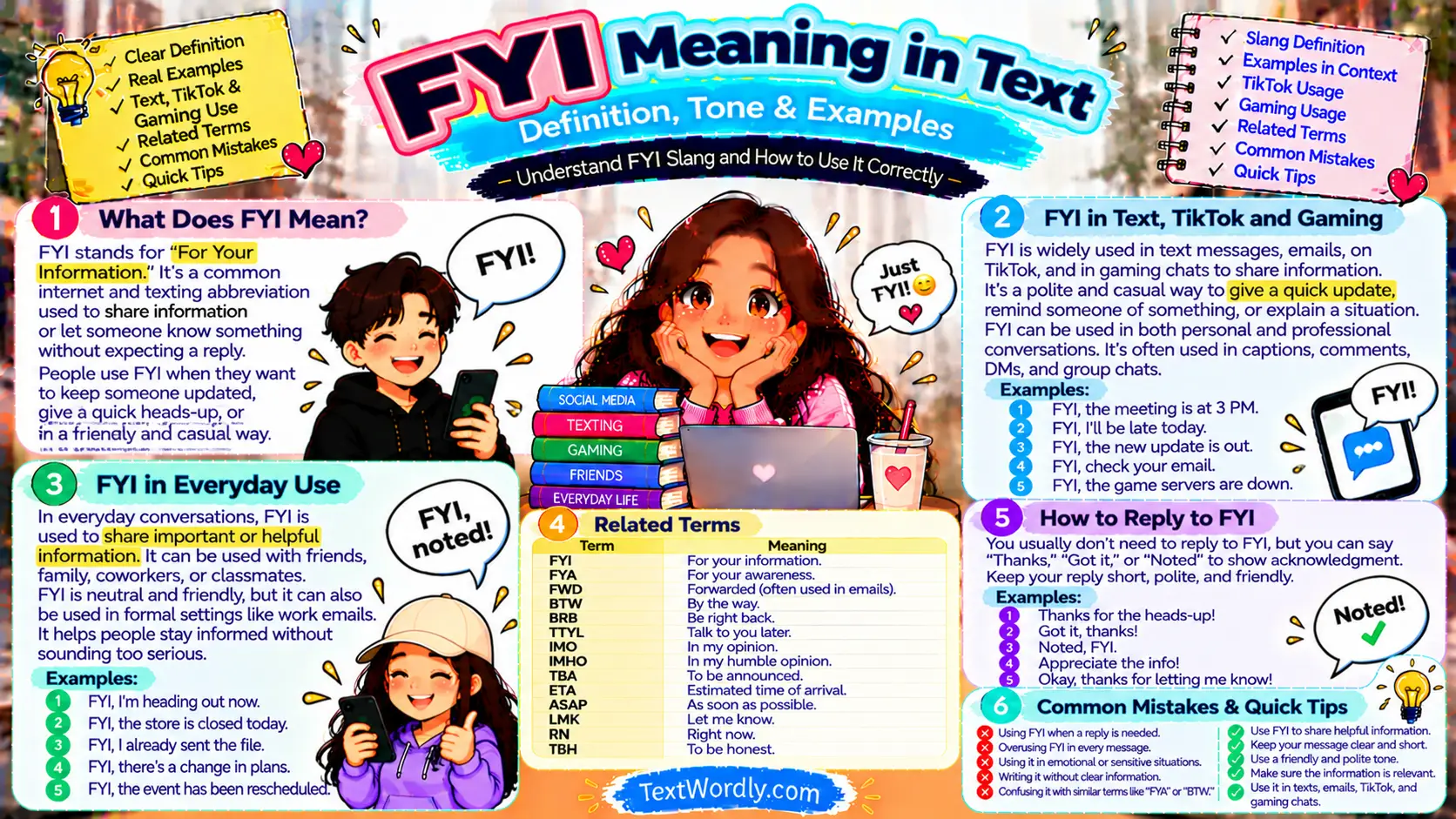
FYI meaning in text: Have you ever received a message saying “FYI, the meeting starts at 3 PM” or “Just FYI, I already sent the pictures” and wondered what the sender meant?
FYI stands for “For Your Information.” It’s a common abbreviation people use when sharing something they think another person should know.
You’ll see FYI in text messages, Snapchat conversations, WhatsApp groups, emails, Slack, Microsoft Teams, and social media comments.
Sometimes FYI is a friendly heads-up. Other times, especially during disagreements, it can sound blunt, corrective, or sarcastic.
For example, “FYI, the restaurant closes at 8 😊” sounds helpful, while “FYI, I already explained that” may sound annoyed.
Understanding FYI meaning in text helps you recognize the sender’s intention, respond naturally, and avoid misunderstandings.
This guide explains what FYI means, how to use it correctly, whether it’s rude, and how it differs from similar expressions.
QUICK ANSWER
FYI = For Your Information
FYI is an abbreviation used to share information that may be useful, relevant, or important to another person.
Example:
Friend: “FYI, the restaurant closes at 9 tonight.”
You: “Thanks for letting me know!”
FYI generally introduces information rather than directly requesting an action, although the message may still require attention.
TL;DR
- FYI means For Your Information.
- It introduces useful details, reminders, updates, or warnings.
- FYI is common in texting, emails, and workplace chats.
- Its tone can be friendly, neutral, blunt, or sarcastic.
- FYI doesn’t automatically mean someone is angry.
- FYI doesn’t always mean no action is required.
- Natural replies include “Got it,” “Thanks for the heads-up,” and “Thanks for letting me know.”
1. What Does FYI Mean in Text?
FYI means “For Your Information.” People use it when sharing information they believe another person should know.
The information might be a reminder, schedule update, warning, or helpful detail.
For example:
“FYI, the movie starts at 7:30.”
The sender is providing information about the movie’s starting time.
| Text Message | What It Communicates |
|---|---|
| “FYI, the store closes early today.” | Helpful update |
| “FYI, I already sent the document.” | Status update |
| “FYI, the party starts at 6.” | Reminder |
| “Just FYI, the road is closed.” | Warning |
| “FYI, she won’t be joining us.” | Informational update |
| “FYI, there’s a new version available.” | Product or software update |
FYI doesn’t necessarily mean the sender expects an immediate response.
Often, they simply want to make sure the recipient has the information.
However, the full message determines whether any action is needed.
2. What Does FYI Stand For?
FYI is an initialism formed from the first letters of “For Your Information.”
- F = For
- Y = Your
- I = Information
The expression is widely used in written communication.
FYI Full Form Example
Short form: “FYI, the meeting has been moved to Friday.”
Full form: “For your information, the meeting has been moved to Friday.”
Both sentences communicate the same update.
How Do You Pronounce FYI?
FYI is usually pronounced by saying each letter separately:
F-Y-I — “eff-why-eye.”
In written messages, the abbreviation saves space and quickly signals that information follows.
3. Why Do People Use FYI in Messages?
People use FYI to pass along useful information without writing a long introduction.
It can help someone prepare, avoid confusion, or stay updated.
Common Reasons for Using FYI
| Purpose | Example |
|---|---|
| Sharing an update | “FYI, the schedule changed.” |
| Giving a reminder | “FYI, tomorrow is the deadline.” |
| Offering a warning | “FYI, the road is icy.” |
| Passing along news | “FYI, they announced the results.” |
| Clarifying something | “FYI, I already paid for it.” |
| Providing context | “FYI, this is the latest version.” |
FYI is especially useful when the sender doesn’t need to ask a question.
However, the information may still lead to a discussion or require action, depending on the situation.
4. How to Use FYI in a Sentence
FYI can appear at the beginning or end of a message.
It can also stand alone as a short label before information.
At the Beginning
“FYI, the restaurant closes at 8.”
This is one of the most common forms.
At the End
“The restaurant closes at 8, FYI.”
This sounds natural in casual texting.
With a Colon
“FYI: The meeting is now at 2 PM.”
A colon works well when introducing an announcement.
Uppercase vs Lowercase
Both FYI and fyi are understandable.
Uppercase is conventional in professional writing, while lowercase is common in casual chats.
Is “Just FYI” Correct?
Yes, it’s common in informal communication.
For example:
“Just FYI, I won’t be available tomorrow.”
The word “just” can make the message sound more casual, although tone still depends on context.
5. FYI Meaning on Snapchat
On Snapchat, FYI means “For Your Information.”
People use it in direct messages when sharing updates, reminders, or details.
Snapchat Conversation
Ava: “Are we still meeting at 5?”
Liam: “FYI, they changed it to 6.”
Ava: “Oh, thanks!”
Liam is providing an updated time.
FYI isn’t a special Snapchat feature or a hidden romantic code.
Its meaning comes from the message itself.
For example:
“FYI, you looked amazing today.”
This could be a compliment or flirtatious message, but FYI simply introduces the statement.
6. FYI Meaning on Instagram, TikTok, and WhatsApp
FYI has the same general meaning across Instagram, TikTok, and WhatsApp.
However, people use it in different types of conversations.
| Platform | Example | Purpose |
|---|---|---|
| “FYI, the event is sold out.” | Update | |
| TikTok | “FYI, there’s a second part.” | Helpful information |
| “FYI, we’re leaving at 8.” | Group reminder | |
| Instagram DM | “FYI, I sent the link.” | Status update |
| TikTok comment | “FYI, the creator explained this already.” | Clarification |
Can FYI Sound Rude in Comments?
Yes.
For example:
“FYI, everyone already knows that.”
This may sound dismissive.
However:
“FYI, there’s a full tutorial on their page!”
This sounds helpful.
The surrounding words determine the tone.
7. FYI Meaning in Emails, Slack, and Teams
FYI is especially common in professional communication.
People use it in emails, Slack, Microsoft Teams, and other workplace messaging tools.
In many workplaces, FYI indicates that a message is primarily informational.
FYI in an Email Subject Line
An email subject might say:
“FYI: Updated Meeting Schedule”
This tells the recipient that the email contains an update.
Workplace Email Example
Subject: FYI — Updated Meeting Schedule
Hi Team,
FYI, tomorrow’s meeting has been moved from 10 AM to 11 AM.
The updated calendar invitation has been sent.
No additional action is needed unless you have a scheduling conflict.
Thanks!
This email clearly communicates the update and whether action is required.
FYI in Slack or Teams
Manager: “FYI, the client approved the design.”
Employee: “Great, thanks for the update.”
FYI When Forwarding an Email
Someone might forward an email with the message:
“FYI — sharing the client’s latest feedback.”
This usually means the sender wants the recipient to see the information.
However, it doesn’t automatically establish whether the recipient needs to respond or act.
FYI vs CC in Email
CC means carbon copy. It is an email recipient field.
FYI is an expression that introduces information.
A person who is CC’d on an email may be included for awareness, but the sender should clarify any expected action.
8. What Does FYI Mean From a Girl or Guy?
When a girl or guy sends FYI, it means “For Your Information.”
The sender’s gender doesn’t change the definition.
Examples include:
- “FYI, I’m free this weekend.” — Sharing availability.
- “FYI, I already texted you.” — Clarification.
- “FYI, you looked really nice today.” — Compliment.
- “FYI, I’m not upset.” — Reassurance.
- “FYI, I don’t like that joke.” — Expressing a boundary.
Does FYI Mean Someone Likes You?
Not by itself.
A message such as “FYI, you’re really cute” may sound flirtatious because of the compliment.
The abbreviation itself isn’t romantic.
Can FYI Show Annoyance?
Yes, depending on context.
For example:
“FYI, I already explained that twice.”
This could indicate frustration.
However, FYI alone isn’t evidence that someone is angry.
9. Is FYI Rude, Polite, or Passive-Aggressive?
FYI is generally neutral, but its tone can change depending on the situation.
FYI Tone Guide
| Message | Possible Tone |
|---|---|
| “FYI, I saved you a seat 😊” | Friendly |
| “FYI, the meeting starts at 2.” | Neutral |
| “FYI, there’s traffic on the highway.” | Helpful |
| “FYI, I already told you.” | Potentially annoyed |
| “FYI, you’re not the only one who’s busy.” | Confrontational |
| “FYI, you did an amazing job!” | Supportive |
Why Can FYI Sound Passive-Aggressive?
FYI sometimes introduces a correction or criticism.
For example:
“FYI, that’s not how it works.”
This may sound dismissive if it isn’t followed by a helpful explanation.
A more constructive version would be:
“Just to clarify, the process works a little differently. Here’s how.”
FYI isn’t inherently passive-aggressive, but it can contribute to that tone.
Does FYI Mean Someone Is Angry?
Not necessarily.
A message such as “FYI, the store closes at 7” is simply informational.
However, “FYI, I already told you that” may sound irritated.
The surrounding words and conversation history matter more than the abbreviation itself.
10. Does FYI Mean No Action Is Required?
Not always.
FYI often signals that a message is informational, but it doesn’t automatically mean the recipient has nothing to do.
Example 1 — Information Only
“FYI, the meeting has been canceled.”
This may simply inform the recipient about a change.
Example 2 — Information With an Existing Responsibility
“FYI, the deadline is tomorrow.”
The message provides information, but the recipient may still need to complete a task.
Example 3 — Explicit Action Required
“FYI, the deadline is tomorrow. Please submit your section by 4 PM today.”
This message includes both an update and a clear instruction.
FYI vs Action Required
| Message | Meaning | Action Needed? |
|---|---|---|
| “FYI, the meeting is canceled.” | Informational update | Usually no |
| “FYI, the deadline is tomorrow.” | Reminder | Depends on responsibilities |
| “Please review the attached file.” | Direct request | Yes |
| “Action required: Submit your report.” | Explicit instruction | Yes |
| “FYI, please confirm your attendance.” | Information plus request | Yes |
Best Workplace Practice
If you’re sending an important message, don’t rely on FYI alone to communicate expectations.
State what the recipient needs to do and when.
This reduces confusion and prevents missed deadlines.
11. Real FYI Texting and Email Examples
These illustrative conversations show how FYI works in everyday situations.
Example 1 — Friendly Reminder
Emma: “What time does the movie start?”
Noah: “FYI, it starts at 7:15.”
Emma: “Thanks!”
Example 2 — Group Plans
Mia: “Are we meeting at the café?”
Jack: “FYI, they changed the location.”
Mia: “Where are we meeting now?”
Example 3 — Work Update
Ava: “Did the client respond?”
Liam: “FYI, they approved the proposal.”
Ava: “That’s great news.”
Example 4 — Clarification
Sophia: “I thought you were coming.”
Ryan: “FYI, I said I might be late.”
Sophia: “Oh, I misunderstood.”
Example 5 — Helpful Warning
Olivia: “I’m leaving for the airport now.”
Ethan: “FYI, there’s heavy traffic on the highway.”
Olivia: “Thanks for the heads-up!”
Example 6 — Forwarded Email
Colleague: “FYI, forwarding the updated project timeline.”
You: “Received, thanks. I’ll review it before tomorrow’s meeting.”
The recipient acknowledges the information and explains what they’ll do next.
12. How to Reply When Someone Says FYI
Your reply depends on whether the information is helpful, surprising, or requires clarification.
FYI doesn’t require a special response.
| FYI Message | Natural Reply |
|---|---|
| “FYI, the meeting is at 3.” | “Got it, thanks!” |
| “FYI, the store is closed.” | “Thanks for letting me know.” |
| “FYI, I sent the document.” | “Received, thank you.” |
| “FYI, the schedule changed.” | “What’s the new schedule?” |
| “FYI, there’s traffic.” | “Thanks for the heads-up!” |
| “FYI, I already explained this.” | “I understand. Thanks for clarifying.” |
Do You Always Need to Reply?
No.
If FYI is simply sharing information, a response may not be necessary.
However, acknowledging important updates can be helpful, especially at work.
How to Respond to a Rude FYI
If someone writes:
“FYI, you should’ve known that already.”
You might reply:
“Thanks for clarifying. I’ll keep that in mind.”
This keeps the conversation professional without escalating the tone.
How to Reply Professionally
For workplace updates, useful responses include:
“Received, thank you.”
“Thanks for sharing. I’ll review the details.”
“Understood. Please let me know if any action is needed from my side.”
These responses are clear, polite, and appropriate for professional communication.
13. FYI vs BTW, FWIW, PSA, and ICYMI
FYI is sometimes confused with other abbreviations used to introduce information.
| Abbreviation | Full Form | Common Purpose |
|---|---|---|
| FYI | For Your Information | Sharing useful information |
| BTW | By The Way | Adding another point |
| FWIW | For What It’s Worth | Offering a suggestion or perspective |
| PSA | Public Service Announcement | Sharing information intended for a wider audience |
| ICYMI | In Case You Missed It | Highlighting something previously shared |
| IMO | In My Opinion | Introducing a personal viewpoint |
FYI vs BTW
“FYI, the store closes at 8.”
This emphasizes useful information.
“BTW, I saw your brother yesterday.”
This adds another topic to the conversation.
FYI vs FWIW
“FYI, the deadline is Friday.”
This shares information.
“FWIW, I think you should start early.”
This offers a perspective or suggestion.
FYI vs PSA
PSA often introduces information meant for a broader audience.
FYI is more flexible and can be directed at one person or a group.
FYI vs ICYMI
“ICYMI, the company announced a new product yesterday.”
ICYMI emphasizes that the recipient may have missed earlier information.
FYI simply introduces information the sender wants to share.
14. FYI vs Heads-Up, CC, and Action Required
FYI is closely related to expressions such as “Heads-up” and “Just so you know.”
However, these phrases have slightly different purposes.
| Expression | Typical Meaning | Example |
|---|---|---|
| FYI | Sharing information | “FYI, the meeting moved.” |
| Just so you know | Giving useful context | “Just so you know, I’ll be late.” |
| Heads-up | Warning or advance notice | “Heads-up, the road is closed.” |
| CC | Copying someone on an email | Adding a colleague to the CC field |
| Action required | Requesting a specific task | “Please submit the report.” |
FYI vs Heads-Up
“FYI, the road is closed.”
This provides information.
“Heads-up, the road ahead is closed.”
This emphasizes advance notice or a warning.
FYI vs CC
FYI is wording within a message.
CC is an email feature used to include additional recipients.
They aren’t interchangeable.
FYI vs Action Required
FYI often indicates awareness.
Action required explicitly signals that the recipient needs to do something.
If you’re sending a workplace message with a deadline, use direct wording such as:
“Action required: Please confirm your attendance by Friday.”
This is clearer than relying on FYI alone.
15. Common FYI Mistakes and Misunderstandings
FYI is easy to understand, but it can create confusion when used without enough context.
Mistakes to Avoid
- Assuming FYI always means no action is required.
- Using FYI to introduce criticism without considering tone.
- Treating FYI as proof that someone is angry.
- Using FYI repeatedly in a message.
- Sending important information without stating the next step.
- Assuming FYI is always appropriate in formal communication.
- Confusing FYI with BTW or IMO.
- Using FYI to make a correction sound unnecessarily harsh.
- Assuming a CC’d email always requires no response.
- Using FYI when an explicit request would be clearer.
Example of an Unclear Workplace Message
“FYI, the report is incomplete.”
The recipient may not know whether they’re expected to fix it.
A clearer version would be:
“The report is missing the final sales figures. Please update it by 2 PM.”
When action is required, clear instructions are more useful than relying on FYI alone.
Avoid FYI in Sensitive Criticism
Instead of:
“FYI, your work wasn’t good enough.”
Try:
“I’d like to discuss a few areas we can improve before the next submission.”
The second message is more constructive.
16. When to Use FYI and When to Avoid It
FYI works best when you’re sharing information that another person may find useful.
It’s especially appropriate for reminders, schedule changes, status updates, and informal workplace communication.
However, it may be less suitable when the message requires an explicit action or involves a sensitive topic.
| Situation | Recommended Wording |
|---|---|
| Sharing a schedule update | “FYI, the meeting is now at 3.” |
| Giving a friendly reminder | “Just FYI, the store closes early.” |
| Warning about traffic | “Heads-up, there’s traffic ahead.” |
| Assigning a task | “Please complete this by Friday.” |
| Addressing a sensitive issue | Use direct, considerate language |
| Sending a formal notice | “Please note the following change.” |
Is FYI Professional?
Yes, FYI is commonly used in professional communication.
However, clarity matters more than brevity.
If the recipient needs to take action, explain exactly what is expected.
When Should You Avoid FYI?
Avoid relying on FYI when you need to deliver sensitive criticism, communicate urgent instructions, or clarify responsibilities.
A complete sentence may be more appropriate.
The main rule is simple: use FYI to share information, but use direct instructions when action is required.
Frequently Asked Questions About FYI Meaning in Text
What does FYI mean from a girl?
FYI means “For Your Information.” It introduces information she wants you to know. The abbreviation itself doesn’t indicate romantic interest.
What does FYI mean from a guy?
It has the same meaning. He’s sharing an update, reminder, or other information.
Is FYI rude in texting?
Not inherently. FYI is usually neutral, but it can sound blunt or sarcastic depending on the message.
What does FYI mean on Snapchat?
On Snapchat, FYI means “For Your Information.” People use it to share updates, reminders, and helpful details.
What does FYI mean in email?
In emails, FYI often indicates that a message is informational. However, the content may still require attention or action.
Does FYI mean no response is needed?
Not always. Some FYI messages don’t require a reply, but important updates may deserve acknowledgment.
What is the difference between FYI and BTW?
FYI emphasizes useful information, while BTW introduces an additional point or topic.
What is the difference between FYI and heads-up?
FYI generally shares information. Heads-up often emphasizes advance notice or a warning.
How do you reply to FYI?
Natural replies include “Got it,” “Thanks for letting me know,” and “Thanks for the heads-up.”
Is FYI still used in 2026?
FYI remains a widely recognizable abbreviation in texting, email, and workplace communication.
Conclusion
Understanding FYI meaning in text helps you recognize when someone is sharing information, offering a reminder, or providing an update.
FYI stands for “For Your Information.” It’s a convenient abbreviation used in text messages, emails, workplace chats, and social media conversations.