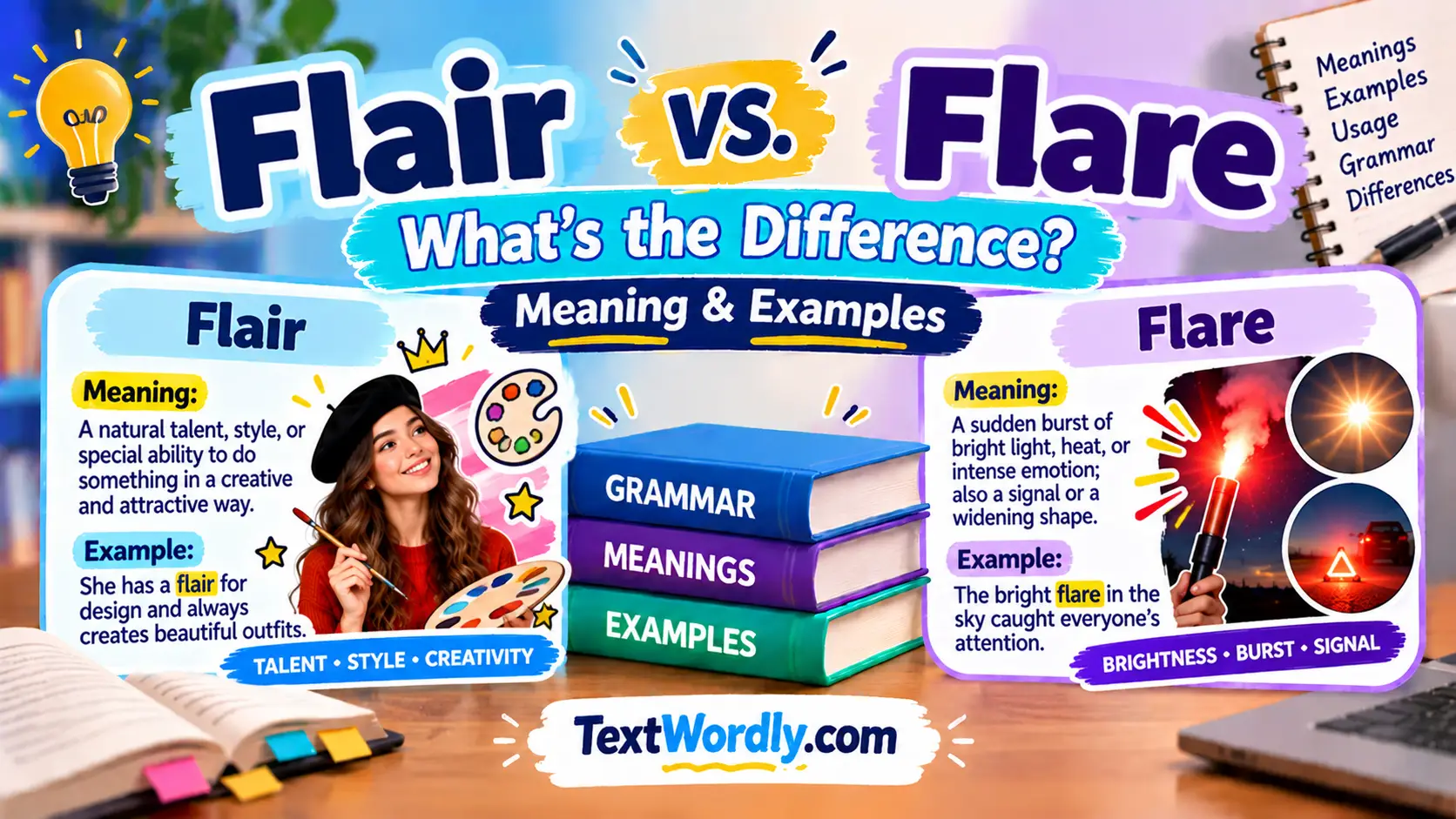
Flair and flare sound identical, but they have different meanings. Flair refers to natural talent, a special instinct, or distinctive style. Flare describes a sudden burst of light, fire, emotion, or activity. It can also mean to widen outward.
For example, a photographer might have a flair for capturing dramatic sunsets, while bright sunlight could create a lens flare in a photograph.
Both words are homophones—words that sound alike but differ in spelling and meaning. Because pronunciation cannot help you distinguish them, the sentence’s context is important.
This guide explains flair vs. flare with definitions, grammar rules, common expressions, practical examples, spelling tips, and a quick quiz.
Quick Answer: Flair vs. Flare
- 🎨 Flair (noun): A natural talent, special ability, instinct, or distinctive style.
- 🔥 Flare (noun): A sudden burst of light or activity, or a bright signaling device.
- ⚡ Flare (verb): To burn brightly, intensify suddenly, or spread outward.
Examples:
- “She has a flair for creative writing.”
- “The chef prepared the meal with flair.”
- “A bright flare illuminated the sky.”
- “The argument began to flare up.”
Memory trick: Flair = talent or style. Flare = flame or sudden intensity.
TL;DR
| Word | Meaning | Part of speech | Example |
|---|---|---|---|
| Flair | Natural talent | Noun | He has a flair for music. |
| Flair | Distinctive style | Noun | She dresses with flair. |
| Flare | Bright burst or signal | Noun | A flare lit the sky. |
| Flare | Sudden increase | Verb | Tensions flared. |
| Flare | Widen outward | Verb | The skirt flares at the hem. |
Bottom line: Use flair for talent, instinct, or style. Use flare for bright bursts, sudden increases, or widening shapes.
Flair vs. Flare: Quick Difference
The clearest difference between flair and flare is their meaning.
Flair describes someone’s ability or distinctive way of doing something.
Flare refers to a burst of light, a sudden increase in intensity, or something spreading outward.
Compare:
- “The artist has a flair for unusual designs.”
- “The campfire began to flare in the wind.”
The first sentence describes talent. The second describes flames becoming brighter or more intense.
| Feature | Flair | Flare |
|---|---|---|
| Main meaning | Talent or style | Burst, increase, or widening |
| Grammar | Noun | Noun and verb |
| Pronunciation | FLARE | FLARE |
| Creative ability | Yes | No |
| Bright light | No | Yes |
| Sudden anger | No | Yes |
| Widening clothing | No | Yes |
Simple test: Can you replace the word with talent or style? Choose flair. Does it involve a burst, increase, or widening? Choose flare.
What Does Flair Mean?
Flair is a noun describing a natural talent, special instinct, or distinctive style.
It often suggests that someone performs an activity with originality, confidence, or unusual skill.
Flair Meaning Natural Talent
- “She has a flair for languages.”
- “He discovered his flair for photography.”
- “The student showed a flair for storytelling.”
Here, flair means a special ability.
Flair Meaning Distinctive Style
- “The decorator arranged the room with flair.”
- “The dancer performed with dramatic flair.”
- “The chef added creative flair to the dish.”
Here, flair describes an impressive personal touch.
Flair Meaning Instinct
Flair can also describe an instinctive ability to recognize or judge something.
Example: “The investigator had a flair for noticing small inconsistencies.”
Key takeaway: Flair is associated with ability, instinct, creativity, and personal style.
What Does Flare Mean?
Flare can function as both a noun and a verb.
Its meanings include a bright burst, a signaling device, a sudden increase in intensity, or a shape that widens.
Flare as a Noun
- “The sailors launched a red flare.”
- “The camera captured a bright lens flare.”
- “A sudden flare of anger interrupted the conversation.”
Flare as a Verb
- “The flames began to flare.”
- “Tensions flared during the meeting.”
- “The skirt flares below the waist.”
Flare in Medical Language
A flare or flare-up can describe a temporary worsening of symptoms associated with a medical condition.
Example: “She reported a flare-up of joint pain.”
This is a vocabulary usage, not a diagnosis.
Important: Flare is not limited to fire. It can also describe emotions, symptoms, conflict, and physical shapes.
Flair vs. Flare Comparison Chart
The following chart shows how these words appear in everyday situations.
| Situation | Correct word | Example |
|---|---|---|
| Natural talent | Flair | She has a flair for art. |
| Personal style | Flair | He dresses with flair. |
| Emergency signal | Flare | The crew launched a flare. |
| Sudden anger | Flare | His temper flared. |
| Creative writing | Flair | She writes with flair. |
| Camera lighting | Flare | The image contains lens flare. |
| Widening pants | Flare | The pants flare at the ankle. |
| Sudden conflict | Flare | Tensions flared overnight. |
| Instinctive judgment | Flair | He has a flair for spotting errors. |
| Temporary symptom increase | Flare | The patient reported a flare-up. |
Compare These Sentences
“The performer has a flair for comedy.”
This means the performer has a natural talent for comedy.
“The stage lights flared during the performance.”
This means the lights suddenly became brighter.
Remember: These words sound identical, but their meanings are not interchangeable.
How to Pronounce Flair and Flare
Flair and flare are homophones in standard American English.
Both have one syllable and the same pronunciation.
| Word | American IPA | Easy pronunciation |
|---|---|---|
| Flair | /flɛr/ | FLARE |
| Flare | /flɛr/ | FLARE |
Pronunciation Examples
- “She has a flair for cooking.”
- “A bright flare appeared in the sky.”
The highlighted words sound exactly alike.
Why Are They Confusing?
You cannot identify the correct spelling by listening alone.
Instead, consider what the sentence describes:
- Talent, instinct, or style: Flair.
- Fire, light, intensity, or widening: Flare.
Pronunciation tip: Learn the meanings and common phrases rather than relying on sound.
How to Use Flair in a Sentence
Use flair when describing someone’s natural ability, creative style, or instinct.
Talent and Ability
- “She has a flair for mathematics.”
- “He developed a flair for public speaking.”
- “The musician has a flair for jazz.”
- “Her flair for languages impressed the teacher.”
- “The employee has a flair for solving problems.”
Style and Creativity
- “The chef presented the meal with flair.”
- “She decorated the apartment with artistic flair.”
- “The actor performed with dramatic flair.”
- “His writing has a distinctive flair.”
- “The designer brought modern flair to the collection.”
Instinct and Judgment
- “The editor has a flair for finding strong headlines.”
- “She has a flair for identifying promising ideas.”
Writing tip: Two especially natural expressions are a flair for something and with flair.
How to Use Flare in a Sentence
Use flare for bright bursts, sudden increases, or outward widening.
Fire and Light
- “A bright flare illuminated the harbor.”
- “The flames began to flare in the wind.”
- “The photographer noticed lens flare.”
- “The rescue team spotted a signal flare.”
- “The fire flared when fresh air entered the room.”
Emotions and Conflict
- “His anger flared during the discussion.”
- “Tensions flared between the teams.”
- “The disagreement flared up unexpectedly.”
- “Her frustration flared after the delay.”
Clothing and Shape
- “The skirt flares below the hips.”
- “The jeans flare near the ankles.”
- “The flower petals flare outward.”
Key point: Flare frequently suggests a sudden change or an expanding shape.
Flair for Something vs. Flare Up
Two expressions that writers frequently confuse are flair for something and flare up.
Have a Flair for Something
Have a flair for means to possess a natural talent or instinctive ability.
Examples:
- “She has a flair for painting.”
- “He has a flair for storytelling.”
- “The designer has a flair for color.”
Flare Up
Flare up is a phrasal verb meaning to become suddenly more intense or active.
Examples:
- “The fire flared up.”
- “An argument flared up during the meeting.”
- “His symptoms flared up again.”
Quick Comparison
| Expression | Meaning |
|---|---|
| Flair for design | Natural design talent |
| Flair for writing | Writing ability or instinct |
| Flare up | Suddenly intensify |
| Flare-up | A sudden increase or worsening |
Memory rule: Flair for = talent. Flare up = sudden increase.
Flare-Up, Flared, and Flaring
Flare has several related forms that appear in everyday English.
Understanding them helps prevent spelling and grammar mistakes.
Flare Up vs. Flare-Up
Flare up is a two-word phrasal verb.
Example: “The disagreement may flare up again.”
Flare-up is a hyphenated noun.
Example: “There was a sudden flare-up of tension.”
Flared
Flared is the past tense and past participle of flare. It can also function as an adjective.
Examples:
- “The flames flared briefly.”
- “She wore flared jeans.”
Flaring
Flaring is the present participle of flare.
Examples:
- “The fire was flaring in the wind.”
- “The flaring lights caught everyone’s attention.”
What About Flairless?
Flairless is an uncommon derived adjective meaning lacking flair.
In everyday American English, without flair or lacking flair is usually clearer.
Grammar tip: Use flare up as a verb and flare-up as a noun.
Flair in Fashion, Art, and Writing
Flair is especially common when discussing creativity, style, and individual expression.
Flair in Fashion
“She has a flair for combining unusual colors.”
This means she has a natural sense of style.
Flair in Art
“The painter approached the project with creative flair.”
Here, flair emphasizes originality and artistic expression.
Flair in Writing
“The author writes dialogue with considerable flair.”
This suggests distinctive, engaging writing.
Flair in Cooking
“The chef adds international flair to familiar dishes.”
This means the food has a recognizable style or creative influence.
Flair in Professional Work
“The marketing team presented the campaign with impressive flair.”
This means the presentation had distinctive style and confidence.
Important distinction: Fashion flair describes style, while flared clothing describes a shape that widens.
Flare in Fire, Light, and Photography
Flare is widely used in descriptions of bright light, flames, emergency signals, and optical effects.
Signal Flare
A signal flare produces a bright light to attract attention or communicate a warning.
Example: “The sailors launched a flare to signal for help.”
Solar Flare
A solar flare is a sudden release of energy from the Sun that produces intense electromagnetic radiation.
Example: “Scientists observed a powerful solar flare.”
Lens Flare
Lens flare occurs when bright light scatters or reflects within a camera’s optical system, producing visible artifacts or reducing image contrast.
Example: “The sunset photograph contains noticeable lens flare.”
Flare of Light
A flare of light is a sudden burst of brightness.
Example: “A brief flare lit the horizon.”
Key takeaway: When the context involves fire, bright light, or a sudden burst, flare is usually the correct spelling.
Flare in Health, Emotions, and Conflict
Flare also describes sudden increases in symptoms, feelings, or disagreements.
Medical Flare-Up
A medical flare-up refers to a period when symptoms become more active or severe.
Example: “The patient reported a flare-up of joint pain.”
The term describes a change in symptoms, not the cause or diagnosis.
Flare of Anger
“A sudden flare of anger interrupted the conversation.”
This means anger appeared or intensified quickly.
Tensions Flared
“Tensions flared during the negotiations.”
This means the conflict or disagreement became more intense.
Flare of Interest
“The announcement caused a flare of public interest.”
This describes a sudden increase in attention or curiosity, although surge of interest may sound more natural in some contexts.
Writing tip: Use flare when you want to emphasize a sudden rise in intensity.
Flair vs. Flare in Clothing and Social Media
These words also appear in fashion terminology and online communities.
Flared Jeans
Flared jeans become wider below the knee.
Example: “She wore flared jeans with a fitted jacket.”
Flared Skirt
A flared skirt widens toward the hem.
Example: “The dress has a gently flared skirt.”
Flares
In fashion, flares can refer to trousers with legs that widen toward the bottom.
Example: “The store displayed several styles of flares.”
Reddit Post Flair
On Reddit, post flair is a label that communities may use to categorize posts.
Example: “Choose the correct post flair before submitting.”
Reddit User Flair
User flair is a label or text displayed alongside a user’s name in communities that support it.
Example: “Members can select a user flair in this community.”
Remember: Flair is the correct spelling for Reddit labels. Flare is used for widening clothing and bursts of light or activity.
Common Flair vs. Flare Mistakes
Because these words sound alike, spelling errors are easy to make.
Mistake 1: Natural Talent
❌ “She has a flare for music.”
✅ “She has a flair for music.”
Why: Flair means natural talent.
Mistake 2: Emergency Signal
❌ “The sailors launched a flair.”
✅ “The sailors launched a flare.”
Why: A flare is a bright signaling device.
Mistake 3: Sudden Anger
❌ “His anger began to flair.”
✅ “His anger began to flare.”
Why: Flare means to intensify suddenly.
Mistake 4: Personal Style
❌ “The dancer performed with flare.”
✅ “The dancer performed with flair.”
Why: Flair means distinctive style or skill.
Mistake 5: Clothing Shape
❌ “She wore flair jeans.”
✅ “She wore flared jeans.”
Why: Flared describes jeans that widen toward the bottom.
Mistake 6: Social Media Labels
❌ “Add a post flare on Reddit.”
✅ “Add a post flair on Reddit.”
Why: Reddit uses flair for labels.
Editing tip: Replace the word with talent/style or burst/intensify/widen to identify the correct spelling.
Easy Memory Tricks for Flair vs. Flare
A few simple associations make these homophones easier to remember.
Flair = Air of Style
Flair contains air.
Think of someone having an air of confidence or a distinctive personal style.
Flair → Air → Talent and style
Flare = Flame
Flare begins with the same three letters as flame.
Both words are associated with fire or brightness.
Flare → Flame → Fire and light
Flair for vs. Flare Up
Remember two common phrases:
- Flair for: Natural talent.
- Flare up: Suddenly intensify.
Grammar Test
Flair is a noun.
Example: “She has a flair for design.”
Flare can be a noun or verb.
Examples:
- “A bright flare appeared.”
- “The flames began to flare.”
Memory Sentence
“The photographer had a flair for capturing dramatic lens flare.”
The first word means talent. The second refers to a lighting effect.
Best memory trick: Flair = talent. Flare = flame.
Flair vs. Flare Practice Quiz
Choose the correct word or form for each sentence.
Questions
1. She has a natural ______ for creative writing.
A. Flair
B. Flare
2. A bright ______ appeared above the rescue boat.
A. Flair
B. Flare
3. The disagreement began to ______ up during the meeting.
A. Flair
B. Flare
4. Which spelling correctly completes the sentence?
“She experienced a sudden ______ of symptoms.”
A. Flair-up
B. Flare-up
5. The photographer noticed a lens ______ in the image.
A. Flair
B. Flare
6. The designer created a skirt that ______ outward near the hem.
A. Flaired
B. Flared
Answers With Explanations
1. A — Flair: Refers to natural talent.
2. B — Flare: Refers to a bright signal or burst of light.
3. B — Flare: Flare up means become suddenly more intense.
4. B — Flare-up: The hyphenated noun describes a temporary worsening or increase.
5. B — Flare: Lens flare is a photographic lighting effect.
6. B — Flared: The verb describes widening outward.
Copyable Answer Key: 1-A | 2-B | 3-B | 4-B | 5-B | 6-B
Frequently Asked Questions
What is the main difference between flair and flare?
Flair means natural talent, instinct, or distinctive style. Flare means a sudden burst of light or activity, an increase in intensity, or outward widening.
Is it flair for something or flare for something?
Flair for something is correct when describing talent or ability. For example, “She has a flair for painting.”
Are flair and flare pronounced the same?
Yes. Both words are pronounced FLARE in standard American English. They are homophones.
What does flare up mean?
Flare up means to become suddenly more intense or active. It can describe flames, anger, conflict, or symptoms.
Is it fashion flair or fashion flare?
Fashion flair refers to style or talent. Flare describes widening clothing, such as flared jeans.
What does flair mean on Reddit?
On Reddit, flair is a label that communities may use to identify posts or users. Common types include post flair and user flair.
What is the difference between flare up and flare-up?
Flare up is a phrasal verb, as in “The fire may flare up.” Flare-up is a noun, as in “There was a flare-up of tension.”
How can I remember flair vs. flare?
Remember flair = talent or style and flare = flame or sudden burst. The word flare begins like flame.
Conclusion
The difference between flair vs. flare becomes easy to understand when you focus on the sentence’s meaning.
Use flair for natural talent, instinct, creativity, or distinctive style.
Use flare for sudden bursts of light, fire, anger, conflict, or activity. It can also describe something widening outward.
Although these words sound identical, they are not interchangeable.
Final memory rule: Flair = talent and style. Flare = fire, sudden intensity, or widening.
Remember this distinction to use both words confidently in everyday conversations, academic writing, professional communication, and social media.