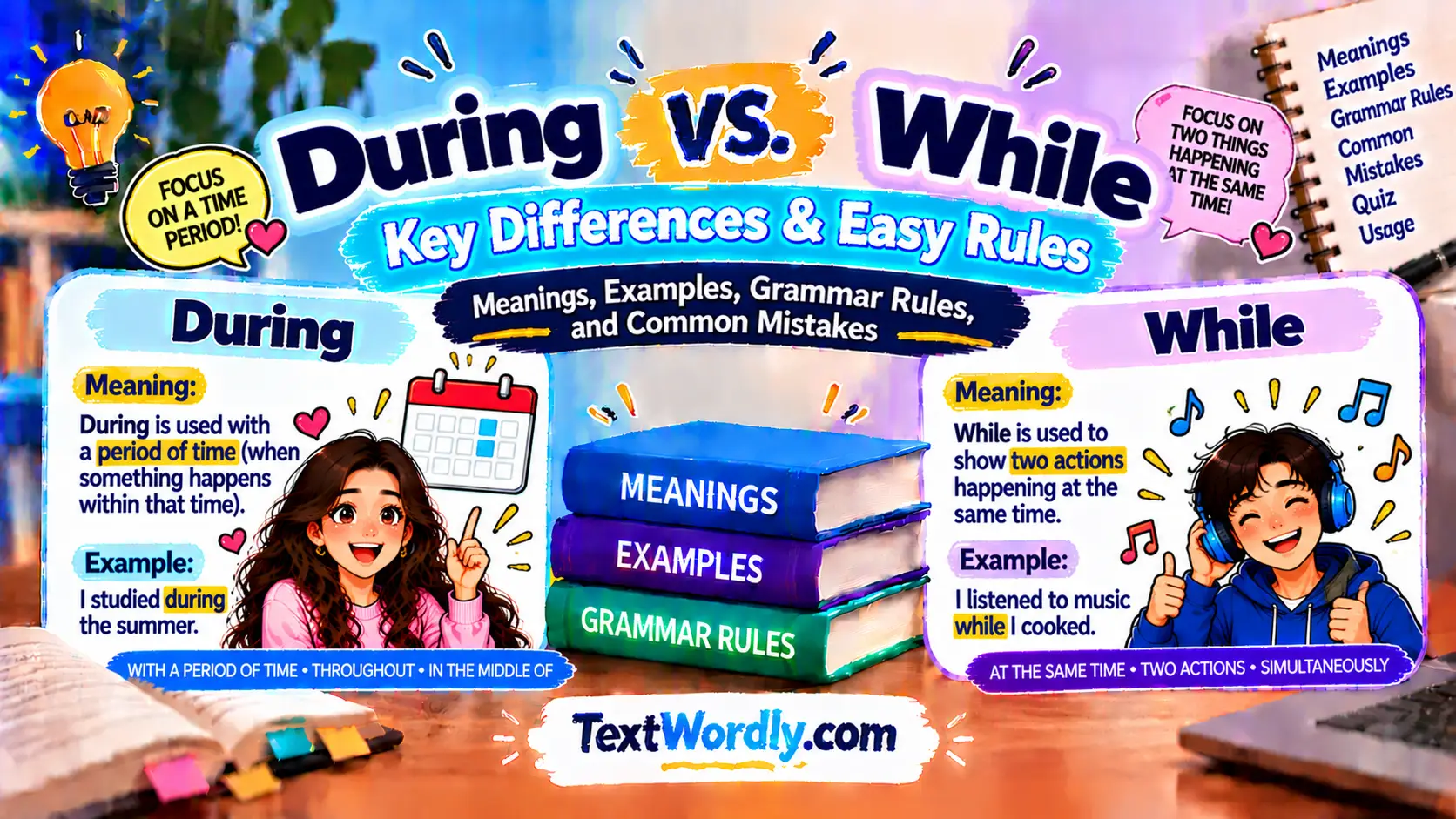
During vs While: Have you ever stopped writing because you weren’t sure whether to use during or while? These two common English words help us talk about time, but they follow different grammar rules.
For example, both “I fell asleep during the movie” and “I fell asleep while watching the movie” are correct. However, you cannot always replace one word with the other without changing the sentence.
The main difference between during vs while is simple: during is a preposition usually followed by a noun phrase, while while is commonly a conjunction that introduces a clause.
You can use during to identify an event or period of time. You can use while to connect actions happening at overlapping times or to introduce contrasting ideas.
This complete guide explains their meanings, grammar rules, sentence structures, common mistakes, and practical examples so you can choose the correct word confidently in everyday American English.
QUICK ANSWER
Use during + noun phrase to identify an event or period of time. Use while + clause to describe overlapping actions or situations. While can also introduce a shortened clause such as “while studying.”
| During | While |
|---|---|
| During the movie | While I watched the movie |
| During the meeting | While we were meeting |
| During the summer | While we were on vacation |
| During dinner | While we were eating dinner |
| Preposition | Usually a conjunction |
Easy rule: During + noun phrase. While + clause.
TL;DR — During vs While
- During is a preposition used before a noun phrase.
- While is commonly a conjunction used before a clause.
- During identifies a time period or event.
- While connects overlapping actions or situations.
- While + -ing is possible when the subject is understood.
- While can also express contrast.
- For usually expresses duration, while throughout emphasizes an entire period.
- The correct choice depends on sentence structure and meaning.
1. What Does During Mean?
During is a preposition that identifies a period of time or an event in which something happens.
It normally comes before a noun or noun phrase.
Examples
- I fell asleep during the movie.
- She took notes during the lecture.
- We traveled during the summer.
- The lights went out during the storm.
In each sentence, during introduces the event or period in which another action occurs.
Grammar Pattern
During + noun or noun phrase
Examples:
- During class
- During lunch
- During the meeting
- During the holidays
During does not normally introduce a complete clause containing its own subject and finite verb.
Correct: During the presentation, I took notes.
Incorrect: During I was presenting, I took notes.
2. What Does While Mean?
While is commonly used as a conjunction that connects actions or situations.
It often introduces a clause containing a subject and verb.
Examples
- I listened to music while I studied.
- She cooked dinner while her husband cleaned.
- He called me while I was driving.
- The children played while it was raining.
These sentences describe situations occurring during overlapping periods.
Grammar Pattern
While + subject + verb
Examples:
- While I was reading
- While she cooked
- While they were talking
- While we waited
While can also introduce a contrast.
Example: While I like coffee, my sister prefers tea.
In this sentence, while means something similar to whereas.
3. During vs While: Key Differences
The biggest difference between during and while is grammatical structure.
During introduces a noun phrase.
While usually introduces a clause.
| Feature | During | While |
|---|---|---|
| Part of speech | Preposition | Usually conjunction |
| Followed by a noun phrase | Yes | Not in the same construction |
| Followed by a complete clause | No | Yes |
| Describes time | Yes | Yes |
| Connects overlapping actions | Indirectly | Yes |
| Can express contrast | Not normally | Yes |
| Shortened -ing clause | Not the normal pattern | Yes |
| Example | During the meeting | While we were meeting |
Compare These Sentences
During: She fell asleep during the movie.
While: She fell asleep while she was watching the movie.
Both describe an action occurring within another activity or period.
However, the sentence structures are different.
4. When Should You Use During?
Use during when you want to identify a particular event or period of time.
Events
- During the concert, everyone cheered.
- During the meeting, the manager explained the plan.
Seasons and Periods
- We visited Florida during the winter.
- She worked part-time during college.
Activities
- He hurt his ankle during the game.
- The phone rang during dinner.
Important Rule
Use a noun phrase after during.
Correct: During the presentation, I took notes.
Incorrect: During I was presenting, I took notes.
The second sentence needs while instead of during.
Does During Mean Throughout?
Not always.
Example: The phone rang during the movie.
This means the phone rang at some point within the movie. It does not mean the phone rang continuously throughout the movie.
5. When Should You Use While?
Use while when connecting clauses that describe overlapping actions or situations.
Simultaneous Actions
- She cooked while I cleaned.
- He listened to music while he worked.
Ongoing Background Action
- The phone rang while I was sleeping.
- Someone knocked while we were eating.
Contrasting Ideas
- While I enjoy summer, my brother prefers winter.
- While the first option is cheaper, the second is more reliable.
Important Rule
While commonly introduces a subject and verb, but it can also appear in shortened clauses when the subject is understood.
Example: She listened to music while studying.
This shortened structure is grammatically correct because the person studying is clearly she.
6. During vs While for Simultaneous Events
Both words can describe events happening during overlapping periods.
However, while is especially useful when you want to connect two actions.
During
The lights went out during the movie.
While
The lights went out while we were watching the movie.
More Examples
| During | While |
|---|---|
| During dinner, the phone rang. | While we were eating dinner, the phone rang. |
| During the storm, the power failed. | While the storm was passing, the power failed. |
| During the lecture, I took notes. | While the professor was speaking, I took notes. |
| During the trip, we met new people. | While we were traveling, we met new people. |
Sentence Transformation
You can often rewrite a sentence by changing the noun phrase into a clause.
During the meeting, I took notes.
Becomes:
While the manager was speaking, I took notes.
The time relationship is similar, but the second sentence gives more information about the action.
7. During vs While in Past Tense
Both words frequently appear in sentences describing past events.
During + Past Event
- I lost my keys during the trip.
- She became sick during the vacation.
- We met during the conference.
While + Past Clause
- I lost my keys while I was traveling.
- She became sick while she was on vacation.
- We met while we were attending the conference.
Past Continuous with While
While often introduces a past continuous clause.
Pattern: While + subject + was/were + verb-ing
Examples:
- While I was studying, the phone rang.
- While they were walking, it started raining.
- While she was cooking, the lights went out.
However, while does not always require the past continuous tense.
Correct: She smiled while he spoke.
Both simple and continuous forms can be appropriate depending on the intended meaning.
8. During vs While in Present and Future Tenses
Both words can describe present and future situations.
Present
During: I usually drink water during lunch.
While: I usually drink water while I eat lunch.
Future
During: We will discuss the issue during tomorrow’s meeting.
While: We will discuss the issue while we are meeting tomorrow.
Important Future Grammar Rule
English commonly uses the present tense after time-related while to refer to the future.
Correct: I will call you while I am traveling.
Usually unsuitable for this meaning: I will call you while I will be traveling.
The first sentence is the natural choice for describing overlapping future events.
This does not mean will can never appear after while. The rule concerns ordinary future-time clauses.
9. While + -ing: Reduced Clauses and Common Errors
One important grammar point is that while can introduce a shortened clause.
Full Clause
While I was studying, the phone rang.
Reduced Clause
While studying, I heard the phone ring.
Both sentences are correct.
In the shortened version, the subject is understood from the main clause.
Common Mistake: Dangling Modifier
Problematic: While driving to work, the rain started.
This wording incorrectly suggests that the rain was driving.
Correct Version
While I was driving to work, the rain started.
Or:
While driving to work, I noticed that it had started raining.
Easy Rule
When using while + -ing, make sure the person performing the action is clear.
This helps prevent confusing or unnatural sentences.
10. During vs While vs When
Another common grammar question involves during, while, and when.
All three relate to time, but they work differently.
| Word | Main Use | Example |
|---|---|---|
| During | Introduces a period or event | During the meeting, I took notes. |
| While | Connects overlapping actions | While I was working, she called. |
| When | Introduces a time-related clause | When I arrived, the meeting began. |
While vs When
While often emphasizes an ongoing situation.
Example: While I was sleeping, the phone rang.
When can identify the time an event happened.
Example: When I arrived, everyone stood up.
Both may be possible in some sentences, but they do not always emphasize the same relationship.
Quick Tip
Use during before a noun phrase, while for overlapping actions, and when when identifying the time of an event.
11. During vs For vs Throughout
During, for, and throughout are all related to time, but they express different meanings.
During
Identifies an event or period.
Example: I studied during the afternoon.
For
Expresses duration.
Example: I studied for three hours.
Throughout
Emphasizes the whole period or something occurring across it.
Example: It rained throughout the afternoon.
Comparison Table
| Word | Meaning | Example |
|---|---|---|
| During | Within a period or event | During the movie |
| For | Length of time | For two hours |
| Throughout | Across an entire period | Throughout the movie |
Common Mistake
Incorrect: I slept during three hours.
Correct: I slept for three hours.
Use for when the main point is how long an action lasted.
Important Difference
During the meeting, my phone rang.
The phone rang at some point within the meeting.
Throughout the meeting, my phone kept ringing.
The ringing happened repeatedly or continued across the meeting.
12. While vs Whereas vs Although
While can also express contrast rather than time.
In this use, it is similar to whereas or although, depending on the sentence.
While for Contrast
While I like tea, my sister prefers coffee.
Whereas for Contrast
I like tea, whereas my sister prefers coffee.
Although for Concession
Although the restaurant is expensive, the food is excellent.
Comparison
| Word | Common Function | Example |
|---|---|---|
| While | Time or contrast | While I like tea, she prefers coffee. |
| Whereas | Contrast | I like tea, whereas she prefers coffee. |
| Although | Concession | Although it was raining, we went outside. |
Important Tip
While can mean during the time that or introduce contrasting ideas.
The surrounding sentence determines the meaning.
13. During vs While in American English Writing
Both during and while are standard in American English.
They are common in everyday conversation, academic writing, and professional communication.
Everyday Conversation
- I fell asleep during the movie.
- I fell asleep while watching the movie.
Business Writing
- Please remain available during the meeting.
- Please take notes while the manager presents.
Academic Writing
- Data were collected during the experiment.
- Researchers recorded observations while participants completed the task.
Comma Rules
Use a comma after an introductory while clause in most ordinary sentences.
Example: While I was working, she called.
A comma is also common after an introductory during phrase.
Example: During the meeting, I took notes.
When the time expression comes at the end, a comma is usually unnecessary.
Example: She called while I was working.
Neither during nor while is automatically more formal. Choose based on structure and meaning.
14. Common During vs While Mistakes
Most mistakes occur when writers confuse a noun phrase with a clause.
| Incorrect | Correct | Explanation |
|---|---|---|
| During I was studying, she called. | While I was studying, she called. | Use while before a clause. |
| While the meeting, I took notes. | During the meeting, I took notes. | Use during before a noun phrase. |
| I slept during three hours. | I slept for three hours. | For expresses duration. |
| During she cooked, I cleaned. | While she cooked, I cleaned. | While connects clauses. |
| While the summer, we traveled. | During the summer, we traveled. | Summer is a noun phrase here. |
Mistake: Assuming While Always Needs Two Written Subjects
Correct: She listened to music while studying.
This shortened clause is acceptable because the subject of studying is understood to be she.
Mistake: Assuming During Means Throughout
During can refer to something happening at one point within a period.
Example: The phone rang during the movie.
The phone did not necessarily ring throughout the entire movie.
Proofreading Checklist
- Is the next phrase a noun or noun phrase?
- Does the sentence contain a full clause?
- Are two actions happening at overlapping times?
- Are you expressing the length of time?
- Are you emphasizing an entire period?
- Is the subject clear in a shortened while clause?
- Are you expressing time or contrast?
These questions can help you choose the correct word.
15. During vs While Examples and Practice Exercises
Let’s practice with everyday situations.
School 🎓
I took notes during the lecture.
I took notes while the teacher was speaking.
Workplace 💼
The manager called during the meeting.
The manager called while I was presenting.
Home 🏠
The lights went out during dinner.
The lights went out while we were eating.
Travel ✈️
I read a book during the flight.
I read a book while I was flying.
Practice Quiz
Test Your Grammar0 of 8 answered
1. I fell asleep ___ the movie.duringwhile
2. She called me ___ I was studying.duringwhile
3. We traveled ___ the summer.duringwhile
4. He listened to music ___ cooking.duringwhile
5. The phone rang ___ the meeting.duringwhile
6. Which sentence is correct?During I was driving, it started raining.While I was driving, it started raining.
7. I studied ___ three hours.duringfor
8. It rained continuously ___ the afternoon.duringthroughout
16. During vs While FAQs and Final Thoughts
Frequently Asked Questions
What is the main difference between during and while?
During is a preposition usually followed by a noun phrase. While is commonly a conjunction introducing a clause.
Can during and while be interchangeable?
They can describe similar time relationships, but the sentence structure usually needs to change.
Is during followed by a verb?
Not directly by an ordinary finite clause. It is normally followed by a noun or noun phrase.
Can while be followed by a verb ending in -ing?
Yes. Shortened clauses such as “while studying” are grammatically correct when the intended subject is clear.
Is while only used for time?
No. While can also express contrast.
What is the difference between during and for?
During identifies a period or event. For usually expresses the length of time.
What is the difference between during and throughout?
During identifies a period in which something happens. Throughout emphasizes the entire period or repeated activity across it.
What is the difference between while and when?
While often emphasizes overlapping actions, while when can identify the time at which an event occurs.
Can I use while in future sentences?
Yes. For example, “I will call you while I am traveling.”
Which word should I use in American English?
Choose based on sentence structure: during before a noun phrase and while before a clause, including an appropriate shortened clause.
Final Thoughts
Understanding during vs while becomes much easier when you focus on grammar rather than meaning alone.
During introduces a period or event, usually through a noun phrase.
While connects overlapping actions or situations and can also introduce contrasting ideas.
Remember the simple pattern:
During + noun phrase
While + clause
Once you understand this distinction, you can use both words more naturally and accurately in everyday American English.