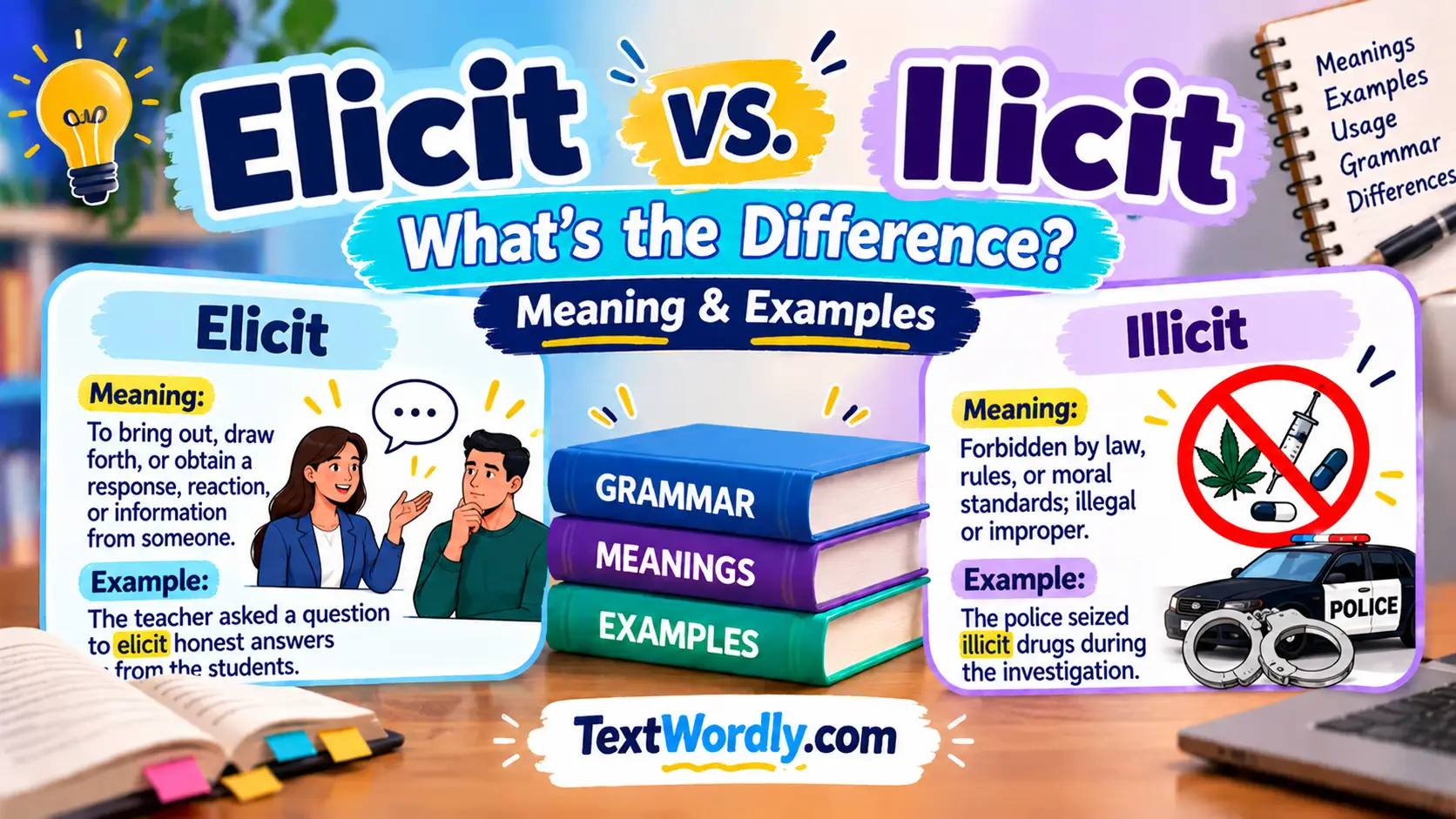
Elicit and illicit sound the same, but they have completely different meanings. Elicit is a verb meaning to draw out information, obtain a response, or cause a reaction. Illicit is an adjective describing something illegal, forbidden, or contrary to accepted rules.
For example, a teacher may elicit answers from students, while investigators may uncover illicit financial transactions.
The easiest way to remember the difference is elicit = draw out and illicit = illegal or forbidden.
Both words are pronounced ih-LISS-it in standard American English. Because they sound alike, understanding their meanings and grammatical functions is essential.
This guide explains elicit vs. illicit with definitions, pronunciation, spelling rules, more than 30 examples, comparison tables, common mistakes, memory tricks, and a practice quiz.
Quick Answer: Elicit vs. Illicit
- 💬 Elicit: To draw out, obtain, or cause a response, feeling, or piece of information.
- 🚫 Illicit: Illegal, forbidden, or prohibited by rules or accepted standards.
Examples:
- “The teacher tried to elicit answers from the class.”
- “The investigation uncovered illicit payments.”
- “The speech elicited applause.”
- “The report described an illicit trading operation.”
Memory trick: Elicit begins with E, like evoke. Illicit begins with I and has two L’s, like illegal.
TL;DR
| Word | Meaning | Grammar | Example |
|---|---|---|---|
| Elicit | Draw out or cause | Verb | The question elicited a response. |
| Illicit | Illegal or forbidden | Adjective | The report identified illicit activity. |
| Elicited | Drew out or caused | Past-tense verb | The performance elicited applause. |
| Illicitly | In an unlawful or prohibited manner | Adverb | The funds were illicitly obtained. |
Bottom line: Use elicit for an action that draws something out and illicit to describe something forbidden or unlawful.
Elicit vs. Illicit: Quick Difference
The main difference between elicit and illicit is both their meaning and grammatical function.
Elicit describes an action. A question may elicit an answer, a joke may elicit laughter, and a moving story may elicit sympathy.
Illicit describes a quality. It commonly appears before nouns such as trade, payments, activity, and relationship.
Compare these sentences:
- “The interviewer’s question elicited useful information.”
- “The investigation uncovered illicit financial activity.”
The first describes obtaining information. The second describes prohibited conduct.
| Feature | Elicit | Illicit |
|---|---|---|
| Meaning | Draw out or cause | Illegal or forbidden |
| Part of speech | Verb | Adjective |
| Pronunciation | ih-LISS-it | ih-LISS-it |
| Spelling | E-L-I-C-I-T | I-L-L-I-C-I-T |
| Common phrase | Elicit feedback | Illicit trade |
Quick rule: Elicit = action. Illicit = description.
What Does Elicit Mean?
Elicit is a verb meaning to draw out, obtain, or bring forth something, particularly information, feelings, or reactions.
It has two closely related uses.
Elicit Information or Answers
In this sense, someone deliberately asks questions or uses a method to obtain information.
Examples:
- “The interviewer tried to elicit detailed answers.”
- “The teacher used pictures to elicit vocabulary.”
- “The survey was designed to elicit honest feedback.”
Elicit a Reaction or Feeling
In this sense, an event, experience, or stimulus causes a reaction. The response does not have to be intentional.
Examples:
- “The comedian’s joke elicited laughter.”
- “The announcement elicited excitement.”
- “The documentary elicited sympathy.”
Important: Elicit does not necessarily mean forcing someone to respond. It often means encouraging, drawing out, or causing a reaction.
What Does Illicit Mean?
Illicit is an adjective meaning illegal, forbidden, unauthorized, or contrary to accepted rules.
It commonly describes activities, transactions, relationships, and arrangements.
Illicit in Legal Contexts
The word frequently refers to conduct prohibited by law.
Examples:
- “Officials investigated an illicit trading network.”
- “The company was accused of making illicit payments.”
- “The report examined illicit financial transactions.”
Illicit in Social Contexts
The word can also describe something considered forbidden or improper under social or institutional standards.
Examples:
- “The novel follows an illicit romance.”
- “The characters kept their illicit relationship hidden.”
An illicit relationship is not necessarily illegal. The word may indicate that the relationship is forbidden or socially disapproved of.
Key takeaway: Illicit often means unlawful, but it can also mean forbidden or improper in a broader sense.
Elicit vs. Illicit Comparison Chart
Because these words sound alike, sentence meaning is the best guide to choosing the correct spelling.
| Situation | Correct word | Example |
|---|---|---|
| Obtaining information | Elicit | The question elicited details. |
| Prohibited business | Illicit | Officials investigated illicit trade. |
| Causing laughter | Elicit | The joke elicited laughter. |
| Forbidden relationship | Illicit | The novel describes an illicit romance. |
| Encouraging feedback | Elicit | The survey elicited feedback. |
| Unlawful payment | Illicit | The report identified illicit payments. |
| Causing emotion | Elicit | The film elicited sympathy. |
| Prohibited transactions | Illicit | The investigation concerned illicit transactions. |
Simple Decision Test
Ask yourself:
Does the word mean “draw out,” “obtain,” or “cause”?
Choose elicit.
Does the word mean “illegal,” “forbidden,” or “prohibited”?
Choose illicit.
How to Pronounce Elicit and Illicit
Elicit and illicit are homophones, meaning they have the same pronunciation but different spellings and meanings.
Both words have three syllables, with stress on the second syllable.
Pronunciation Guide
| Word | IPA | Easy pronunciation |
|---|---|---|
| Elicit | /ɪˈlɪsɪt/ | ih-LISS-it |
| Illicit | /ɪˈlɪsɪt/ | ih-LISS-it |
Pronunciation Examples
- “The question may elicit a response.”
- “The report described illicit activity.”
Both words sound the same.
Why Context Matters
You cannot distinguish these words by listening alone.
Instead, identify whether the sentence needs a verb describing an action or an adjective describing something prohibited.
Pronunciation tip: Elicit and illicit sound alike, but their meanings and grammatical functions are different.
Elicit as a Verb vs. Illicit as an Adjective
One of the easiest ways to remember the difference is through grammar.
Elicit is a verb. Illicit is an adjective.
A verb describes an action, while an adjective describes a noun.
Elicit as a Verb
- “The question may elicit an answer.”
- “The speech elicited applause.”
- “The researcher is eliciting feedback.”
Illicit as an Adjective
- “An illicit transaction”
- “An illicit business operation”
- “An illicit agreement”
Grammar Comparison
| Elicit | Illicit |
|---|---|
| Elicit information | Illicit information gathering |
| Elicit feedback | Illicit payments |
| Elicit laughter | Illicit trade |
| Elicit a reaction | Illicit activity |
Grammar test: If the word describes what someone does, use elicit. If it describes something forbidden, use illicit.
How to Use Elicit in a Sentence
Use elicit when describing something that draws out information, emotions, answers, or reactions.
It is especially common in education, research, communication, psychology, and professional writing.
Everyday Examples
- “The joke elicited laughter from the audience.”
- “Her question elicited a thoughtful answer.”
- “The announcement elicited excitement.”
- “The story elicited sympathy.”
- “The surprising news elicited several reactions.”
Professional Examples
- “The researcher designed questions to elicit detailed responses.”
- “The manager tried to elicit feedback from employees.”
- “The interviewer elicited important information.”
- “The teacher used pictures to elicit vocabulary.”
- “The advertisement was intended to elicit an emotional reaction.”
Writing tip: Common objects of elicit include response, reaction, information, feedback, laughter, emotion, and answer.
How to Use Illicit in a Sentence
Use illicit when describing prohibited, unlawful, or forbidden activities and arrangements.
The word frequently appears in journalism, legal discussions, business reporting, and formal writing.
Everyday and Social Examples
- “The novel describes an illicit relationship.”
- “The character became involved in illicit activities.”
- “The documentary examined an illicit marketplace.”
- “The investigation uncovered illicit dealings.”
- “The report warned about illicit online sales.”
Professional and Legal Examples
- “The authorities investigated illicit financial transactions.”
- “The business was accused of accepting illicit payments.”
- “Officials examined evidence of illicit trade.”
- “The investigation identified illicit profits.”
- “The organization introduced policies to prevent illicit activity.”
Important: Whether conduct is actually illegal depends on the relevant law and circumstances. The adjective itself does not establish wrongdoing.
Elicited, Eliciting, and Elicits
Because elicit is a verb, it changes form depending on tense and sentence structure.
Elicit Verb Forms
| Form | Usage | Example |
|---|---|---|
| Elicit | Base form | Questions can elicit responses. |
| Elicits | Third-person singular present | The story elicits sympathy. |
| Elicited | Past tense | The speech elicited applause. |
| Eliciting | Present participle | The teacher is eliciting answers. |
What Does Elicited Mean?
Elicited means drew out, obtained, or caused a response in the past.
Example: “The question elicited an honest answer.”
What Does Eliciting Mean?
Eliciting describes the ongoing action of drawing out or causing something.
Example: “The interviewer is eliciting detailed responses.”
Common Mistake
❌ “The speech illicit a strong reaction.”
✅ “The speech elicited a strong reaction.”
Remember: Illicit is not a verb form of elicit.
Elicit vs. Solicit vs. Evoke
Elicit, solicit, and evoke have related meanings, but they are used differently.
Elicit means to draw out or bring forth a response.
Solicit means to ask for or seek something, often formally.
Evoke means to bring a feeling, memory, or image into someone’s mind.
Comparison Table
| Word | Main meaning | Example |
|---|---|---|
| Elicit | Draw out or obtain | The question elicited an answer. |
| Solicit | Request or seek | The company solicited feedback. |
| Evoke | Bring to mind or arouse | The song evoked memories. |
Elicit vs. Solicit
A company may solicit feedback by sending a survey.
However, the survey may fail to elicit responses if nobody answers.
Solicit emphasizes asking. Elicit emphasizes drawing something out.
Elicit vs. Evoke
A question may elicit an explanation.
A familiar smell may evoke childhood memories.
Key takeaway: Use elicit for drawing out a response, solicit for requesting something, and evoke for bringing feelings or memories to mind.
Illicit vs. Illegal vs. Licit
Illicit, illegal, and licit are related words, but their meanings are not identical.
Illicit means forbidden, prohibited, or unlawful.
Illegal specifically means contrary to the law.
Licit means lawful or permitted. It is more common in formal writing.
Comparison Table
| Word | Meaning | Example |
|---|---|---|
| Illicit | Forbidden or unlawful | Illicit trade |
| Illegal | Against the law | Illegal parking |
| Licit | Lawful or permitted | Licit business activity |
Is Illicit Always Illegal?
Not necessarily.
Although illicit frequently refers to unlawful conduct, it can also describe something forbidden by social rules or accepted standards.
For example, an illicit romance may be considered improper without necessarily violating criminal law.
Licit vs. Illicit
Licit is the opposite of illicit.
Example: “The investigation distinguished licit transactions from illicit ones.”
Important: Use illegal when you specifically mean against the law. Use illicit when the broader idea of forbidden or prohibited conduct is appropriate.
Common Phrases With Elicit and Illicit
Learning common word combinations makes it easier to choose the correct spelling.
Common Phrases With Elicit
- Elicit a response: Draw out an answer or reaction.
- Elicit information: Obtain information.
- Elicit feedback: Encourage opinions or suggestions.
- Elicit laughter: Cause laughter.
- Elicit sympathy: Cause feelings of sympathy.
- Elicit an emotional reaction: Produce an emotional response.
Common Phrases With Illicit
- Illicit activity: Prohibited or unlawful conduct.
- Illicit trade: Trade involving unlawful or prohibited practices.
- Illicit payments: Payments made unlawfully or improperly.
- Illicit profits: Gains from prohibited activities.
- Illicit substances: Substances prohibited under applicable laws.
- Illicit relationship: A relationship considered forbidden or improper.
Quick Sentence Test
“The teacher wanted to ______ a response.”
Correct: elicit
“The investigation uncovered ______ transactions.”
Correct: illicit
Remember: Elicit is an action. Illicit is a description.
Elicit vs. Illicit in Academic and Professional Writing
Both words are useful in formal writing, but they appear in different contexts.
Elicit in Research
Researchers often design questions, interviews, and experiments to elicit information or reactions.
Example: “The interview questions were designed to elicit detailed accounts of participants’ experiences.”
Elicit in Education
Teachers use questions, pictures, and discussions to elicit student responses.
Example: “The instructor used an open-ended question to elicit discussion.”
Illicit in Journalism
Journalists may use illicit when reporting on prohibited transactions, unlawful trade, or forbidden arrangements.
Example: “The report examined allegations of illicit financial activity.”
Illicit in Business Compliance
Businesses may use illicit when discussing prohibited payments, improper transactions, or compliance risks.
Example: “The company introduced controls designed to detect illicit payments.”
Professional writing tip: Use these words precisely. Do not describe conduct as illicit without an appropriate factual basis.
Common Elicit vs. Illicit Mistakes
Because elicit and illicit are homophones, spelling errors are common.
Here are six mistakes to avoid.
Mistake 1: Using Illicit for a Response
❌ “The question illicited a response.”
✅ “The question elicited a response.”
Mistake 2: Using Elicit for Illegal Activity
❌ “The authorities uncovered elicit activity.”
✅ “The authorities uncovered illicit activity.”
Mistake 3: Confusing Grammar
❌ “The teacher tried to illicit answers.”
✅ “The teacher tried to elicit answers.”
Mistake 4: Incorrect Adjective
❌ “The company investigated elicit payments.”
✅ “The company investigated illicit payments.”
Mistake 5: Incorrect Past Tense
❌ “The movie illicit strong emotions.”
✅ “The movie elicited strong emotions.”
Mistake 6: Incorrect Business Context
❌ “Officials reported elicit trading.”
✅ “Officials reported illicit trading.”
Final checking rule: Elicit = draw out. Illicit = forbidden.
Easy Memory Tricks for Elicit vs. Illicit
A few simple associations can help you remember the correct spelling.
Elicit = E for Evoke
Both elicit and evoke begin with E.
They can describe bringing out feelings or reactions, although their meanings are not identical.
Elicit → E → Evoke a response
Illicit = I for Illegal
Both illicit and illegal begin with I.
They also contain a double L.
Illicit → ILL → Illegal
Elicit = Action
Think of a teacher asking questions to draw out answers.
Elicit = Obtain a response
Illicit = Description
Think of a report describing prohibited financial activity.
Illicit = Forbidden activity
Perfect Memory Sentence
“The investigation tried to elicit information about an illicit operation.”
Remember: Elicit brings something out; illicit describes something forbidden.
Elicit vs. Illicit Practice Quiz
Choose the correct word or word form to complete each sentence.
Questions
1. The teacher tried to ______ answers from the students.
A. Elicit
B. Illicit
2. The authorities investigated an ______ business operation.
A. Elicit
B. Illicit
3. The company sent a survey, but it failed to ______ useful feedback.
A. Elicit
B. Illicit
4. The report described ______ financial transactions.
A. Elicit
B. Illicit
5. The familiar song ______ memories of childhood.
A. Elicited
B. Illicit
6. The documentary ______ strong emotions from viewers.
A. Elicited
B. Illicit
Answers With Explanations
1. A — Elicit: Means to draw out or obtain answers.
2. B — Illicit: Describes unlawful or prohibited activity.
3. A — Elicit: Means to obtain feedback, not merely request it.
4. B — Illicit: Describes prohibited or unlawful transactions.
5. A — Elicited: Grammatically correct here, although evoked would be the more natural choice for memories brought to mind.
6. A — Elicited: Means caused or brought out an emotional response.
Copyable Answer Key: 1-A | 2-B | 3-A | 4-B | 5-A | 6-A
FAQs About Elicit vs. Illicit
What is the difference between elicit and illicit?
Elicit is a verb meaning to draw out or cause a response, feeling, or piece of information. Illicit is an adjective meaning illegal, forbidden, or prohibited.
Are elicit and illicit pronounced the same?
Yes. Both words are commonly pronounced ih-LISS-it in standard American English. They are homophones.
Is it elicit or illicit a response?
The correct phrase is elicit a response because elicit means to draw out or cause a reaction.
What does illicit mean in simple words?
Illicit means illegal, forbidden, or not allowed under applicable rules or standards.
What is the past tense of elicit?
The past tense of elicit is elicited. For example, “The question elicited an honest answer.”
Can illicit be used as a verb?
No. In standard English, illicit is an adjective, not a verb. Use elicit when you need the verb meaning to draw out a response.
Is illicit always the same as illegal?
No. Illicit often means illegal, but it can also describe conduct forbidden by social rules or accepted standards without necessarily being unlawful.
How can I remember elicit vs. illicit?
Remember Elicit = E for evoke and Illicit = I for illegal. The double L in illicit also resembles the double L in illegal.
Conclusion
The difference between elicit vs. illicit becomes easy once you focus on meaning and grammar.
Use elicit when someone or something draws out a response, obtains information, or causes an emotional reaction.
Use illicit when describing activities, relationships, transactions, or arrangements that are illegal, forbidden, or otherwise prohibited.
Although the two words sound the same, they are not interchangeable.
The easiest memory trick is: Elicit = draw out a response. Illicit = illegal or forbidden.
With these explanations, comparison tables, pronunciation rules, examples, and practice questions, you can confidently use both words in everyday, academic, and professional American English.