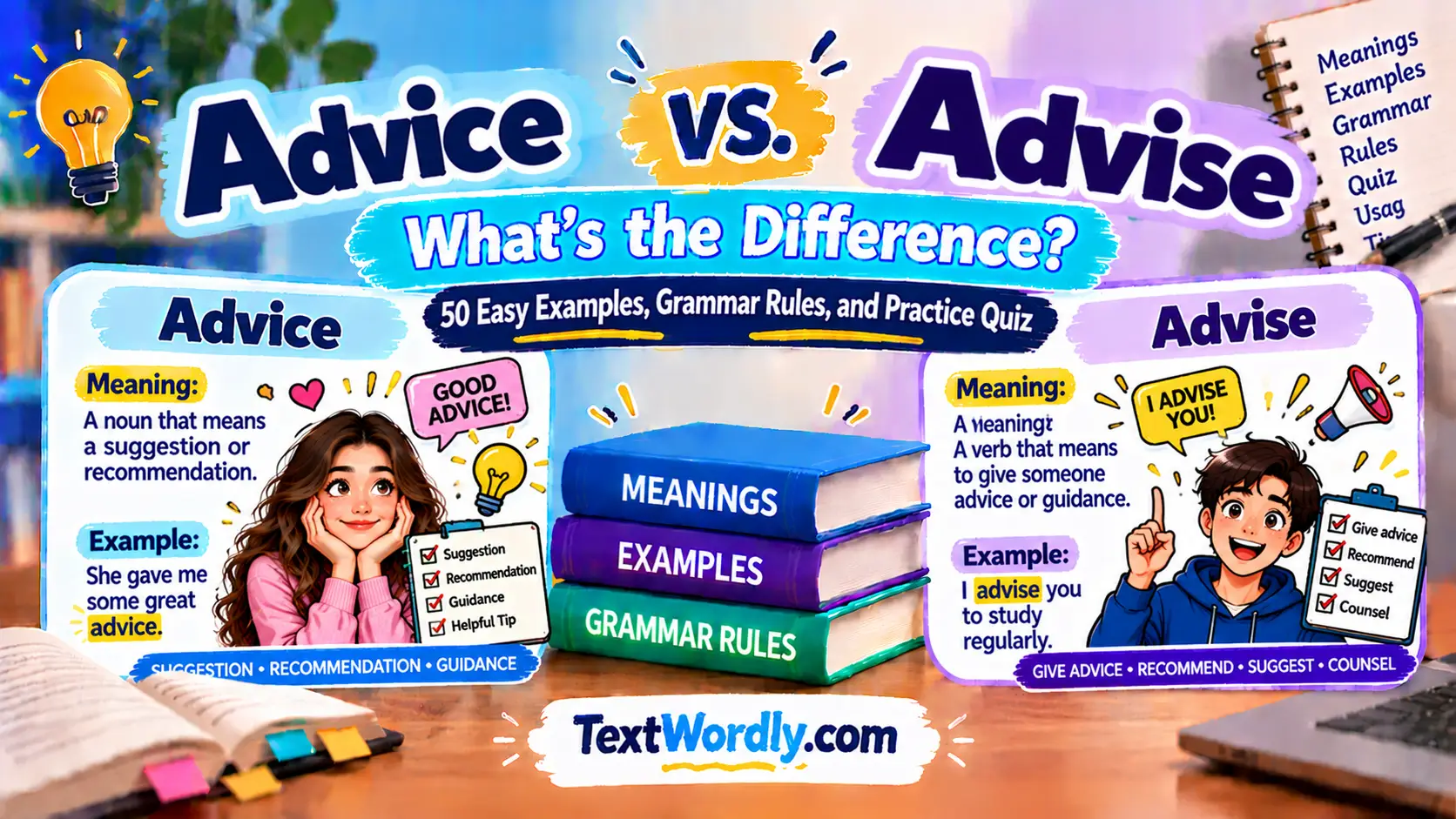
Advice vs Advise: The difference between advice and advise is simple: advice is a noun, while advise is a verb. Both words relate to giving suggestions or guidance, but they work differently in a sentence.
For example:
- Advice: My teacher gave me helpful advice.
- Advise: My teacher advised me to study.
The first sentence names the guidance. The second describes the action of giving it.
These words also sound slightly different. Advice ends with an S sound, while advise ends with a Z sound.
Below, you’ll find 50 practical examples, simple grammar rules, pronunciation tips, common mistakes, and a short quiz to help you choose the correct word.
1. Advice vs Advise: Quick Answer
Advice means a suggestion or recommendation about what someone should do.
Advise means to give that suggestion or recommendation.
| Feature | Advice | Advise |
|---|---|---|
| Part of speech | Noun | Verb |
| Meaning | Guidance or recommendation | To give guidance |
| Pronunciation | /ədˈvaɪs/ | /ədˈvaɪz/ |
| Common phrase | Give advice | Advise someone |
| Example | I need advice. | Please advise me. |
The Easiest Rule
Ask yourself:
Am I talking about the suggestion itself? Use advice.
Am I describing someone giving a suggestion? Use advise.
Remember: Advice = Noun. Advise = Verb.
2. What Does Advice Mean?
Advice is a noun that means guidance, recommendations, or suggestions intended to help someone make a decision.
You might receive advice from a friend, teacher, doctor, parent, or professional.
Common Uses of Advice
- Good advice
- Helpful advice
- Professional advice
- Medical advice
- Financial advice
- A piece of advice
Examples
“Your advice helped me make a decision.”
“I need some advice about my new job.”
Important: Advice is an uncountable noun in standard American English. We say some advice or a piece of advice, not an advice.
3. What Does Advise Mean?
Advise is a verb meaning to recommend, suggest, guide, or sometimes formally inform someone.
It describes an action rather than a thing.
Common Uses of Advise
- Advise someone to do something
- Advise someone on a topic
- Advise against an action
- Advise caution
- Advise someone of a change
Examples
“The doctor advised her to rest.”
“The consultant advises small businesses.”
“We advise caution during severe weather.”
In formal communication, advise can also mean inform.
Example: “Please be advised that the office will close early.”
4. Advice vs Advise: Key Differences
Although these words share a related meaning, their grammatical roles are different.
| Grammar Question | Advice | Advise |
|---|---|---|
| Is it a noun? | Yes | No |
| Is it a verb? | No | Yes |
| Can it follow some? | Yes | Not in the same noun pattern |
| Can it take a past-tense form? | No | Yes — advised |
| Can it describe an action? | Not directly | Yes |
Compare Two Sentences
“She gave me advice about studying.”
“She advised me to study.”
Both are correct. The first uses a noun, while the second uses a verb.
Writing tip: Changing advice to advise often requires changing the sentence structure, not just replacing one letter.
5. 50 Advice vs Advise Examples in Sentences
These 50 examples demonstrate how both words work in everyday American English.
Everyday Conversations
- My friend gave me useful advice.
- I advise you to leave early.
- Her advice made the decision easier.
- He advised me to stay calm.
- Thank you for your honest advice.
- I advise checking the weather first.
- That was excellent advice.
- She advised us against taking unnecessary risks.
- Can I ask you for some advice?
- My neighbor advised me to call ahead.
School and Education
- The teacher offered helpful advice.
- The counselor advised students about college applications.
- I followed my tutor’s advice.
- Our professor advised us to revise the essay.
- His study advice improved my routine.
- The librarian advised us to use reliable sources.
- Students often seek career advice.
- She advised me on choosing classes.
- The principal shared practical advice.
- The instructor advised taking detailed notes.
Work and Business
- The manager gave the team useful advice.
- Consultants advise businesses on strategy.
- We requested professional advice.
- The supervisor advised us to review the contract.
- Her leadership advice was valuable.
- The accountant advised the owner about expenses.
- I appreciate your business advice.
- The company advised customers of the delay.
- His interview advice helped me prepare.
- The director advised against rushing the launch.
Health and Wellness
- Seek qualified medical advice when appropriate.
- The doctor advised him to rest.
- Her fitness advice was easy to follow.
- The nurse advised the patient to drink water.
- I asked for nutrition advice.
- Health professionals often advise regular exercise.
- The pharmacist offered medication advice.
- The physician advised her to follow the prescribed plan.
Money, Travel, and Technology
- I need budgeting advice.
- The financial planner advised us about potential risks.
- His travel advice saved us time.
- The guide advised visitors to arrive early.
- The technician gave me practical advice.
- Experts advise using strong passwords.
- I followed the support team’s advice.
- The agent advised us to compare prices.
- She shared some helpful shopping advice.
- The mechanic advised replacing the worn tires.
- That was the best advice I received all week.
- The lawyer advised the client to review the agreement.
What These Examples Teach
Notice that advice frequently appears after verbs such as give, seek, follow, and offer.
Advise appears as the action word, often followed by a person, an infinitive, or an -ing form.
6. When to Use Advice Correctly
Use advice when naming guidance or recommendations.
It commonly appears in these sentence patterns:
| Pattern | Example |
|---|---|
| Give advice | She gave me advice. |
| Ask for advice | I asked for advice. |
| Follow advice | He followed her advice. |
| Seek advice | They sought legal advice. |
| Offer advice | The teacher offered advice. |
Good Advice vs Good Advise
The correct phrase is good advice because good describes a noun.
Correct: “That is good advice.”
Incorrect: “That is good advise.”
A useful test is to replace advice with guidance. If the sentence still makes sense, you probably need the noun.
7. When to Use Advise Correctly
Use advise when describing the act of giving guidance.
Several sentence patterns are especially common.
Advise Someone to Do Something
“The coach advised us to practice.”
Advise Doing Something
“I advise checking the instructions.”
Advise Someone on or About Something
“She advises clients on retirement planning.”
Advise Against Something
“The doctor advised against strenuous exercise.”
Advise That + Clause
“The committee advised that additional testing be completed.”
Advise Someone of Something
“The company advised customers of the schedule change.”
Grammar tip: Avoid “I advise you going.” A more natural and standard construction is “I advise you to go.”
8. Why Advice Is Uncountable
One of the most common English grammar mistakes is treating advice as a countable noun.
In standard American English, advice does not normally take a plural -s or an indefinite article directly.
| Incorrect | Correct |
|---|---|
| An advice | A piece of advice |
| Two advices | Two pieces of advice |
| Many advices | A lot of advice |
| Give me an advice | Give me some advice |
| These advices are helpful | This advice is helpful |
How to Count Recommendations
Use piece or pieces when you need to specify a number.
“She gave me one piece of advice.”
“He shared three pieces of advice.”
You can also use the countable noun suggestion:
“She gave me three suggestions.”
9. Advice vs Advise Pronunciation
The pronunciation difference is small but important.
Advice
/ədˈvaɪs/
S sound
Noun
Advise
/ədˈvaɪz/
Z sound
Verb
Both words are normally stressed on the second syllable.
Easy Pronunciation Practice
Say these sentences aloud:
“That is good advice.”
“I advise you to wait.”
The final sound in advice is voiceless /s/. The final sound in advise is voiced /z/.
10. Advice vs Advise in School and Academic Writing
Students use both words in assignments, essays, research discussions, and emails to instructors.
Examples
- “The professor gave useful advice about the assignment.”
- “The professor advised us to revise our drafts.”
- “Students should seek advice before choosing a major.”
- “The advisor advised the student on course selection.”
Academic Writing Tip
If the sentence describes a recommendation, use advice.
If it describes someone making that recommendation, use advise.
Compare:
“The researcher’s advice was helpful.”
“The researcher advised the team.”
This distinction also applies to formal academic writing.
11. Advice vs Advise in Professional Emails
Business emails frequently use both words, particularly when asking for guidance or communicating official information.
Is “Please Advise” Correct?
Yes. Please advise is grammatically correct.
However, it can sound vague or abrupt when used alone.
A clearer alternative is:
“Could you please advise me on the next steps?”
What Does “Please Be Advised” Mean?
Please be advised is a formal expression meaning please be informed.
Example:
“Please be advised that the meeting has been rescheduled.”
Professional Email Comparison
| Expression | Meaning |
|---|---|
| Please advise | Please provide guidance |
| I need your advice | I need your recommendation |
| Please be advised | Please be informed |
| Thank you for your advice | Thank you for your guidance |
Use the expression that best matches your intended meaning.
12. Advice, Advised, Advises, and Advising
Because advise is a verb, it changes form depending on tense and sentence structure.
| Word | Grammar Role | Example |
|---|---|---|
| Advice | Noun | Her advice helped me. |
| Advise | Base verb | I advise caution. |
| Advises | Present tense | She advises clients. |
| Advised | Past tense | He advised me yesterday. |
| Advising | Present participle | They are advising students. |
Common Confusion
Incorrect: “She advice me yesterday.”
Correct: “She advised me yesterday.”
Incorrect: “He gives good advise.”
Correct: “He gives good advice.”
Remember: Advice is never the past tense of advise.
13. Common Advice vs Advise Mistakes
These errors appear frequently in student writing and professional communication.
| Incorrect Sentence | Correct Sentence |
|---|---|
| Please advice me. | Please advise me. |
| She gave me good advise. | She gave me good advice. |
| I need an advice. | I need some advice. |
| He advice students every day. | He advises students every day. |
| They advised me helpful. | They gave me helpful advice. |
| Can you give me two advices? | Can you give me two pieces of advice? |
Quick Grammar Checklist
Before choosing the word, ask:
- Is it a suggestion or guidance? Choose advice.
- Is someone recommending or informing? Choose advise.
- Is the action in the past? Consider advised.
- Am I counting recommendations? Use pieces of advice.
14. Memory Tricks and Common Expressions
You can remember the difference with two simple associations.
AdviCe = Concept: The recommendation itself.
AdviSe = Suggest: The action of recommending.
Common Expressions
| Advice Expressions | Advise Expressions |
|---|---|
| Give advice | Advise someone |
| Follow advice | Advise caution |
| Ask for advice | Advise against |
| Seek professional advice | Advise someone to act |
| A piece of advice | Advise someone on a topic |
Advice vs Suggestion
Advice often refers to guidance intended to help someone make a decision.
A suggestion may be a recommendation, idea, or possible option.
Both words can overlap in meaning, but suggestion is countable while advice is generally uncountable.
15. Advice vs Advise Practice Quiz
Choose the correct word to complete each sentence.
1. My teacher gave me useful ______. A. advice B. advise
2. I ______ you to read the instructions. A. advice B. advise
3. She ______ me to apply for the scholarship yesterday. A. advice B. advised
4. Can you give me a piece of ______? A. advice B. advise
5. The counselor ______ students about their courses. A. advices B. advises
6. The manager is ______ the team on the new policy. A. advising B. advicing
Answer Key With Explanations
| Question | Answer | Explanation |
|---|---|---|
| 1 | A — advice | The sentence needs a noun meaning guidance. |
| 2 | B — advise | The sentence needs a verb meaning recommend. |
| 3 | B — advised | The action happened yesterday, so the past tense is needed. |
| 4 | A — advice | A piece of advice is the correct noun phrase. |
| 5 | B — advises | Third-person singular present tense of advise. |
| 6 | A — advising | The correct -ing form of advise is advising. |
Score guide: Six correct answers means you understand the main difference. If you missed a question, review the noun and verb patterns before trying again.
16. Advice vs Advise FAQs
1. What is the main difference between advice and advise?
Advice is a noun meaning guidance or a recommendation. Advise is a verb meaning to recommend, guide, or inform someone.
2. Is it “please advice” or “please advise”?
The correct phrase is please advise because advise is a verb.
Example: “Please advise me on the next steps.”
3. Is it “good advice” or “good advise”?
The correct expression is good advice. The adjective good modifies the noun advice.
4. Can I say “an advice”?
No. In standard American English, advice is uncountable. Say a piece of advice or some advice instead.
5. Is it “advise me” or “advice me”?
Use advise me because the sentence requires a verb.
Example: “Could you advise me about the application?”
6. What is the past tense of advise?
The past tense of advise is advised.
Example: “My teacher advised me to practice.”
7. Can advice be used as a verb?
In standard contemporary American English, advice is a noun, not a verb. Use advise when describing the action of giving guidance.
8. How can I remember advice vs advise?
Remember Advice = Noun and Advise = Verb. You can also listen for the final /s/ sound in advice and the /z/ sound in advise.
Final Takeaway
The difference between advice and advise depends on grammatical function.
Advice is the recommendation you receive or give. Advise is the action of recommending or informing.
If you’re naming guidance, choose advice. If you’re describing someone giving guidance, choose advise.