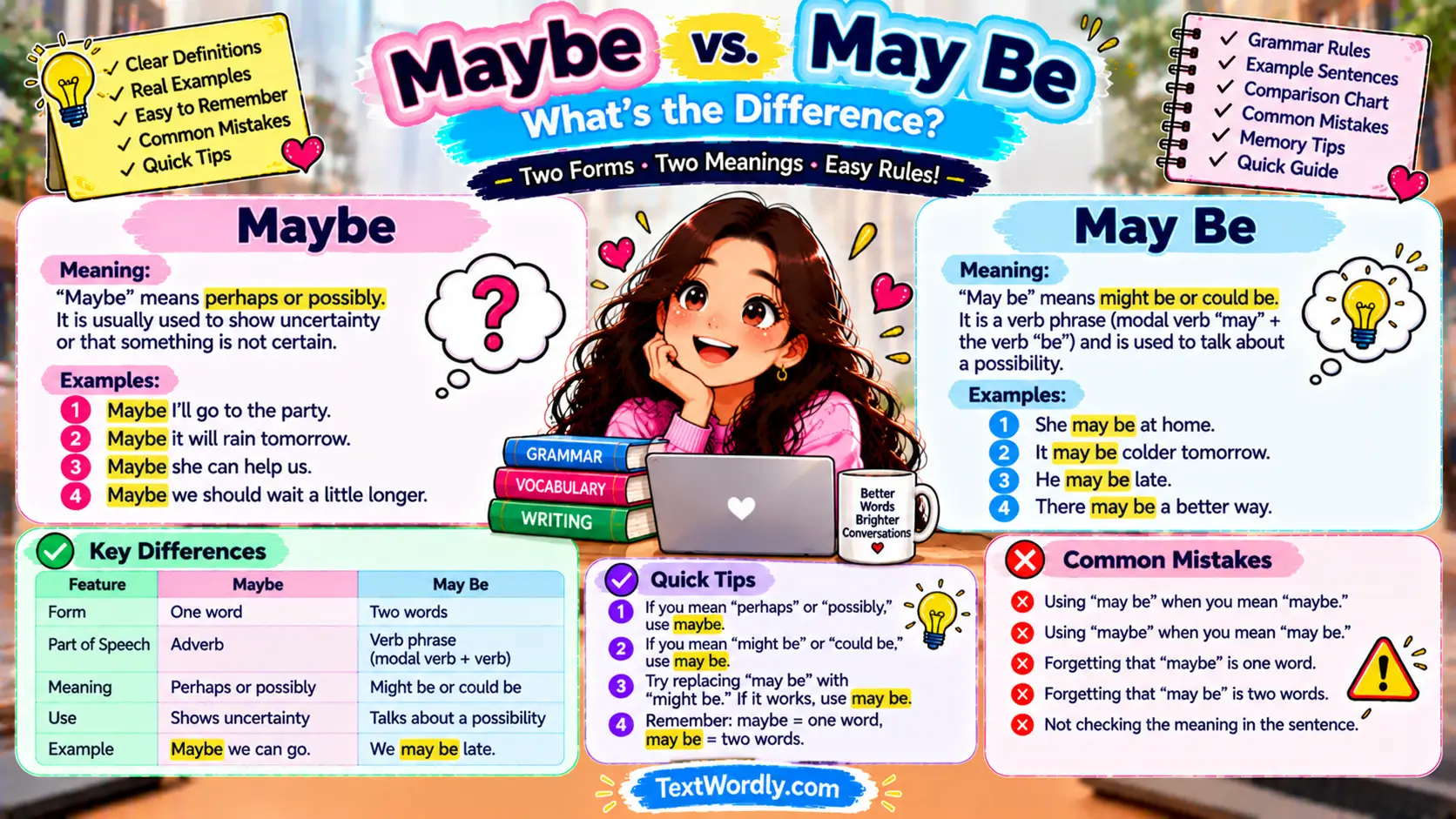
Maybe vs May Be: Have you ever wondered whether to write maybe or may be? These expressions sound the same and both express possibility, but they have different grammatical functions.
Maybe is an adverb meaning perhaps or possibly. May be is a verb phrase consisting of the modal verb may and the base verb be.
For example, “Maybe she’s tired” and “She may be tired” communicate similar ideas. However, their sentence structures are different.
Understanding maybe vs may be helps you avoid common spelling mistakes and write more naturally in emails, conversations, school assignments, and professional American English.
QUICK ANSWER
Maybe (one word): An adverb meaning perhaps or possibly.
May be (two words): A verb construction expressing that something is possible.
| Maybe | May Be |
|---|---|
| Maybe she’ll call. | She may be busy. |
| Maybe it’s raining. | It may be raining. |
| Maybe we should wait. | There may be a delay. |
TL;DR: Use maybe when you can replace it with perhaps. Use may be when may is a modal verb followed by be. Remember: maybe is one word, while may be is two.
1. What Does Maybe Mean?
Maybe is an adverb that means perhaps or possibly.
It introduces uncertainty about an action, situation, or idea.
Examples:
- Maybe I’ll call tomorrow.
- Maybe she forgot her keys.
- Maybe we’ll visit the museum.
The word does not express certainty. It simply suggests that something is possible.
2. What Does May Be Mean?
May be consists of two separate verbs.
- May: A modal verb expressing possibility.
- Be: The base form of the verb be.
Examples:
- She may be tired.
- The answer may be correct.
- They may be ready.
The phrase often has a meaning similar to might be.
3. Maybe vs May Be: Key Differences
The difference is grammatical rather than simply stylistic.
| Feature | Maybe | May Be |
|---|---|---|
| Spelling | One word | Two words |
| Grammar | Adverb | Modal verb + be |
| Meaning | Perhaps or possibly | Might be |
| Example | Maybe he’s right. | He may be right. |
| Replacement | Perhaps | Might be |
Memory trick: Maybe = perhaps. May be = might be.
4. When Should You Use Maybe?
Use maybe when you want to introduce a possibility or uncertain suggestion.
Examples:
- Maybe we should leave early.
- Maybe the store is closed.
- Maybe I’ll work from home tomorrow.
It often appears at the beginning of a sentence, but it can appear elsewhere.
Example: We could meet on Friday, maybe.
5. When Should You Use May Be?
Use may be when a sentence needs the modal verb may followed by be.
Examples:
- The package may be late.
- He may be at work.
- This may be the best solution.
The construction also works with different verb forms.
Example: She may be sleeping.
Here, may be sleeping expresses a possible ongoing action.
6. Maybe Meaning Perhaps
The easiest way to recognize maybe is to replace it with perhaps.
Compare:
- Maybe she’s busy.
- Perhaps she’s busy.
Another example:
- Maybe we’ll win.
- Perhaps we’ll win.
Both versions express uncertainty.
This substitution is a useful proofreading test, although the words can differ slightly in tone.
7. May Be Meaning Might Be
May be often means something similar to might be.
Examples:
- She may be sick.
- She might be sick.
- The answer may be wrong.
- The answer might be wrong.
Both expressions communicate possibility.
However, may and might are not always interchangeable in every grammatical context.
8. Maybe at the Beginning or End of a Sentence
Maybe commonly appears at the beginning of a sentence.
Examples:
- Maybe I’ll call later.
- Maybe we should wait.
- Maybe she knows the answer.
It can also appear at the end, especially in casual conversation.
Example: We could try again tomorrow, maybe.
A comma can help separate a sentence-final maybe when it functions as an afterthought.
9. Maybe as a Standalone Answer
Maybe can be a complete response in conversation.
Example:
“Are you coming to the party?”
“Maybe.”
This answer expresses uncertainty without repeating the entire sentence.
Other examples:
- “Will it rain?” — “Maybe.”
- “Can we meet tomorrow?” — “Maybe.”
- “Is she coming?” — “Maybe.”
This use is natural in everyday American English.
10. There May Be and May Not Be
May be also appears in constructions that express possible existence or absence.
Examples:
- There may be a delay.
- There may be another solution.
- The information may not be accurate.
The words may and be can be separated by another word.
Example: She may still be waiting.
This shows that the verb phrase is more flexible than a simple subject + may be pattern.
11. May Be in Continuous and Passive Sentences
May be works with continuous and passive constructions.
Continuous Construction
Use may be followed by an -ing verb.
Examples:
- She may be working late.
- They may be waiting outside.
- It may be raining.
Passive Construction
Use may be followed by a past participle.
Examples:
- The event may be postponed.
- The package may be delivered tomorrow.
- The rules may be updated.
These constructions express possible actions or situations.
12. Maybe vs Perhaps vs Possibly
All three words express uncertainty, but their usage and tone can differ.
| Word | Common Use | Example |
|---|---|---|
| Maybe | Everyday conversation | Maybe she’s right. |
| Perhaps | Slightly more formal | Perhaps she’s right. |
| Possibly | Emphasizes possibility | She could possibly be right. |
Maybe is common in casual American English.
Perhaps often sounds more formal, while possibly can appear in several grammatical positions.
13. May Be vs Might Be
May be and might be both express possibility.
Examples:
- It may be difficult.
- It might be difficult.
- She may be late.
- She might be late.
Might can sometimes sound more tentative, but it does not always mean a lower probability.
Choose the expression that best fits your intended meaning and tone.
14. Common Maybe vs May Be Mistakes
The most common errors happen when writers use the adverb maybe where a verb phrase is required.
| Incorrect | Correct |
|---|---|
| She maybe tired. | She may be tired. |
| May be we’ll leave early. | Maybe we’ll leave early. |
| The package maybe late. | The package may be late. |
| Maybe the answer correct. | Maybe the answer is correct. |
| He maybe working today. | He may be working today. |
Quick test: Replace maybe with perhaps or may be with might be. The expression that fits the sentence usually identifies the correct spelling.
15. Maybe vs May Be Examples and Practice Quiz
Choose the correct expression in each sentence.
Test Your Grammar0 of 6 answered
1. ___ we’ll visit the park tomorrow.MaybeMay be
2. She ___ busy right now.maybemay be
3. ___ I should call him later.MaybeMay be
4. There ___ a problem with the system.maybemay be
5. ___ they forgot the meeting.MaybeMay be
6. The meeting ___ postponed.maybemay be
16. Maybe vs May Be FAQs and Final Thoughts
Frequently Asked Questions
What is the difference between maybe and may be?
Maybe is an adverb meaning perhaps. May be is a verb phrase expressing possibility.
Is maybe one word or two?
Maybe is one word when it means perhaps.
Is may be grammatically correct?
Yes. It is correct when may functions as a modal verb followed by be.
Is it “maybe she’s right” or “she may be right”?
Both are correct. They communicate similar ideas using different grammatical structures.
Can maybe start a sentence?
Yes. “Maybe we’ll go tomorrow” is natural and correct.
Can maybe be a complete answer?
Yes. For example, “Are you coming?” — “Maybe.”
Does may be mean might be?
Often, yes. Both express possibility, although their tone and context can differ.
How can I remember the difference?
Replace maybe with perhaps and may be with might be. Check which expression fits the sentence.
Final Thoughts
The difference between maybe vs may be becomes easy once you understand their grammatical functions.
Maybe = Perhaps (adverb).
May be = Might be (verb phrase).
Use maybe to introduce uncertainty or make a tentative suggestion. Use may be when the sentence needs the modal verb may followed by be.