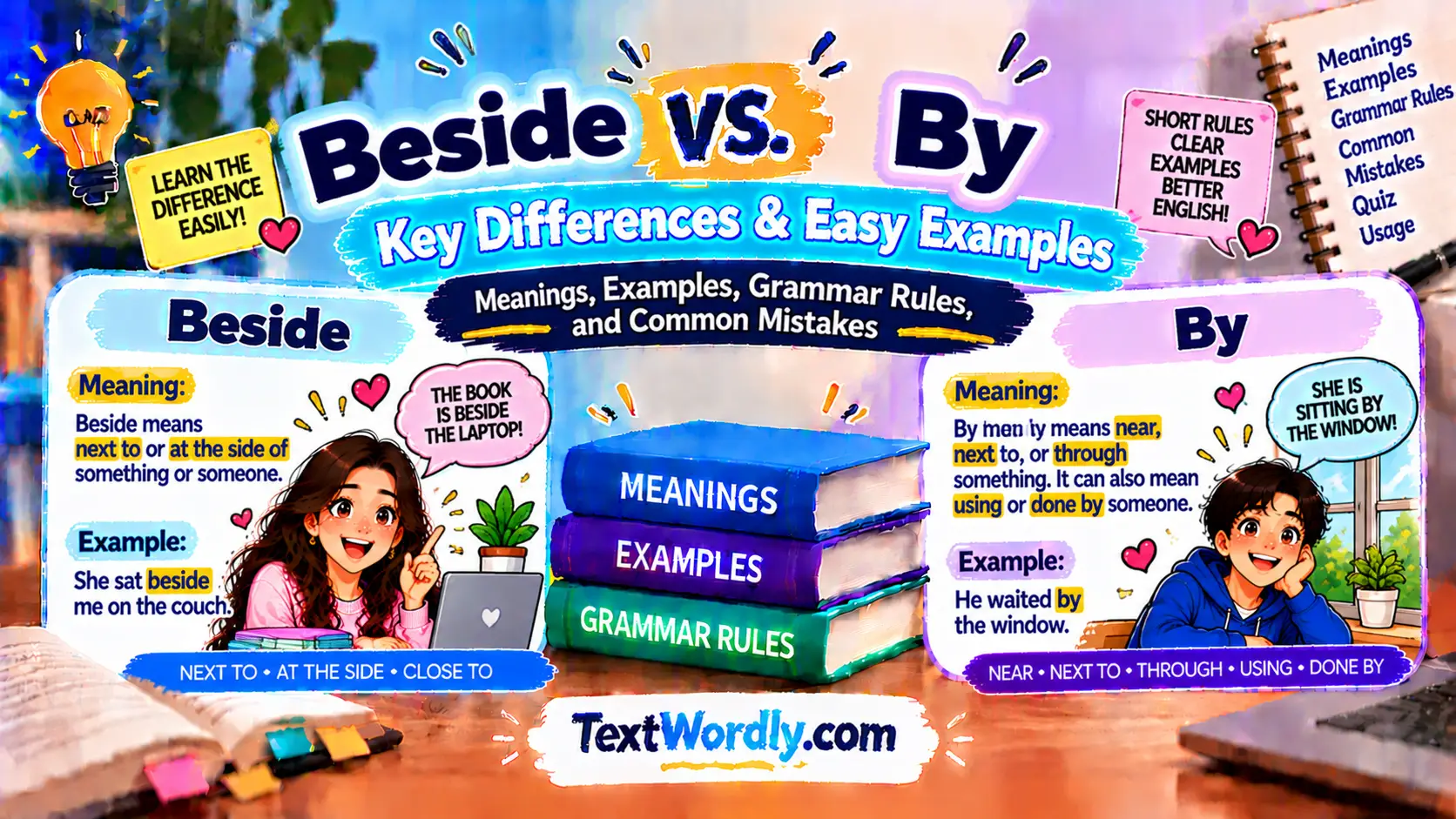
Beside vs By: Have you ever wondered whether to use beside or by in a sentence? These two small English words often describe location, but they do not always mean the same thing.
For example, you can say, “She sat beside me” or “She sat by me.” Both sentences are correct. However, you cannot say “Finish your homework beside Friday” because beside does not express a deadline.
The main difference between beside vs by is simple: beside usually means next to or at the side of, while by can mean near, no later than, through a particular method, or performed by someone.
Understanding these differences will help you write more naturally and avoid common preposition mistakes.
This guide explains the meanings, grammar rules, location differences, time expressions, and everyday uses of beside and by with clear examples and practical exercises.
QUICK ANSWER
Beside usually means directly next to someone or something. By can also mean next to or near, but it has several additional meanings involving deadlines, methods, transportation, measurements, and passive voice.
| Beside | By |
|---|---|
| She sat beside me. | She sat by me. |
| The lamp is beside the bed. | The lamp is by the bed. |
| Emphasizes being next to something | Can mean next to or nearby |
| Does not express deadlines | Finish the work by Friday. |
TL;DR — Beside vs By
- Beside usually means next to or at the side of.
- By can mean near, next to, before a deadline, or through a method.
- Both words can describe physical location.
- By is used for deadlines, transportation, methods, and passive voice.
- Beside can also mean in comparison with.
- Besides means in addition to and should not be confused with beside.
- For deadlines, remember the difference between by, before, and until.
1. What Does Beside Mean?
Beside is a preposition that usually means next to or at the side of someone or something.
It describes a close physical position.
Examples
- She sat beside her friend.
- The chair is beside the table.
- He stood beside the door.
- A small garden grows beside the house.
In these sentences, beside tells us where someone or something is located.
Beside Can Also Mean “In Comparison With”
Beside sometimes means compared with.
Example: The old building looks small beside the new skyscraper.
Here, beside creates a comparison between two buildings.
This meaning is less common than the physical-location meaning, but it is grammatically correct.
2. What Does By Mean?
By is a versatile English word that commonly functions as a preposition and can also function as an adverb.
It has several meanings depending on the context.
Examples
- She stood by the window. — Location
- Finish your homework by Monday. — Deadline
- I traveled by train. — Transportation
- The book was written by Sarah. — Authorship
- He paid by credit card. — Method
Unlike beside, by is not limited to describing position.
It can explain when something must happen, how an action is completed, or who performs an action.
3. Beside vs By: Key Differences
The biggest difference between beside and by is their range of meanings.
Beside mainly describes position or comparison. By has many additional grammatical functions.
| Feature | Beside | By |
|---|---|---|
| Next to someone | Yes | Yes |
| Near something | Usually directly next to | Yes |
| Deadline | No | Yes |
| Method | No | Yes |
| Transportation | No | Yes |
| Passive voice agent | No | Yes |
| Comparison | Yes | Sometimes, in different constructions |
| Measurement | No | Yes |
Compare These Sentences
Beside: The dog slept beside the sofa.
By: The dog slept by the sofa.
Both are correct.
However:
Correct: Please arrive by 8 AM.
Incorrect: Please arrive beside 8 AM.
Only by expresses a deadline.
4. When Should You Use Beside?
Use beside when you want to describe someone or something directly next to another person or object.
Everyday Examples
- My sister sat beside me.
- The keys are beside the laptop.
- He parked his bicycle beside the wall.
- The restaurant stands beside the library.
Writing Tip
Beside is useful when you want readers to picture a clear position.
Example: The child stood beside her mother.
This sentence suggests that the child was at her mother’s side.
You can also use beside for comparisons, such as describing one object as small beside another.
5. When Should You Use By?
Use by when you want to express location, time, method, transportation, agency, or measurement.
Location
The car is parked by the gate.
Deadline
Submit your assignment by Friday.
Method
She contacted me by email.
Transportation
We traveled by bus.
Passive Voice
The cake was made by my grandmother.
Measurement
The room measures ten feet by twelve feet.
Because by has several meanings, the surrounding words determine how readers understand it.
6. Beside vs By for Location
Both words can describe physical location, but they may suggest slightly different positions.
Beside generally emphasizes being directly next to something.
By can mean directly next to or simply nearby.
Examples
Beside: The chair is beside the desk.
By: The chair is by the desk.
The first sentence emphasizes that the chair is next to the desk.
The second can describe a nearby position without emphasizing the exact arrangement.
Location Comparison
| Sentence | Meaning |
|---|---|
| She stood beside the car. | She stood next to the car. |
| She stood by the car. | She stood next to or near the car. |
| The lamp is beside the bed. | The lamp is directly next to the bed. |
| The lamp is by the bed. | The lamp is next to or near the bed. |
This difference is a general tendency, not an absolute rule.
In many everyday situations, both words are interchangeable.
7. Beside vs By vs Near vs Next To
English uses several prepositions to describe location.
Four common choices are beside, by, near, and next to.
Quick Comparison
| Word | Meaning | Example |
|---|---|---|
| Beside | Directly next to | The chair is beside the table. |
| By | Next to or near | She stood by the window. |
| Near | Close to, not necessarily adjacent | The school is near my house. |
| Next to | Immediately adjacent | The bank is next to the pharmacy. |
Important Difference
Near does not necessarily mean immediately next to.
For example:
“The hospital is near the school.”
The hospital might be a short distance away.
However:
“The hospital is next to the school.”
This suggests that the two buildings are immediately adjacent.
Easy Rule
Use beside or next to when you want to emphasize immediate adjacency.
Use near when you mean close without specifying an exact position.
Use by when you want a flexible expression of proximity.
8. By for Time: By vs Before vs Until
One important use of by is to express a deadline.
It means no later than a particular time.
Examples
- Finish the report by Friday.
- Please arrive by 9 AM.
- Submit the form by tomorrow.
- The package should arrive by Monday.
By vs Before vs Until
These words express different time relationships.
| Word | Meaning | Example |
|---|---|---|
| By | No later than a time | Finish the report by Friday. |
| Before | Earlier than a time | Finish the report before Friday. |
| Until | Continue up to a time | Work on the report until Friday. |
Important Example
By Friday: Friday is the latest permitted day, unless a more specific time is stated.
Before Friday: Complete the task earlier than Friday.
Until Friday: Continue an action or situation up to Friday.
Beside cannot replace by in deadline expressions.
9. By for Methods and Transportation
By commonly explains how something happens.
It can introduce a method, a means of communication, or a form of transportation.
Method
She improved her English by practicing every day.
Communication
He sent the documents by email.
Transportation
We traveled by train.
Payment
She paid by credit card.
By + -ing
A useful grammar pattern is:
By + verb ending in -ing
Examples:
- You can learn new words by reading books.
- She improved her writing by practicing daily.
- He saved money by cooking at home.
This construction explains the method used to achieve a result.
10. By in Passive Voice and Measurements
By is important in passive sentences because it can identify who or what performs an action.
Active vs Passive Voice
Active: Sarah wrote the letter.
Passive: The letter was written by Sarah.
The meaning remains similar, but the sentence structure changes.
More Examples
- The painting was created by an artist.
- The building was designed by an architect.
- The report was prepared by the research team.
By for Measurements
By can also connect dimensions.
Example: The room measures ten feet by twelve feet.
By for Amounts
By can express how much something changes.
Example: Prices increased by 10%.
Here, by identifies the amount of the increase, not the final price.
These meanings are not interchangeable with beside.
11. Beside vs Besides: Common Confusion
A frequent English grammar mistake is confusing beside with besides.
Although the words look similar, their meanings are different.
Beside usually means next to.
Besides commonly means in addition to or apart from.
Examples
Beside: She sat beside her sister.
Besides: Besides English, she studies Spanish.
Comparison Table
| Word | Meaning | Example |
|---|---|---|
| Beside | Next to | The bag is beside the chair. |
| Besides | In addition to | Besides coffee, I like tea. |
| By | Near, through, or no later than | The book is by the lamp. |
Besides can also function as an adverb meaning moreover.
Example: I don’t want to go. Besides, it’s raining.
12. Common Expressions with Beside and By
Both words appear in useful English expressions.
Beside the Point
Means irrelevant to the main subject.
Example: Your comment is beside the point.
Beside Yourself
Means overwhelmed by strong emotion.
Example: She was beside herself with worry.
Side by Side
Means next to each other.
Example: The children walked side by side.
By the Way
Introduces additional information or changes the topic.
Example: By the way, I saw your brother yesterday.
By Yourself
Means alone or without help.
Example: Did you finish the project by yourself?
By Chance
Means accidentally or unexpectedly.
Example: We met by chance.
By Mistake
Means accidentally.
Example: I deleted the file by mistake.
Stand By
Can mean wait, remain ready, or support someone, depending on the context.
Example: Please stand by for further instructions.
These expressions show why beside and by cannot always replace each other.
13. Beside vs By in American English Writing
Both beside and by are common and correct in American English.
American speakers frequently use by in casual location descriptions.
Examples
- Sit by me.
- Leave the bag by the door.
- Stand by the window.
Beside is also natural, especially when describing a more specific position.
Examples
- She sat beside her brother.
- The notebook was beside the computer.
- He stood beside the teacher.
Formal Writing
Both words are appropriate in professional and academic contexts.
Beside: Position the sensor beside the main unit.
By: The samples were analyzed by the research team.
Neither word is automatically more formal. Choose the one that expresses the intended meaning.
14. Common Beside vs By Mistakes
Many mistakes happen when writers assume the words always mean the same thing.
| Incorrect | Correct | Reason |
|---|---|---|
| Finish it beside Friday. | Finish it by Friday. | Deadline |
| We traveled beside train. | We traveled by train. | Transportation |
| The book was written beside Sarah. | The book was written by Sarah. | Authorship |
| She paid beside card. | She paid by card. | Payment method |
| He sat besides me. | He sat beside me. | Directly next to |
Mistake: Confusing By and Before
By Friday includes Friday as the deadline in ordinary usage.
Before Friday means earlier than Friday.
Mistake: Confusing By and Until
Arrive by six means arrive no later than six.
Stay until six means remain there up to six.
Final Proofreading Checklist
- Does the sentence describe a location?
- Is the object directly next to another object?
- Are you expressing a deadline?
- Are you explaining a method?
- Are you identifying who performed an action?
- Did you accidentally use besides instead of beside?
Checking these points can prevent common grammar errors.
15. Beside vs By Examples and Practice Exercises
Let’s review the difference with everyday sentences.
School 🎓
The student sat beside the teacher.
Workplace 💼
Please send the report by Thursday.
Home 🏠
The lamp is beside the sofa.
Travel 🚆
We traveled by train.
Reading 📚
The novel was written by a famous author.
Practice Quiz
Test Your Grammar0 of 5 answered
1. Which word correctly completes: Finish your homework ___ Friday.besideby
2. Which sentence is correct?She sat beside her friend.She sat by her friend.Both sentences are correct.
3. Which word correctly completes: We traveled ___ bus.besideby
4. Which word means ‘in addition to’?besidebesidesby
5. Which sentence expresses a deadline that includes Friday?Finish before Friday.Finish by Friday.
16. Beside vs By FAQs and Final Thoughts
Frequently Asked Questions
What is the main difference between beside and by?
Beside usually means next to. By can mean next to or near, but it also expresses deadlines, methods, transportation, and agency.
Can beside and by be used interchangeably?
Yes, in many location sentences. However, they are not interchangeable when by expresses time, method, or agency.
Is beside more formal than by?
Not necessarily. Both words are appropriate in formal and informal English.
Does by mean next to?
Yes. By can mean next to or near something.
Can beside mean near?
Yes, but it generally emphasizes being directly next to or at the side of something.
Is it correct to say “sit by me”?
Yes. Both “Sit by me” and “Sit beside me” are grammatically correct.
What is the difference between beside and besides?
Beside means next to. Besides commonly means in addition to or apart from.
What does by Friday mean?
It means no later than Friday, with the precise deadline depending on the surrounding context.
Can beside express a deadline?
No. Use by when describing a deadline.
Which word should I use in American English?
Use beside when emphasizing direct adjacency. Use by for nearness, deadlines, methods, transportation, and agency.
Final Thoughts
Understanding beside vs by becomes easier once you recognize that the two words overlap in meaning mainly when describing location.
Beside usually means next to or at the side of something. It can also express comparison in certain contexts.
By can describe location, but it has several additional uses involving time, methods, transportation, measurements, and agency.