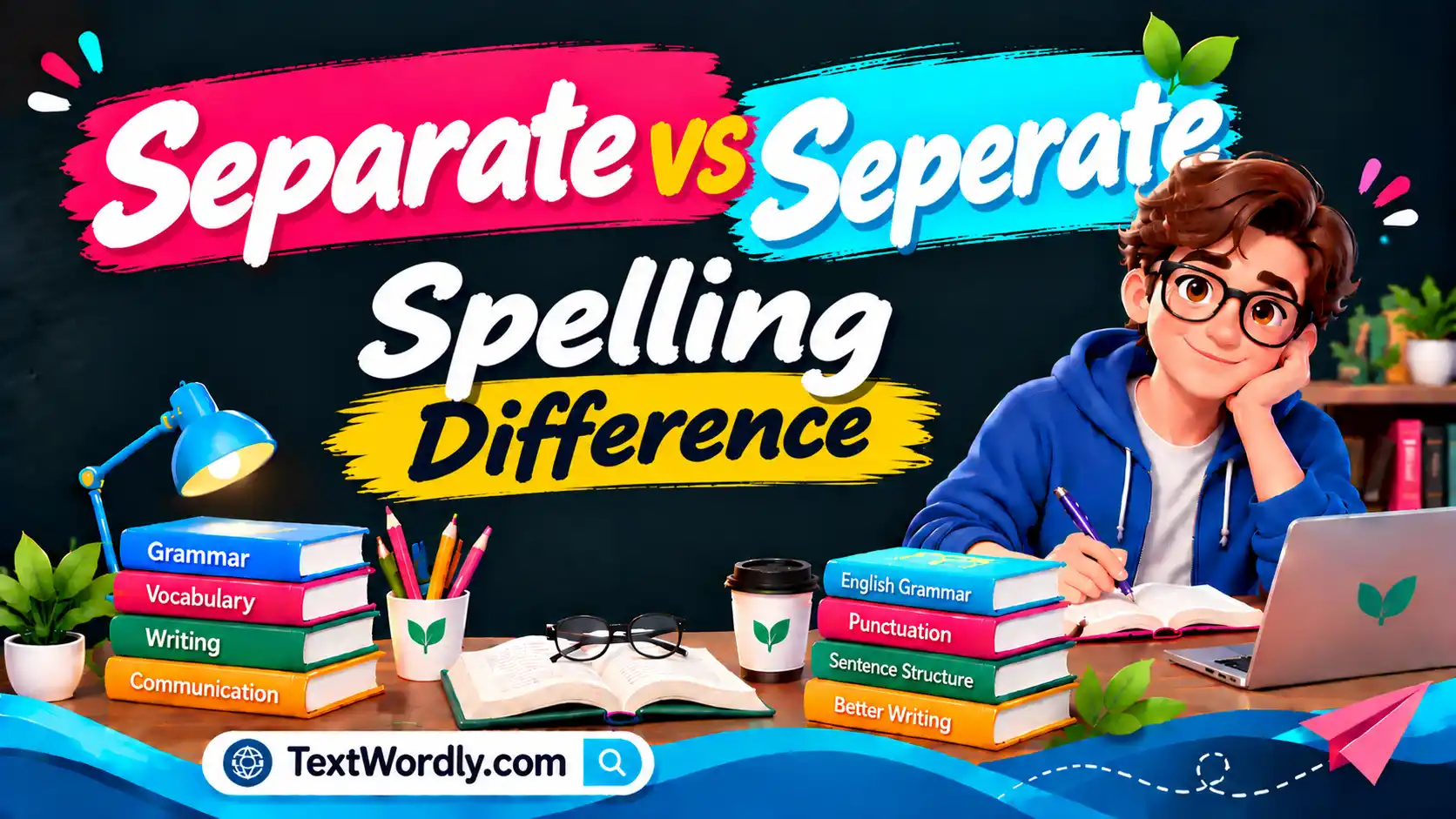
Learn why separate is the correct spelling and seperate is incorrect, with pronunciation clues, examples, common mistakes, and memory tips.
Separate vs seperate is a common spelling and usage question. One form is standard, while the other is a frequent misspelling. Learning the correct letter pattern and using a short memory test can make the choice much easier.
Separate vs Seperate: Which Spelling Is Correct?
Separate is the correct spelling. Seperate is incorrect. The common mistake happens because the first vowel sound can make the word feel like it should contain another e.
Why Separate Is Correct
The correct spelling is s-e-p-a-r-a-t-e. It contains an a in the middle: separate. Remembering that middle a can prevent the common misspelling seperate.
Separate Examples
- Please keep the two files separate.
- The teacher put the students into separate groups.
- We need a separate document for each project.
- The rooms have separate entrances.
- Keep raw and cooked foods separate.
Separate as an Adjective, Verb, and Noun
Separate can describe things that are apart: “separate rooms.” It can also be a verb: “Please separate the papers.” In some contexts, separate can function as a noun in the phrase “separate” or “separates,” but adjective and verb uses are much more common in everyday writing.
Common Separate Spelling Mistakes
The main mistake is writing seperate with an e where the correct word has an a. Pronunciation can contribute to the error because the middle vowel may not sound strongly in fast speech.
How to Remember Separate
Use the phrase “there is a rat in separate” as a memory aid: sep-a-rat-e. It is a playful spelling trick, not a definition, but it can help you remember the middle a.
Correct vs Incorrect Spelling
| Form | Status | Tip |
|---|---|---|
| separate | Correct | Use this form in standard writing. |
| seperate | Incorrect | Avoid this spelling. |
Common Mistakes to Avoid
- Choosing a spelling based only on pronunciation.
- Typing the word quickly without proofreading.
- Remembering a familiar misspelling from repeated exposure.
- Relying on a simple spelling rule without checking the actual word.
- Ignoring the word family or related forms.
Easy Proofreading Method
When you are unsure, slow down and look at the word letter by letter. Compare it with the correct form, then read the complete sentence. If the word has a related base form, use that relationship as an additional spelling clue.
Practice Sentences
- The writer checked the spelling before publishing.
- The student corrected the sentence during proofreading.
- The editor explained the correct word form.
- The final draft was clear and accurate.
- Regular practice makes spelling easier to remember.
- A dictionary can confirm an unfamiliar spelling.
American English Usage
This guide follows standard American English for general web writing. The spellings covered here are standard forms in American English. When writing professionally, consistency and careful proofreading help prevent repeated spelling errors.
Related Text Wordly Guides
Your vs You’re · Each vs Every · Good vs Well · Bring vs Take · Accept vs Except
Trusted Dictionary and Writing Resources
Merriam-Webster Dictionary · Cambridge Dictionary · Oxford Learner’s Dictionaries · Britannica Dictionary · Grammarly Writing Resources
Frequently Asked Questions
Which spelling should I use?
Use the standard form identified as correct in this guide. The alternative is a common misspelling.
Why do people make this mistake?
Pronunciation, typing habits, and repeated exposure to incorrect spellings can make the error easy to remember.
Can a memory trick help?
Yes. A short spelling pattern or related word can make the correct form easier to recall.
Should I use a dictionary?
Yes. A reputable dictionary can confirm spelling, meaning, pronunciation, and usage.
Separate vs Seperate in Everyday Writing
Separate is used often when describing things that are apart, divided, or handled individually. You may see it in instructions, business documents, school writing, and everyday conversation. The misspelling seperate is common because the middle vowel can be difficult to hear clearly.
More Separate Examples
- Please place each item in a separate folder.
- The two companies operate as separate businesses.
- We created separate lists for each department.
- The instructions are in a separate document.
- Keep the ingredients in separate containers.
- The students worked on separate projects.
Separate as a Verb
As a verb, separate means to divide, move apart, or cause things to become apart. For example, “Please separate the blue papers from the red papers.” The same spelling is used, but the grammatical role changes with the sentence.
Separate and Related Forms
Related forms include separated, separating, and separation. Seeing the word family can help reinforce the presence of the letter a in separate. It also helps you recognize the correct spelling when the word appears in a longer form.
Separate vs Seperate: Final Spelling Check
Remember the middle a: sep-a-rate. If you type seperate, pause and compare it with the correct form. A quick visual check can catch this error before it reaches a published article, email, or assignment.
Separate vs Seperate: Quick Practice
Try these examples: “Use a separate file,” “Keep the colors separate,” and “Please separate the documents.” The middle a remains visible in the correct spelling. If you see seperate, compare it directly with separate before continuing to write.
Reading the word in short phrases also helps. Common combinations include separate room, separate account, separate document, separate issue, and separate category. Repeated exposure to correct phrases makes the spelling more familiar.
Separate in Professional Writing
Separate is common in phrases such as separate document, separate account, separate section, separate category, and separate issue. These combinations appear often in business and web writing. Learning them as phrases reinforces the correct middle a.
When editing, remember that separate describes things that are apart or divides things into groups. The exact sentence meaning can help you confirm that you are using the word correctly.
Separate vs Seperate: A Reliable Memory Routine
Use the middle vowel as your main clue. The correct spelling is separate, with an a in the middle. Say the word slowly, look at the written form, and then compare it with the sentence. This routine helps when pronunciation makes the vowel difficult to hear.
Keep the memory phrase “a rat” in separate if it helps: sep-a-rat-e. The phrase is only a mnemonic, but it gives you a quick visual path to the correct spelling.
These checks are useful in school assignments, business documents, instructions, and web content. When the word appears, focus on its middle a and compare the spelling visually before publishing.
Conclusion
Knowing the correct spelling of separate vs seperate helps you write with greater accuracy and confidence. Focus on the letter pattern, meaning, and context rather than pronunciation alone. With regular proofreading and practice, the correct form becomes easier to remember.