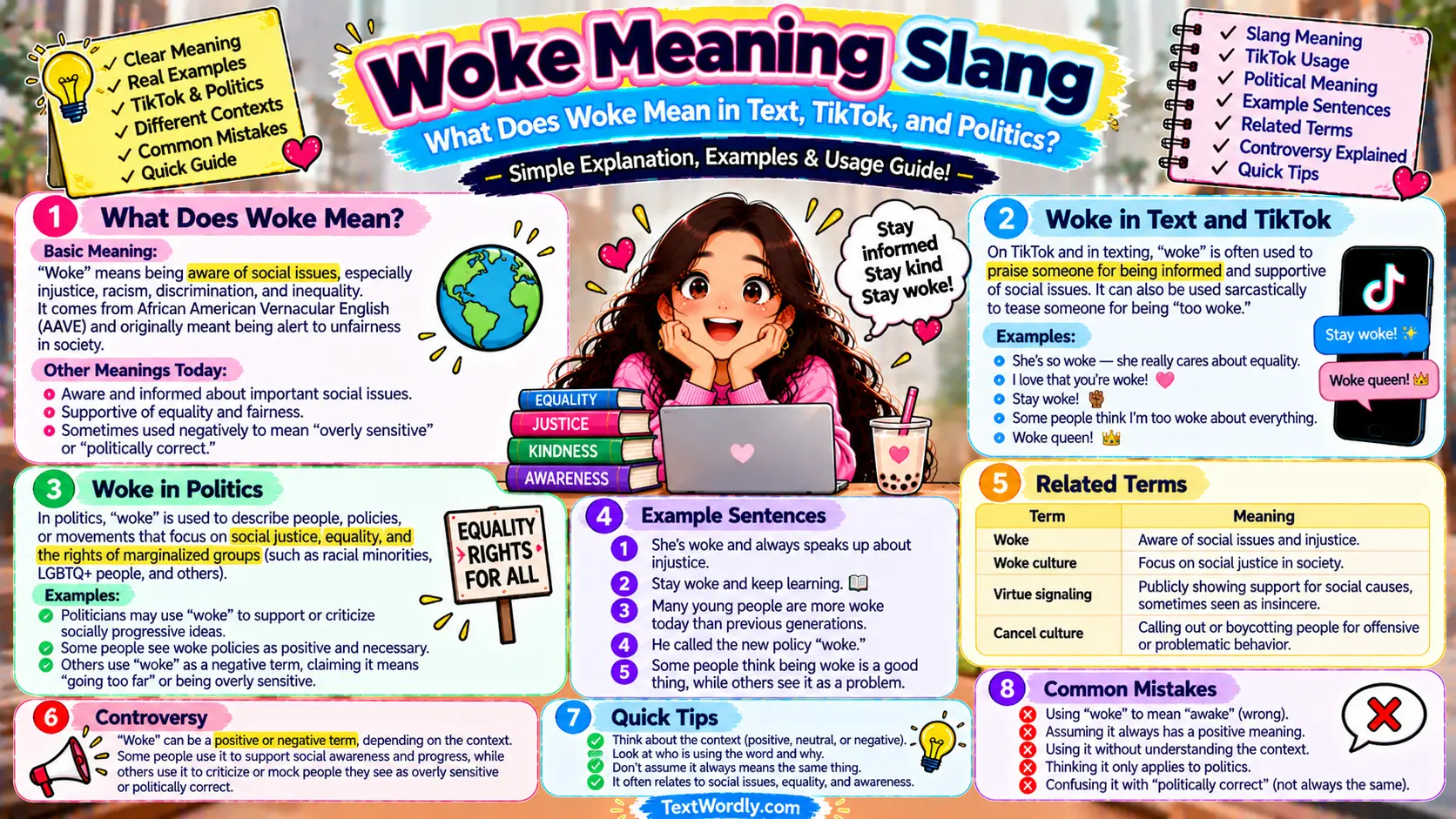
Woke Meaning Slang: Have you ever seen someone write “Stay woke! 👀” or describe a movie as “too woke” and wondered what they meant?
The word woke has changed significantly over time. Its meaning depends on the speaker, the situation, and whether it’s being used seriously or sarcastically.
Originally, woke meant being alert and aware, especially of racial injustice. Today, it can describe social awareness, but people also use it to criticize ideas they consider excessively progressive.
This guide explains the woke meaning in slang, its history, modern political uses, and real conversation examples in simple English.
QUICK ANSWER
Woke 👀 = Aware of social injustice, or a contested political label
Original meaning: Alert to injustice, particularly racism.
Positive use: Socially aware and concerned about inequality.
Negative use: Criticism of something perceived as excessively progressive.
“Stay woke”: Remain alert, informed, and aware.
TL;DR
Woke developed as an expression of alertness in African American English, particularly regarding racial injustice. Its use expanded through social movements and popular culture. Today, it may express praise, criticism, or sarcasm. Understanding the context is essential.
1. What Does Woke Mean in Slang?
In slang, woke means being aware of social problems, especially racism, discrimination, and inequality.
The word originally emphasized recognizing injustices that others might overlook.
For example:
“She’s woke about racial discrimination.”
This describes social awareness.
“That conversation helped me become more woke.”
The speaker became more informed about an issue.
However, the word also has a modern critical meaning. Some speakers use woke negatively when discussing progressive beliefs, institutions, or policies.
Neither meaning should automatically be assumed without considering the surrounding conversation.
2. What Does Woke Mean in Text Messages?
In texting, woke may communicate social awareness, criticism, or sarcasm.
Common Texting Examples 💬
| Text Message | Possible Meaning |
|---|---|
| “Stay woke 👀” | Stay aware |
| “She’s woke.” | She’s socially aware |
| “That’s so woke.” | Praise or sarcasm |
| “Get woke!” | Become more aware |
| “Too woke for me.” | Criticism |
| “I’m woke now.” | I understand something new |
Example Conversation
Alex: “I didn’t realize that policy affected people differently.”
Jordan: “Yeah, it’s important to stay woke.”
Jordan is encouraging awareness.
However, a message such as “Wow, so woke” might be sarcastic depending on the context.
3. Where Did the Word Woke Come From?
The slang meaning of woke developed within African American English (AAE).
The expression stay woke encouraged people to remain alert, including to racism and potential danger.
An important historical example appears in a 1938 recording by blues musician Lead Belly, who used stay woke while discussing the Scottsboro Boys case.
That recording documents an early use; it doesn’t establish that he invented the phrase.
A Brief Timeline
| Period | Development |
|---|---|
| Early 20th century | Woke used in African American speech |
| 1938 | Lead Belly’s documented stay woke usage |
| 2008 | Erykah Badu’s song “Master Teacher” features stay woke |
| 2010s | Wider visibility through racial-justice activism |
| 2020s | Increasingly used in political criticism and debate |
The word’s history is longer than social media.
4. What Does “Stay Woke” Mean?
“Stay woke” means remain alert, informed, and aware of what is happening.
Historically, it was closely associated with awareness of racial injustice.
Examples 👀
“Stay woke and know your rights.”
The speaker encourages awareness.
“Don’t ignore unfair treatment. Stay woke.”
The speaker encourages attention to discrimination.
Does Stay Woke Always Mean Politics?
No.
Sometimes it simply means “pay attention” or “don’t be fooled.”
However, its historical connection to Black communities and racial awareness remains important.
5. What Does Woke Mean on TikTok?
On TikTok, woke appears in discussions about social issues, movies, celebrities, and politics.
TikTok Examples 📱
“This creator is woke.”
This may be praise for social awareness.
“This movie is too woke.”
This usually expresses criticism of perceived progressive messaging.
“Stay woke, everyone.”
The creator encourages awareness.
Is Woke Always an Insult?
No.
Some TikTok users employ it positively, while others use it negatively or sarcastically.
The full video and surrounding comments provide important context.
6. Woke Meaning on Instagram, Snapchat, and Social Media
Woke keeps its main meanings across platforms.
| Platform | Example | Possible Meaning |
|---|---|---|
| “Stay woke.” | Remain aware | |
| Snapchat | “You’re woke now?” | Genuine or teasing question |
| TikTok | “That show is woke.” | Praise or criticism |
| “What does woke mean here?” | Request for clarification | |
| Group chats | “That’s a woke take.” | Socially aware or sarcastic opinion |
Online messages can be difficult to interpret because readers cannot always hear the speaker’s tone.
A short comment like “Very woke” may be sincere praise or mockery.
7. What Does Woke Mean in Politics?
In American politics, woke is a contested label.
Some people use it positively to describe awareness of systemic injustice and concern for social equality.
Others use it critically to describe progressive policies or cultural ideas they consider excessive.
Examples
“We should stay woke about discrimination.”
This is a favorable use.
“That company has become too woke.”
This is a critical use, although the precise objection is unclear.
Why Is the Meaning Controversial?
People often use the same word for different issues.
A clearer conversation identifies the actual policy, statement, or behavior being discussed.
8. Is Woke a Compliment or an Insult?
Woke can be a compliment, an insult, or a neutral description.
| Usage | Meaning | Example |
|---|---|---|
| Positive | Aware of injustice | “She’s woke about discrimination.” |
| Negative | Perceived as excessively progressive | “That campaign is too woke.” |
| Sarcastic | Mocking claimed awareness | “Wow, so woke.” |
| Neutral | Describing a political label | “They debated what woke means.” |
How Can You Tell?
Look at the speaker’s tone and the surrounding discussion.
The word alone doesn’t reveal someone’s complete political beliefs.
9. What Is Woke Culture?
Woke culture is an informal expression used to describe ideas and behaviors associated with social awareness, inclusion, and inequality.
People may connect it with discussions about racism, representation, gender, or institutional fairness.
However, it has no single universally accepted definition.
Why Do People Disagree About It?
Supporters may use the phrase to describe efforts toward greater fairness.
Critics may use it to describe social pressure, performative activism, or policies they oppose.
Because the term is broad, it’s useful to ask which specific action or belief someone means.
10. What Does Anti-Woke Mean?
Anti-woke generally describes opposition to ideas, policies, or cultural trends that someone labels woke.
It often appears in political debates about education, corporations, entertainment, and social issues.
Example
“The politician described the proposal as anti-woke.”
This suggests opposition to policies associated with the speaker’s understanding of woke politics.
Is Anti-Woke One Fixed Ideology?
No.
Different people use the label for different positions.
Someone may oppose a particular corporate policy, while another person may use the term more broadly.
The label alone doesn’t explain every belief involved.
11. What Does “Go Woke, Go Broke” Mean?
“Go woke, go broke” is a political slogan suggesting that companies may lose customers or money when they adopt positions critics consider excessively progressive.
Example 💬
“People online are saying the brand went woke and went broke.”
This reports a criticism of the brand.
Does the Slogan Prove a Company Lost Money?
No.
The slogan is a claim or prediction, not financial evidence.
To determine whether a company’s revenue actually declined—and why—reliable financial information would be necessary.
12. Woke vs Awake: What’s the Difference?
Awake usually means not sleeping.
Woke can be the past tense of wake, but it also has a separate slang meaning.
Examples
“I’m awake now.”
The person isn’t sleeping.
“I woke up at seven.”
This describes a past action.
“She’s woke about discrimination.”
This describes social awareness.
| Expression | Meaning |
|---|---|
| Awake | Not sleeping |
| Woke up | Past action of waking |
| Woke (slang) | Socially aware or politically labeled |
| Stay woke | Remain alert or aware |
13. Woke vs Politically Correct: What’s the Difference?
Politically correct commonly describes language or behavior intended to avoid offending or excluding people.
Woke traditionally emphasizes awareness of injustice, although its modern political meaning is broader.
Example
Politically correct: “The organization changed wording it considered disrespectful.”
Woke: “The organization examined whether its policies treated groups unfairly.”
Are They Synonyms?
No.
The ideas may overlap, but they aren’t identical.
Both terms can also be used critically, so context remains important.
14. What Does “Too Woke” Mean?
“Too woke” is usually a negative judgment.
It suggests that someone believes a person, organization, or piece of entertainment has gone too far in promoting progressive ideas.
Examples
“That advertisement is too woke.”
The speaker dislikes its perceived social or political messaging.
“He’s acting too woke.”
The speaker criticizes someone’s behavior or opinions.
Does Too Woke Have a Fixed Meaning?
No.
Different speakers may object to different things.
A useful response is:
“What specifically do you mean by too woke?”
This helps clarify the disagreement.
15. Realistic Woke Slang Conversation Examples
These fictional conversations demonstrate different meanings.
Positive Meaning 👀
Alex: “She speaks up when people are treated unfairly.”
Jordan: “She’s really woke about those issues.”
Negative Meaning 💬
Mia: “He says that commercial is too woke.”
Jack: “What part does he disagree with?”
Sarcastic Meaning 😂
Alex: “He learned one new term and now acts like an expert.”
Jordan: “Wow, so woke.”
Texting Example 📱
Mia: “I never noticed that problem before.”
Jack: “Glad you’re paying attention. Stay woke.”
Political Discussion
Alex: “People keep calling that policy woke.”
Jordan: “We should ask which part they mean.”
16. How to Use Woke Correctly and Avoid Misunderstandings
Woke is useful when discussing language history, social awareness, and contemporary political expressions.
However, it can be vague or emotionally charged.
When precision matters, use expressions such as socially aware, concerned about discrimination, or progressive, if those accurately describe the subject.
How to Reply When Someone Says Woke
| Someone Says | Possible Reply |
|---|---|
| “Stay woke!” | “I’ll keep paying attention.” |
| “She’s woke.” | “What issue is she focused on?” |
| “That’s too woke.” | “What specifically bothers you?” |
| “Are you woke?” | “What do you mean by woke?” |
| “You’re acting woke.” | “Can you explain what you mean?” |
Frequently Asked Questions
What does woke mean in slang?
It originally refers to awareness of injustice, especially racial discrimination. It also has broader and sometimes negative political uses.
What does stay woke mean?
Stay alert, informed, and aware.
Is woke an insult?
Sometimes. It depends on the speaker’s intention.
Is woke a compliment?
It can be, especially when praising social awareness.
What does anti-woke mean?
Opposition to ideas or policies someone labels woke.
What does go woke, go broke mean?
It’s a slogan claiming that adopting certain progressive positions can hurt a company’s business.
Is woke the same as awake?
No. Awake generally means not sleeping, while woke has additional slang meanings.
Who invented woke slang?
No single inventor has been established. Its social-awareness use developed within African American English.
Conclusion
Understanding woke meaning slang requires recognizing both its historical roots and modern uses.
Originally, woke 👀 encouraged alertness and awareness, particularly regarding racial injustice.
Today, it can express social awareness, political criticism, or sarcasm.
The key is simple: consider the context and ask what someone specifically means before interpreting the word.