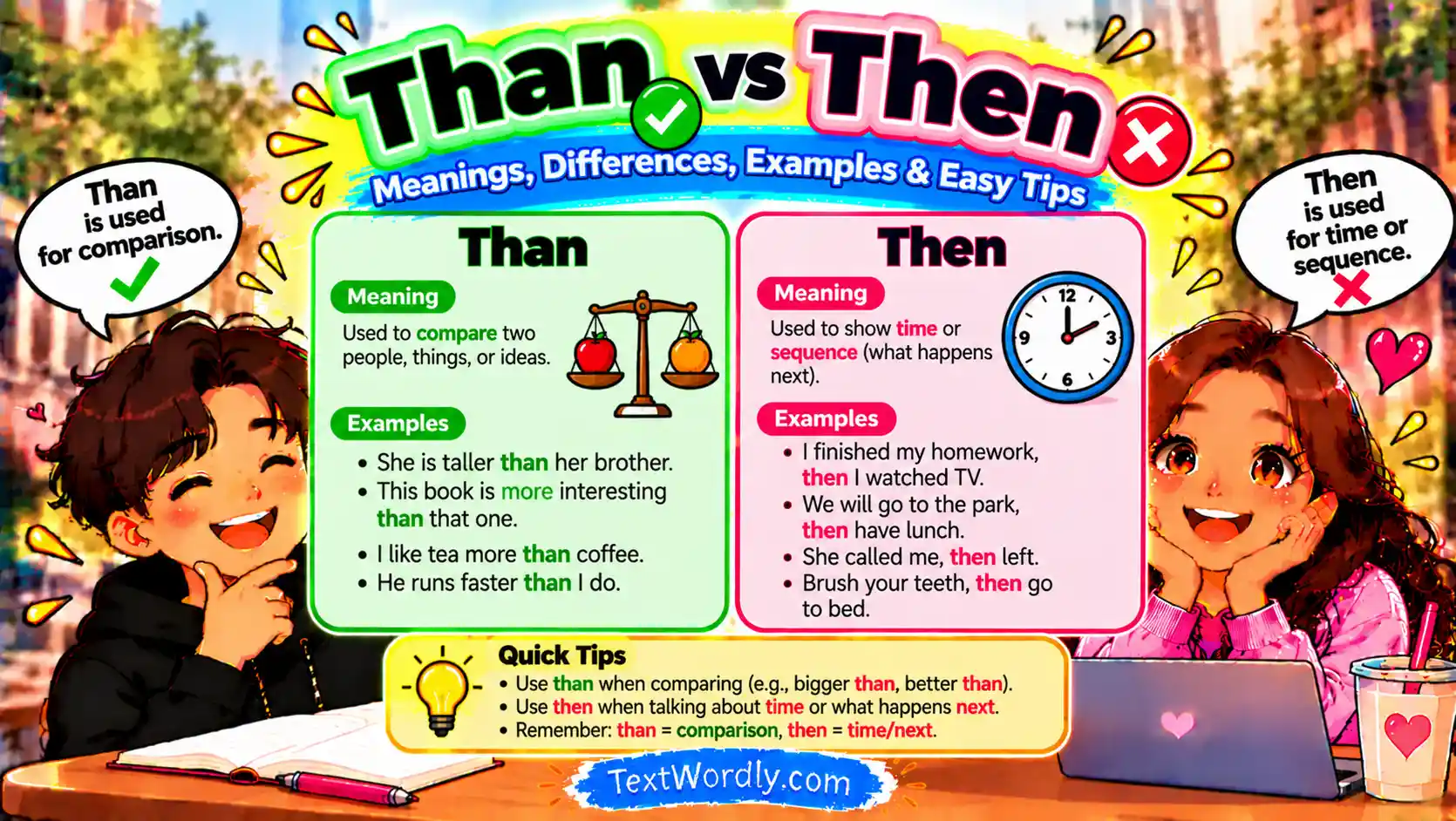
Than is used mainly for comparisons. Then usually refers to time, sequence, or a result. Compare “taller than” with “finish this, then leave.”
Than vs then is a common English usage topic. These words are often confused because they look or sound similar. Learning their grammatical roles makes everyday American English easier to understand and write.
Than vs Then: The Main Difference
| Word | Meaning or role | Example |
|---|---|---|
| Than | Used mainly for comparisons | She is taller than me. |
| Then | Refers to time, sequence, or a result | Finish your work, then leave. |
What Does Than Mean?
The first word has its own meaning and grammatical role. Identify what the sentence is trying to say before choosing the spelling. Context is more reliable than sound alone.
What Does Then Mean?
The second word works differently. It may describe a different grammatical relationship, so replacing both words with the same synonym can create errors.
Than vs Then Examples in Sentences
- The teacher explained the difference clearly.
- We used the correct word in the sentence.
- The example shows why context matters.
- Good writers check the grammatical role.
- Proofreading can catch this common mistake.
- The surrounding words provide useful clues.
Common Mistakes to Avoid
- Choosing the word because it sounds right.
- Ignoring whether the word is a noun, verb, adjective, or adverb.
- Assuming an apostrophe always shows possession.
- Using a formal rule without considering normal modern usage.
- Ignoring the surrounding sentence.
How to Remember the Difference
Use a short replacement test. Substitute a simple word with the same intended meaning. If the replacement does not fit, reconsider the original choice. Repeating the pair in short sentences is one of the easiest ways to remember it.
Quick Comparison
| Question | Best check |
|---|---|
| What does the word mean? | Look at the sentence context. |
| What is its grammatical role? | Check what the word modifies or replaces. |
| Does it sound similar? | Do not rely on sound alone. |
| Still unsure? | Check a reliable dictionary. |
Practice Examples
Try reading each sentence slowly. Identify the meaning first, then choose the word. This approach is more reliable than memorizing spelling without understanding the grammar.
- The writer checked the sentence before publishing.
- The reader used context to understand the word.
- The editor corrected the confusing form.
- The student learned the rule through examples.
- The final sentence was clear and precise.
Than vs Then in American English
In American English, these words follow the core distinctions explained in this guide. Formal writing may preserve traditional grammar rules, while everyday speech can be more flexible. When writing for school, work, or a broad audience, choose the form that clearly matches the sentence.
Related Text Wordly Guides
Continue learning with Your vs You’re, Good vs Well, Bring vs Take, Has vs Have, Affect vs Effect.
Dictionary and Writing Resources
For definitions, pronunciation, usage notes, and additional examples, consult Merriam-Webster Dictionary, Cambridge Dictionary, Oxford Learner’s Dictionaries, Britannica Dictionary, Grammarly Writing Resources.
Frequently Asked Questions
Why are these words confused?
They have similar spelling, pronunciation, or appearance, which can make the distinction easy to miss.
What is the easiest way to remember them?
Focus on meaning and grammatical role, then test the sentence with a simple replacement.
Can context help?
Yes. Nearby words and the overall situation often reveal the intended meaning.
Should I use a dictionary?
Yes, especially when a word has multiple meanings or a sentence uses a less common grammatical form.
Than vs Then in Comparisons
Than commonly appears after comparative words such as better, faster, older, smaller, more, and less. It connects two things being compared.
Examples include “This book is longer than that one” and “The second option is less expensive than the first.” If the sentence compares two people, objects, amounts, or ideas, than is usually the correct choice.
Then for Time and Sequence
Then commonly refers to what happens next or what happened at a particular time. It often appears in instructions and stories.
- Finish dinner, then wash the dishes.
- We lived there then.
- First read the question, then choose an answer.
- If that is true, then we should reconsider the plan.
Than vs Then: A Fast Test
Ask whether the sentence compares two things. If yes, than is usually right. If the word means next, afterward, at that time, or as a result, use then.
Than vs Then: More Examples
Comparisons provide the strongest clue for than. Words such as more, less, better, worse, taller, shorter, older, and younger often lead into a comparison with than. For example, “This route is shorter than the other route.”
Sequence and time provide strong clues for then. If you can replace the word with “next,” “after that,” or “at that time,” then is often correct.
Comparison Examples
- My new phone is faster than my old one.
- This chapter is easier than the previous chapter.
- Today feels warmer than yesterday.
- The blue option costs less than the red one.
Sequence Examples
- First save the file, then close the program.
- We ate lunch and then went home.
- Back then, the town was much smaller.
- Read the instructions, then start the exercise.
Than vs Then in Conditional Sentences
Then can also appear after an if-clause to show a result: “If the weather changes, then the event may move indoors.” Than does not have this function. Identifying comparison versus result is a reliable way to choose.
Than vs Then: How Context Helps
Context makes this pair straightforward. If two things are being measured or compared, than normally connects the comparison. If the sentence describes what happens next, what happened before, or a result, then normally fits.
For example, “The new model is cheaper than the old model” is a comparison. “Buy the new model, then register it” shows sequence.
Quick Proofreading Checklist
- Look for a comparative word.
- Ask whether two things are being compared.
- Try replacing the word with next or afterward.
- Read the complete sentence again.
Than vs Then: Final Review
Remember the core distinction: than belongs to comparisons, while then usually belongs to time, sequence, or result. “Better than” and “older than” show comparison. “First this, then that” shows sequence.
During proofreading, ask one question: “Am I comparing two things?” If yes, than is usually correct. If you mean next, afterward, at that time, or as a result, then is the better choice.
Conclusion
Understanding than vs then helps you avoid common English word-choice errors. Focus on meaning, grammar, context, and sentence structure instead of sound alone. With regular practice, the correct form becomes easier to recognize.