Learn when to use less and fewer, the countable and uncountable noun rule, common exceptions, examples, and an easy test for American English.
Less vs fewer is a common English usage topic. These words can be confused because their spelling, pronunciation, or grammatical behavior is similar. The easiest solution is to learn each word’s role and then apply a short context test.
Less vs Fewer: The Basic Rule
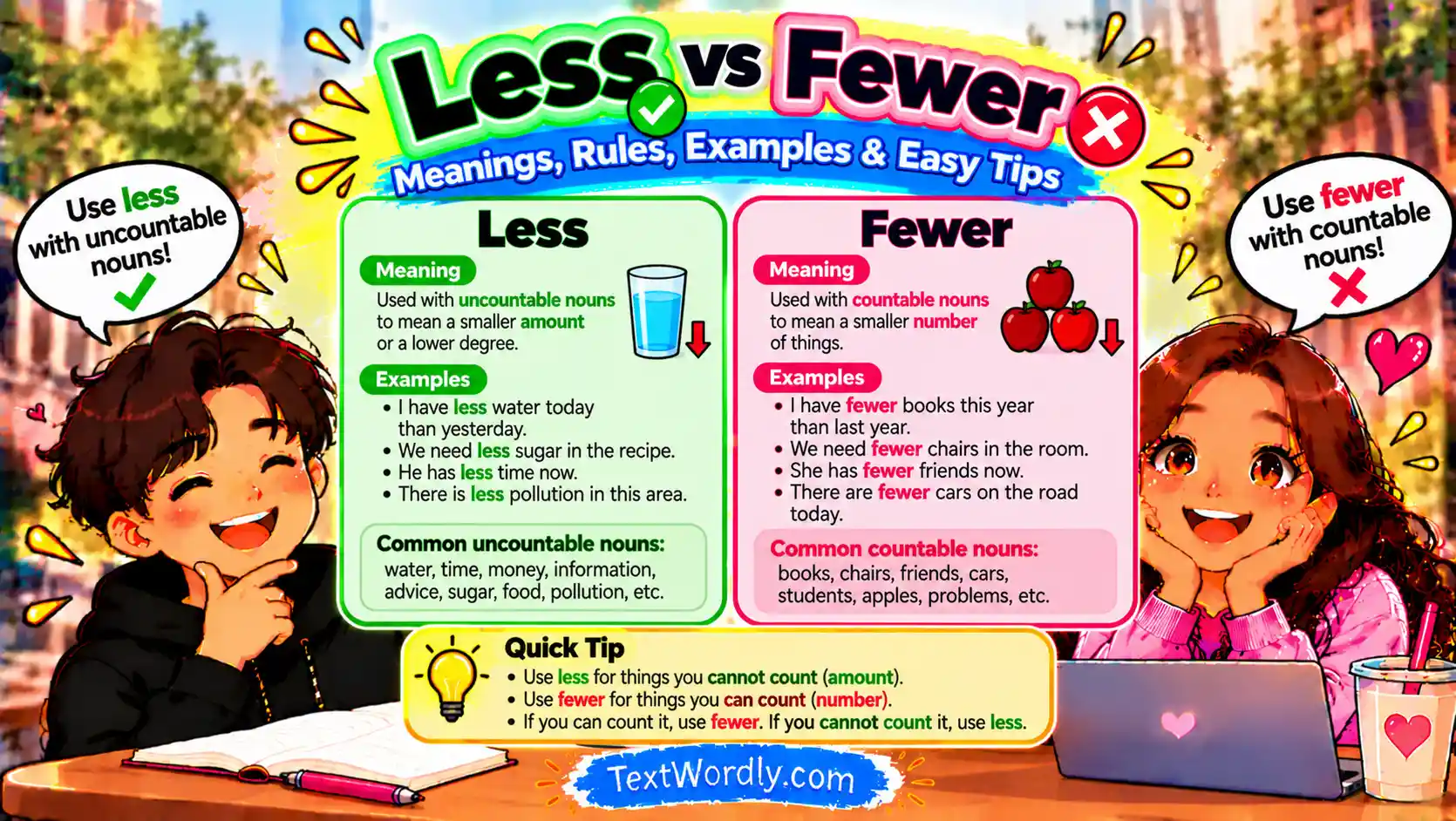
Fewer is normally used with countable plural nouns. Use it when you can count the individual items: fewer books, fewer students, fewer mistakes, or fewer emails.
Less is normally used with uncountable nouns. Use it for amounts that are treated as a whole: less water, less traffic, less time, or less information.
Examples
- We need fewer chairs for the smaller room.
- She made fewer mistakes this time.
- Try to use less sugar in the recipe.
- The new route takes less time.
Less vs Fewer: Common Exceptions
English usage has some established exceptions. Expressions involving time, money, distance, and measurement can use less even when a number is involved, especially when the amount is treated as a single quantity. For example, “less than five miles” and “less than ten minutes” are common standard expressions.
Less vs Fewer in Everyday Writing
For ordinary writing, ask whether the noun names separate items or one amount. If you can naturally count the items one by one, fewer is usually the better choice. If the noun represents an amount, less is usually appropriate.
Definitions and Word Roles
Start by identifying what each word means and how it functions in a sentence. Meaning should come before spelling or pronunciation. This makes the rule easier to apply in both casual and formal writing.
Common Mistakes
- Choosing a word only because it sounds right.
- Ignoring the noun or verb that follows.
- Applying a rule without checking context.
- Confusing American and British English conventions.
- Using a familiar form without proofreading the complete sentence.
How to Remember the Difference
Use a replacement test. Read the complete sentence and ask what the word is supposed to mean. Then replace it with a simple word or phrase with the same function. If the sentence changes meaning, choose the other form.
Quick Comparison
| Question | What to check |
|---|---|
| What does the word mean? | Read the surrounding sentence. |
| What grammatical role does it have? | Check whether it acts as a noun, verb, adjective, or adverb. |
| Is the usage regional? | Check American vs British English conventions. |
| Still unsure? | Use a reliable dictionary. |
Examples in Everyday English
Clear examples are useful because grammar rules become easier to remember when connected to normal situations. Read the examples aloud, then create one sentence of your own using each form.
- The writer checked the sentence before publishing.
- The student used the correct word in an email.
- The editor explained why the original form was confusing.
- The reader used context to understand the meaning.
- The final sentence was clear and natural.
- The teacher gave another example to make the rule easier.
American English Usage
This guide follows standard American English where regional spelling or usage matters. Some English forms differ across countries, so a form that is normal in British English may not be the preferred form in American writing. When the audience is American, follow the American convention consistently.
Practice: Choose the Correct Word
Test yourself before checking a dictionary. Identify the meaning first, choose the word, and then read the sentence again. This habit improves accuracy more effectively than memorizing isolated spellings.
- Read the sentence once for meaning.
- Identify the grammatical role.
- Apply the specific rule.
- Check the final sentence for natural usage.
Related Text Wordly Guides
Your vs You’re · Bring vs Take · Good vs Well · Affect vs Effect · Has vs Have
Trusted Dictionary and Writing Resources
Merriam-Webster · Cambridge Dictionary · Oxford Learner’s Dictionaries · Britannica Dictionary · Grammarly Writing Resources
Frequently Asked Questions
Why are these words confusing?
Similar spelling, pronunciation, or related meanings can make the forms easy to mix up.
What is the fastest way to choose the correct word?
Identify the intended meaning and grammatical role before choosing the spelling.
Does American English matter?
Yes. Some spelling and usage conventions differ between American and British English.
Should I check a dictionary?
Yes. A reputable dictionary can confirm meaning, pronunciation, usage notes, and regional conventions.
Less vs Fewer: Detailed Usage Tips
The countable versus uncountable rule is a strong starting point, but real English includes many phrases that depend on how the speaker views an amount. Countable nouns refer to separate things that can be numbered individually, such as apples, questions, people, and pages. Uncountable nouns describe substances, concepts, or amounts that are not normally counted as separate units, such as water, advice, traffic, and information.
Compare “fewer questions” with “less confusion.” You can count questions one by one, but confusion is treated as an amount. This distinction helps you make a natural choice without memorizing hundreds of examples.
More Examples
- There are fewer students in the class today.
- The report contains fewer pages than the earlier version.
- We have less information than we expected.
- The new process creates less waste.
- She spent less money this month.
- The team received fewer complaints.
When Numbers Appear
Expressions with measurements can be flexible because the measurement may be treated as one total amount. Phrases such as “less than ten minutes,” “less than five miles,” and “less than fifty dollars” are widely used. Do not change every numbered expression to fewer simply because a number appears.
Less vs Fewer in Formal Writing
In careful writing, use fewer with clearly countable plural nouns and less with mass or uncountable nouns. If a phrase is an established measurement expression, check natural usage rather than applying the rule mechanically.
Less vs Fewer: Final Examples
Use fewer when the noun can be counted as separate units: fewer emails, fewer students, fewer pages, or fewer appointments. Use less for amounts that are treated as a whole: less time, less noise, less water, or less information.
When a measurement is treated as one amount, less can sound completely natural. “The trip takes less than three hours” is a standard example. The goal is clear, natural English, not a mechanical rule that ignores established expressions.
Less vs Fewer: Editing Checklist
Before publishing, identify the noun after less or fewer. Ask whether it names separate countable items or one amount. Check measurement expressions separately, because established phrases can naturally use less. Finally, read the sentence aloud and make sure the choice sounds natural for the intended American audience.
Examples such as “fewer customers,” “fewer questions,” “less stress,” and “less traffic” show the basic pattern. Learning these common combinations makes the rule easier to apply without stopping to think about every sentence.
These distinctions are especially useful in polished web content, school writing, emails, and everyday American English. When in doubt, focus on the noun and the intended amount instead of choosing by sound.
In short, fewer focuses on countable items, while less focuses on amounts and uncountable nouns. Measurements can be treated as single amounts in established expressions. This simple framework handles most everyday choices.
Conclusion
Understanding less vs fewer helps you avoid common English usage errors. Focus on meaning, grammar, context, and regional style rather than relying only on pronunciation. With regular practice, the correct form becomes easier to recognize and use naturally.