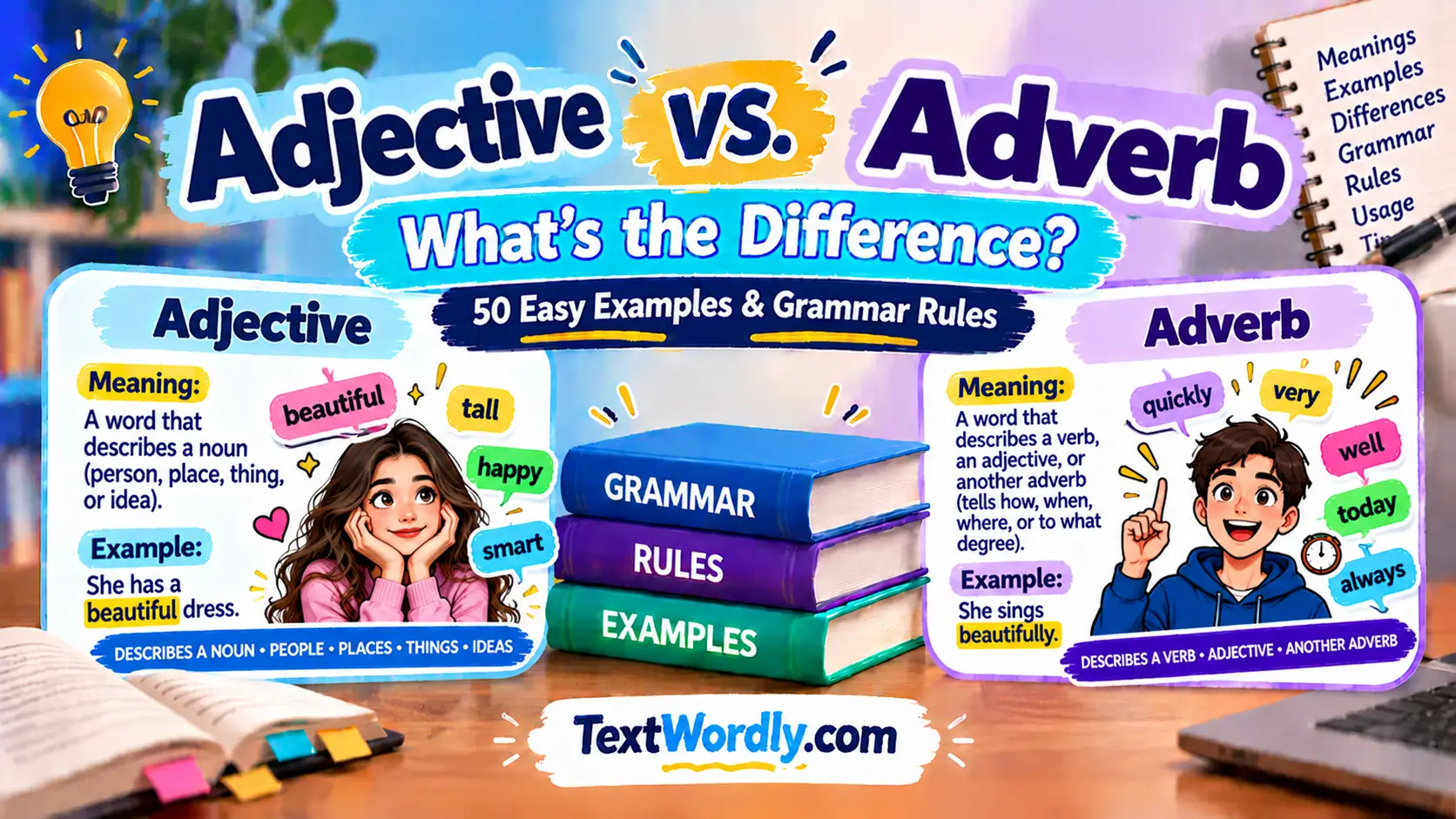
Adjective vs Adverb: An adjective describes a noun or pronoun, while an adverb modifies a verb, adjective, another adverb, or sometimes an entire sentence. Both add useful details, but they perform different jobs.
Compare these sentences:
- She is a careful driver. — Careful is an adjective describing driver.
- She drives carefully. — Carefully is an adverb modifying drives.
The difference becomes easier when you focus on what each word describes rather than how it is spelled.
This guide explains adjective vs adverb examples through 50 sentences, comparison tables, common exceptions, grammar rules, and a practice quiz.
Adjective vs Adverb: Quick Answer
The simplest rule is to identify the word being described.
| Feature | Adjective | Adverb |
|---|---|---|
| Main function | Describes a noun or pronoun | Modifies a verb, adjective, adverb, or clause |
| Common questions | What kind? Which one? How many? | How? When? Where? How often? To what degree? |
| Example | A quiet room | Speak quietly |
| Common position | Before a noun or after a linking verb | Position varies by function |
| Common spelling | Different endings | Many end in -ly |
Quick memory trick: An adjective tells you about a person or thing. An adverb often tells you how, when, or where something happens.
However, not all adverbs end in -ly, and some words function as both adjectives and adverbs.
What Is an Adjective?
An adjective is a word that describes or gives information about a noun or pronoun.
It can describe qualities such as size, color, appearance, condition, or personality.
Adjective Examples
“The blue car is parked outside.”
“She has a beautiful voice.”
“The tall building is downtown.”
“The children are happy.”
In the first three sentences, the adjectives appear before nouns. In the fourth, happy follows the linking verb are and describes the subject children.
Common Adjectives
| Adjective | Example |
|---|---|
| Tall | A tall tree |
| Cold | Cold water |
| Friendly | A friendly neighbor |
| Bright | A bright light |
| Careful | A careful student |
Adjectives can also appear after linking verbs such as be, seem, become, feel, and look.
What Is an Adverb?
An adverb modifies a verb, adjective, another adverb, or sometimes an entire sentence.
Adverbs can express manner, time, place, frequency, or degree.
Adverb Examples
“She speaks clearly.”
“He arrived yesterday.”
“The children played outside.”
“The movie was extremely interesting.”
Here, clearly modifies speaks, while extremely modifies the adjective interesting.
Common Types of Adverbs
| Type | Example | Sentence |
|---|---|---|
| Manner | Carefully | She writes carefully. |
| Time | Yesterday | He arrived yesterday. |
| Place | Here | Please come here. |
| Frequency | Often | They often visit. |
| Degree | Very | The test was very difficult. |
Important: Many adverbs end in -ly, but words such as fast, often, very, and here do not.
Adjective vs Adverb: Key Differences
The main difference is the grammatical role each word plays.
| Adjective | Adverb |
|---|---|
| A careful driver | Drives carefully |
| A quiet child | Speaks quietly |
| A quick answer | Answers quickly |
| A happy student | Smiles happily |
| A slow train | Moves slowly |
Sentence Breakdown
Consider:
“The careful student writes neatly.”
Careful describes the noun student, so it is an adjective.
Neatly modifies the verb writes, so it is an adverb.
Another Example
“The extremely tired student walked slowly.”
- Extremely modifies tired — adverb.
- Tired describes student — adjective.
- Slowly modifies walked — adverb.
A single sentence can contain several adjectives and adverbs.
50 Adjective vs Adverb Examples in Sentences
These 50 examples are arranged into 25 adjective-and-adverb pairs. Each pair shows how a related word functions in a sentence.
Everyday Activities
- Adjective: She is a careful driver.
- Adverb: She drives carefully.
- Adjective: He gave a quick answer.
- Adverb: He answered quickly.
- Adjective: The room is quiet.
- Adverb: The children spoke quietly.
- Adjective: This is a slow computer.
- Adverb: The computer runs slowly.
- Adjective: She has a beautiful voice.
- Adverb: She sings beautifully.
School and Learning
- Adjective: He is a good student.
- Adverb: He performs well in class.
- Adjective: The teacher gave a clear explanation.
- Adverb: The teacher explained it clearly.
- Adjective: It was an easy question.
- Adverb: She answered the question easily.
- Adjective: The students were happy.
- Adverb: The students smiled happily.
- Adjective: This is a simple exercise.
- Adverb: The teacher explained it simply.
Work and Communication
- Adjective: He is a polite employee.
- Adverb: He speaks politely to customers.
- Adjective: She gave a professional presentation.
- Adverb: She handled the meeting professionally.
- Adjective: The instructions were clear.
- Adverb: The instructor explained the steps clearly.
- Adjective: It was a serious discussion.
- Adverb: They discussed the problem seriously.
- Adjective: She made a confident statement.
- Adverb: She spoke confidently.
Sports and Movement
- Adjective: He is a fast runner.
- Adverb: He runs fast.
- Adjective: It was a hard workout.
- Adverb: She trained hard.
- Adjective: The athlete made a graceful movement.
- Adverb: The athlete moved gracefully.
- Adjective: The player made a sudden turn.
- Adverb: The player turned suddenly.
- Adjective: He took a deep breath.
- Adverb: He breathed deeply.
Feelings and Descriptions
- Adjective: She gave a warm welcome.
- Adverb: She greeted everyone warmly.
- Adjective: The baby was peaceful.
- Adverb: The baby slept peacefully.
- Adjective: He gave an angry response.
- Adverb: He responded angrily.
- Adjective: She made a cheerful comment.
- Adverb: She spoke cheerfully.
- Adjective: It was a perfect performance.
- Adverb: The singer performed perfectly.
What these examples show: Adjectives describe qualities of people or things. Adverbs often describe how actions happen.
How to Identify Adjectives in a Sentence
To identify an adjective, find the noun or pronoun it describes.
Before a Noun
“She bought a beautiful dress.”
Beautiful describes the noun dress.
After a Linking Verb
“He seems tired.”
Tired describes he.
Describing a Condition
“The soup tastes delicious.”
Delicious describes the soup rather than the action of tasting.
Quick Identification Test
Ask:
What kind of person or thing is being described?
In “The careful student answered,” careful describes the student.
That makes it an adjective.
How to Identify Adverbs in a Sentence
To identify an adverb, find the word or clause it modifies.
Modifying a Verb
“She writes neatly.”
Neatly explains how she writes.
Modifying an Adjective
“The test was extremely difficult.”
Extremely modifies difficult.
Modifying Another Adverb
“He runs very quickly.”
Very modifies quickly.
Modifying a Sentence
“Fortunately, everyone arrived safely.”
Fortunately comments on the entire situation.
Adverb Placement
Different types of adverbs appear in different positions.
“She always studies before dinner.”
“She studies carefully.”
“Yesterday, she studied at home.”
Remember: The function of the word matters more than its position.
How to Form Adverbs From Adjectives
Many adverbs are formed by adding -ly to an adjective.
| Adjective | Adverb |
|---|---|
| Quick | Quickly |
| Careful | Carefully |
| Quiet | Quietly |
| Slow | Slowly |
| Polite | Politely |
| Beautiful | Beautifully |
| Easy | Easily |
| Happy | Happily |
Common Spelling Rules
Add -ly: Quick → Quickly.
Change -y to -ily: Happy → Happily.
Some words ending in -le change to -ly: Gentle → Gently.
Some forms are irregular: Good → Well.
Important Exceptions
Not every adjective forms an adverb by adding -ly.
For example:
“He runs fast.”
“She works hard.”
These words already function as adverbs without an additional ending.
Adjectives vs Adverbs After Linking Verbs
Linking verbs connect the subject to a description.
Common linking verbs include be, seem, become, feel, look, smell, taste, and sound.
Correct Examples
“The flowers smell sweet.”
“The music sounds beautiful.”
“She looks tired.”
“The food tastes delicious.”
The adjectives describe the subjects.
Look Happy vs Look Happily
“She looks happy.”
This means she appears happy.
“She looks happily at the photograph.”
Here, happily describes the manner of looking.
Feel Bad vs Feel Badly
“I feel bad.”
This describes an emotional or physical condition.
“I feel badly.”
This can suggest difficulty with the sense of touch, although the expression may also appear in informal usage.
Grammar tip: Use adjectives after linking verbs when describing the subject. Use adverbs when describing an actual action.
Good vs Well, Bad vs Badly, and Hard vs Hardly
Some adjective-and-adverb pairs require special attention.
Good vs Well
Good is generally an adjective.
“She is a good singer.”
Well is commonly an adverb.
“She sings well.”
However, well can also be an adjective when describing health.
“I don’t feel well.”
Bad vs Badly
Bad is an adjective.
“The food smells bad.”
Badly is an adverb.
“He performed badly.”
Hard vs Hardly
Hard can be an adjective or adverb.
“She is a hard worker.”
“She works hard.”
Hardly means almost not.
“She hardly works.”
These sentences have very different meanings.
Adjectives and Adverbs That Have the Same Form
Some words function as both adjectives and adverbs without changing their spelling.
These adverb uses are sometimes called flat adverbs.
| Word | Adjective Example | Adverb Example |
|---|---|---|
| Fast | A fast train | The train moves fast. |
| Hard | Hard work | She works hard. |
| Late | A late arrival | He arrived late. |
| Early | An early meeting | She arrived early. |
| Daily | A daily routine | We exercise daily. |
Words Ending in -ly That Are Adjectives
Not every word ending in -ly is an adverb.
Common examples include:
- Friendly
- Lovely
- Lonely
- Silly
- Lively
“She is a friendly teacher.”
Here, friendly describes the noun teacher.
Late vs Lately
“He arrived late.”
This means after the expected time.
“I haven’t seen him lately.”
Here, lately means recently.
Important: Adding -ly can change meaning rather than simply changing grammatical function.
Comparative and Superlative Adjectives vs Adverbs
Adjectives and adverbs can both express comparisons.
Comparative Forms
Comparatives compare two people, things, or actions.
Adjective:
“She is a faster runner.”
Adverb:
“She runs faster.”
Superlative Forms
Superlatives identify the highest or lowest degree within a group.
Adjective:
“He is the fastest runner.”
Adverb:
“He runs the fastest.”
Comparison Table
| Base Word | Comparative | Superlative |
|---|---|---|
| Fast | Faster | Fastest |
| Hard | Harder | Hardest |
| Quickly | More quickly | Most quickly |
| Carefully | More carefully | Most carefully |
| Good | Better | Best |
| Well | Better | Best |
More Careful vs More Carefully
“He gave a more careful answer.”
Careful is an adjective describing answer.
“He answered more carefully.”
Carefully is an adverb modifying answered.
Common Adjective vs Adverb Mistakes
These mistakes frequently appear in conversation and writing.
| Incorrect or Nonstandard | Standard Correction | Reason |
|---|---|---|
| She sings beautiful. | She sings beautifully. | Modifies an action |
| He drives careful. | He drives carefully. | Modifies drives |
| The soup tastes deliciously. | The soup tastes delicious. | Describes the soup |
| She looks happily. | She looks happy. | Describes her appearance |
| He runs fastly. | He runs fast. | Fast already works as an adverb |
| She works hardly. | She works hard. | Hardly means almost not |
| He did good on the test. | He did well on the test. | Standard formal usage |
Some adjective forms are used informally as adverbs in particular dialects or expressions. For standard academic writing, follow the conventional forms shown above.
Memory Tricks and Sentence Identification Tips
The easiest method is to identify what the descriptive word modifies.
Adjective → Describes a noun or pronoun.
Adverb → Modifies a verb, adjective, another adverb, or clause.
The Three-Step Test
- Find the descriptive word.
- Identify what it modifies.
- Decide whether that target is a noun, pronoun, verb, adjective, or another adverb.
Example
“The careful boy answered quickly.”
Careful describes the noun boy, so it is an adjective.
Quickly modifies the verb answered, so it is an adverb.
Another Example
“The extremely tired student walked slowly.”
Extremely modifies the adjective tired.
Tired describes the noun student.
Slowly modifies the verb walked.
One sentence can contain both adjectives and adverbs.
Adjective vs Adverb Practice Quiz
Choose the correct word in each sentence.
Question 1: She speaks English ______.
A. fluent B. fluently
Question 2: He is a ______ driver.
A. careful B. carefully
Question 3: The soup tastes ______.
A. delicious B. deliciously
Question 4: She completed the task ______.
A. quick B. quickly
Question 5: He runs very ______.
A. fast B. fastly
Question 6: The students worked ______.
A. hard B. hardly
Answer Key With Explanations
| Question | Answer | Explanation |
|---|---|---|
| 1 | B — Fluently | Modifies the verb speaks. |
| 2 | A — Careful | Describes the noun driver. |
| 3 | A — Delicious | Describes the soup after a linking verb. |
| 4 | B — Quickly | Modifies the verb completed. |
| 5 | A — Fast | Fast functions as an adverb without -ly. |
| 6 | A — Hard | Means with effort; hardly means almost not. |
Review the explanations for any questions you missed. Identifying the modified word is usually the most reliable method.
Adjective vs Adverb FAQs
1. What is the main difference between an adjective and an adverb?
An adjective describes a noun or pronoun. An adverb modifies a verb, adjective, another adverb, or sometimes an entire clause.
2. What are five examples of adjectives?
Five common adjectives are happy, tall, beautiful, careful, and quiet.
3. What are five examples of adverbs?
Five common adverbs are quickly, slowly, carefully, often, and very.
4. Do all adverbs end in -ly?
No. Adverbs such as fast, hard, often, and very do not end in -ly.
5. Is friendly an adjective or an adverb?
Friendly is generally an adjective.
Example: “She is a friendly person.”
6. Is fast an adjective or an adverb?
Fast can be both.
“A fast runner” uses an adjective.
“He runs fast” uses an adverb.
7. Should I say feel bad or feel badly?
Use feel bad when describing your emotional or physical condition. Bad is an adjective after the linking verb feel. Feel badly can suggest that your sense of touch is impaired.
8. How can I identify adjectives and adverbs in a sentence?
Find the word being modified. If it describes a noun or pronoun, it is an adjective. If it modifies a verb, adjective, another adverb, or clause, it is an adverb.
Final Takeaway
The difference between adjectives and adverbs depends on what each word modifies.
Adjectives describe nouns and pronouns.
Adverbs modify verbs, adjectives, other adverbs, or entire clauses.
Remember that not every adverb ends in -ly, and some words, such as fast and hard, can function as both adjectives and adverbs.