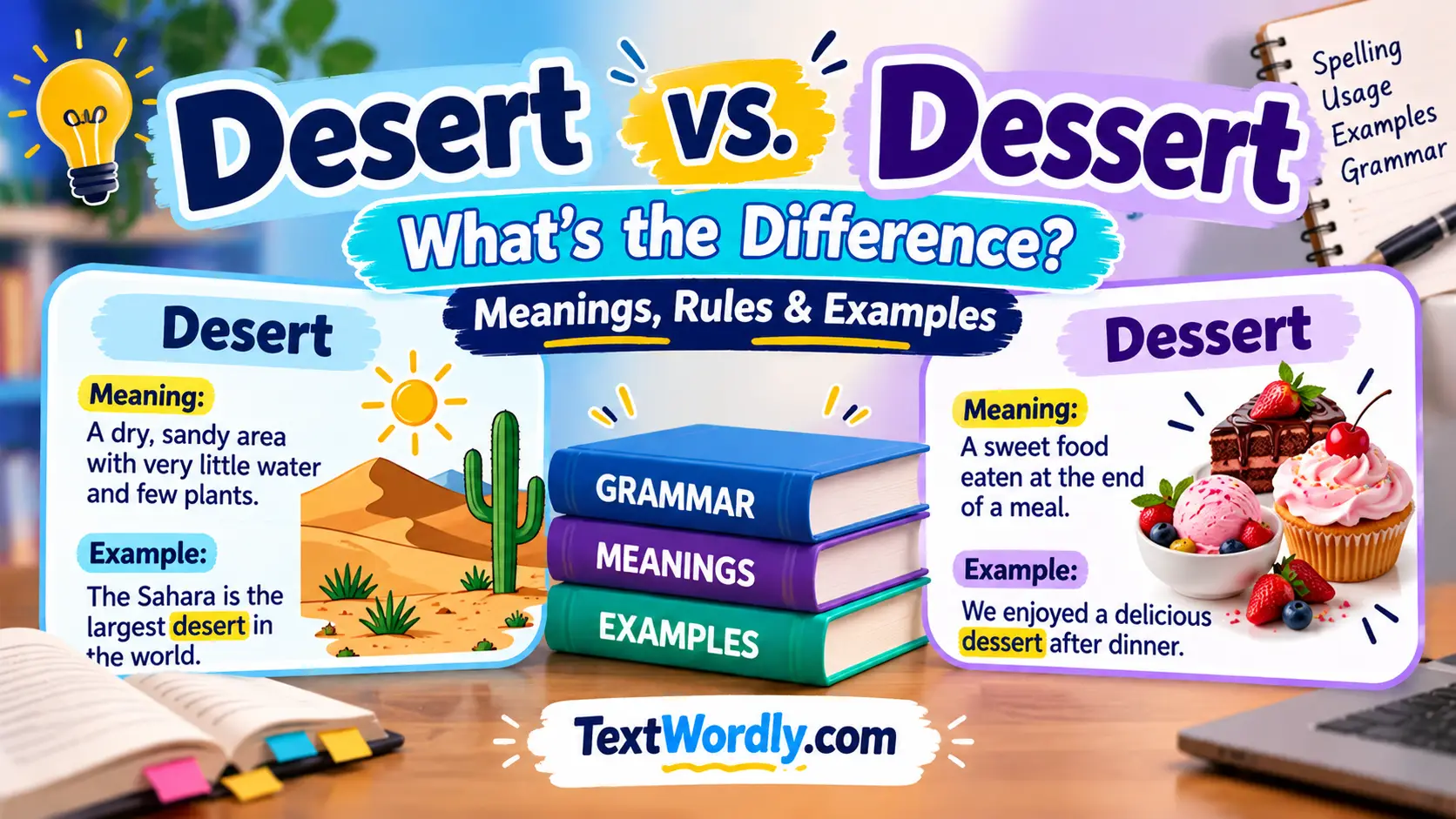
The difference between desert vs. dessert is simple: desert usually means a dry region with very little rainfall, while dessert means a sweet dish or course typically served after a meal.
For example, the Sahara Desert is a dry region, while chocolate cake is a popular dessert.
But there is another important difference. Desert can also be a verb meaning to abandon someone or something. You will also see the spelling deserts in the expression just deserts, meaning deserved consequences.
These words look similar, but their meanings, pronunciations, and grammatical uses are different.
This guide explains how to spell and pronounce each word correctly, with everyday examples, comparison tables, common mistakes, and simple memory tricks.
Quick Answer: Desert vs. Dessert
- 🏜️ Desert: A dry geographical region with very little precipitation.
- 🍰 Dessert: A usually sweet course served at the end of a meal.
- 🚶 Desert (verb): To abandon or leave someone or something.
- ⚖️ Just deserts: The consequences someone deserves.
Examples:
- “The travelers crossed the desert.”
- “We ordered cheesecake for dessert.”
- “He refused to desert his teammates.”
- “The dishonest player finally received his just deserts.”
Easy memory trick: Dessert has two S’s because you might want two servings.
TL;DR
| Word | Meaning | Pronunciation |
|---|---|---|
| Desert (noun) | Dry region | DEZ-ert |
| Dessert (noun) | After-meal course | dih-ZURT |
| Desert (verb) | Abandon | dih-ZURT |
| Deserts (in just deserts) | Deserved consequences | dih-ZURTS |
Remember: One S for the dry region, two S’s for the sweet course.
Desert vs. Dessert: Quick Difference
The easiest way to distinguish desert from dessert is to identify what your sentence describes.
Use desert for a dry geographical region or when describing abandonment. Use dessert for food served at the end of a meal.
| Feature | Desert | Dessert |
|---|---|---|
| Spelling | One S | Two S’s |
| Main meaning | Dry region | After-meal course |
| Part of speech | Noun or verb | Noun |
| Common example | Sahara Desert | Chocolate cake |
| Plural | Deserts | Desserts |
| Related terms | Deserted, desertion | Dessert menu, dessert spoon |
Quick test: If you mean dry land, use desert. If you mean something served after dinner, use dessert.
What Does Desert Mean?
A desert is a geographical region characterized by very low precipitation.
Many people picture deserts as hot places filled with sand dunes. However, deserts can also be cold, rocky, or icy.
The defining feature is dryness, not temperature.
Types of Deserts
Hot deserts: These generally experience high temperatures and limited rainfall.
Examples include the Sahara and parts of the Arabian Desert.
Cold deserts: These experience cold conditions and receive little precipitation.
Examples include the Gobi Desert and Antarctica’s polar desert.
Desert Sentence Examples
- “The Sahara Desert covers a large area of North Africa.”
- “Camels have adaptations that help them survive in the desert.”
- “The hikers crossed the desert before sunset.”
- “Some deserts experience freezing temperatures.”
- “The Mojave Desert is located in the southwestern United States.”
Important fact: Not every desert is hot, and not every desert is covered with sand.
What Does Dessert Mean?
Dessert is a noun referring to a course usually served at the end of a meal.
Desserts are commonly sweet, although some dining traditions include fruit, cheese, or other foods as the final course.
In American English, popular desserts include cakes, pies, brownies, cookies, pudding, and ice cream.
Common Dessert Examples
- Chocolate cake
- Apple pie
- Cheesecake
- Ice cream
- Brownies
- Cookies
- Fruit salad
- Chocolate pudding
Dessert Sentence Examples
- “We ordered chocolate cake for dessert.”
- “My favorite dessert is apple pie.”
- “The restaurant offers several homemade desserts.”
- “She prepared a delicious dessert for her family.”
- “Would you like coffee with your dessert?”
Grammar tip: Dessert can be used without an article when referring to the course generally: “We had dessert.” It can also be countable: “The menu offers six desserts.”
Desert vs. Dessert Comparison Table
Although these words differ by only one letter, they are not interchangeable.
The following table shows which spelling belongs in common situations.
| Situation | Correct word | Example |
|---|---|---|
| Dry geographical region | Desert | The desert receives little rainfall. |
| Food after dinner | Dessert | We had pie for dessert. |
| Abandoning a person | Desert | He would never desert his friends. |
| Restaurant menu | Dessert | The dessert menu looks delicious. |
| Dry climate | Desert | Desert climates can be extreme. |
| Leaving an assigned post | Desert | The soldier deserted his post. |
| Deserved consequences | Deserts | He received his just deserts. |
| Multiple sweet dishes | Desserts | The bakery sells several desserts. |
Key takeaway: The sentence’s meaning determines the correct spelling.
How to Pronounce Desert and Dessert
One of the most confusing details is that desert has different pronunciations depending on its meaning.
When desert means a dry region, the stress falls on the first syllable.
When dessert means food, the stress falls on the second syllable. The verb desert, meaning to abandon, also stresses the second syllable.
Pronunciation Guide
| Word | IPA | Easy pronunciation |
|---|---|---|
| Desert (dry region) | /ˈdez.ɚt/ | DEZ-ert |
| Dessert (food) | /dɪˈzɝːt/ | dih-ZURT |
| Desert (abandon) | /dɪˈzɝːt/ | dih-ZURT |
Examples
- “The DEZ-ert is extremely dry.”
- “We ate chocolate cake for dih-ZURT.”
- “Do not dih-ZURT your responsibilities.”
Pronunciation rule: The noun desert meaning dry land stresses the first syllable. The verb desert and the noun dessert stress the second.
Desert as a Noun vs. a Verb
Desert can function as both a noun and a verb, but its meaning changes.
As a noun, it refers to a dry geographical region. As a verb, it means to abandon, leave behind, or withdraw support from someone or something.
Desert as a Noun
- “The desert stretches beyond the mountains.”
- “Many animals live in the desert.”
- “The country contains several deserts.”
Desert as a Verb
- “He refused to desert his family.”
- “The soldiers were accused of deserting their posts.”
- “She felt that her friends had deserted her.”
Verb Forms of Desert
| Verb form | Example |
|---|---|
| Desert | Never desert your teammates. |
| Deserts | He deserts his responsibilities. |
| Deserted | The soldiers deserted their posts. |
| Deserting | She was accused of deserting the team. |
Important: Dessert is not a verb in standard everyday English. You cannot use it to mean abandon.
How to Use Desert in a Sentence
Use desert when discussing dry regions, geographical conditions, or abandonment.
The word appears in geography lessons, environmental writing, travel descriptions, and conversations about loyalty.
Desert Meaning Dry Land
- “The desert landscape looked beautiful at sunrise.”
- “Some plants survive in the desert with very little water.”
- “The travelers carried extra supplies across the desert.”
- “The Sonoran Desert supports many plant and animal species.”
- “Cold deserts receive very little precipitation.”
Desert Meaning Abandon
- “He promised never to desert his friends.”
- “The captain refused to desert the crew.”
- “She felt deserted during the difficult period.”
- “The soldiers were warned not to desert their posts.”
- “The organization did not desert its original mission.”
Writing tip: If desert describes an action, it generally means leaving or abandoning someone or something.
How to Use Dessert in a Sentence
Use dessert when referring to the final course of a meal or a sweet dish.
This word is common in recipes, restaurant menus, food reviews, and everyday conversations.
Dessert Sentence Examples
- “We had vanilla ice cream for dessert.”
- “Chocolate cake is her favorite dessert.”
- “The bakery sells several homemade desserts.”
- “She made apple pie for dessert.”
- “Would you like to see the dessert menu?”
- “The children were excited about dessert.”
- “He ordered cheesecake after dinner.”
- “We saved room for dessert.”
- “The restaurant specializes in frozen desserts.”
- “They served fresh fruit as dessert.”
Dessert or Desserts?
Use dessert when discussing the course generally.
Example: “We had dessert after dinner.”
Use desserts when referring to multiple dishes or varieties.
Example: “The restaurant offers five different desserts.”
Desert vs. Dessert Spelling Rules
The main spelling difference is the number of S’s.
Desert contains one S, while dessert contains two consecutive S’s.
Correct Spellings
- Desert: D-E-S-E-R-T
- Dessert: D-E-S-S-E-R-T
Examples
❌ “The Sahara Dessert is enormous.”
✅ “The Sahara Desert is enormous.”
❌ “We ordered cake for desert.”
✅ “We ordered cake for dessert.”
❌ “The soldier decided to dessert his post.”
✅ “The soldier decided to desert his post.”
Why Does Dessert Have Two S’s?
The two words have different linguistic histories. Their spelling differences are not based on a modern English grammar rule.
However, a simple mnemonic can help:
Dessert = Sweet Stuff = Two S’s.
Remember: Spelling tricks help with memory, but meaning is the most reliable guide.
Just Deserts vs. Just Desserts
The expression just deserts is one of the most frequently misunderstood uses of these words.
Just deserts means the consequences or treatment someone deserves, often a fitting punishment for wrongdoing.
Despite its pronunciation, the established idiom uses deserts with one S, not desserts with two.
Correct Example
“The dishonest employee finally received his just deserts.”
This means the employee experienced consequences considered deserved.
Why Is It Spelled Deserts?
In this expression, deserts comes from an older noun meaning something deserved or earned.
It is related to the idea of deserve, not the geographical meaning of a dry region.
Just Deserts vs. Just Desserts
| Phrase | Meaning | Usage |
|---|---|---|
| Just deserts | Deserved consequences | Standard idiom |
| Just desserts | A playful reference to sweet dishes | Food-related wordplay |
A bakery might deliberately use Just Desserts as a name or slogan, but the established expression about deserved consequences is just deserts.
Memory trick: Deserts = what someone deserves.
Deserted, Desertion, and Desertification
Several words are related to desert, but they do not all mean the same thing.
Understanding these terms can improve vocabulary and prevent confusion.
Deserted
Deserted means abandoned, left behind, or empty.
Example: “The travelers discovered a deserted village.”
A deserted place does not have to be located in a desert.
Desertion
Desertion means the act of abandoning a person, duty, position, or responsibility.
Example: “The soldier faced accusations of desertion.”
Desertification
Desertification is land degradation in drylands caused by factors such as climatic variations and human activities.
Example: “Poor land management can contribute to desertification.”
It does not simply mean that an existing desert is expanding.
Quick Comparison
| Word | Meaning |
|---|---|
| Deserted | Abandoned or empty |
| Desertion | Act of abandoning |
| Desertification | Land degradation in drylands |
| Desert | Dry region or the act of abandoning |
Common Phrases With Desert
The word desert appears in geographical descriptions, environmental discussions, and figurative expressions.
Learning these combinations helps you recognize when the single-S spelling is appropriate.
| Phrase | Meaning |
|---|---|
| Desert climate | Climate with very low precipitation |
| Desert landscape | Scenery found in a desert region |
| Desert animals | Animals adapted to desert conditions |
| Desert plants | Plants adapted to dry environments |
| Desert island | Remote or uninhabited island |
| Deserted building | Empty or abandoned building |
| Food desert | Area with limited access to affordable, nutritious food |
| Desert a post | Abandon an assigned position |
Example Sentences
- “The desert climate is extremely dry.”
- “Many desert plants conserve water.”
- “The neighborhood was described as a food desert because residents had limited access to grocery stores.”
Note: Food desert is a social and geographic term, not a reference to an actual desert.
Common Phrases With Dessert
Dessert appears in food writing, menus, celebrations, and everyday conversation.
These phrases generally describe sweet dishes, dining experiences, or the final course of a meal.
| Phrase | Meaning |
|---|---|
| Dessert menu | List of available after-meal dishes |
| Dessert table | Table displaying desserts |
| Dessert recipe | Instructions for preparing a dessert |
| Dessert spoon | Spoon commonly used for dessert |
| Frozen dessert | Frozen sweet dish |
| Chocolate dessert | Dessert containing chocolate |
| Homemade dessert | Dessert prepared at home |
| Save room for dessert | Leave enough appetite for the final course |
Example Sentences
- “The restaurant’s dessert menu includes cheesecake.”
- “She prepared a homemade dessert for the celebration.”
- “We decided to save room for dessert.”
Quick reminder: When discussing food served after a meal, choose dessert with two S’s.
Common Desert vs. Dessert Mistakes
Because these words look so similar, writers frequently confuse them.
The following examples show how to correct the most common mistakes.
Mistake 1: Using Desert for Sweet Food
❌ “I want chocolate cake for desert.”
✅ “I want chocolate cake for dessert.”
Mistake 2: Using Dessert for Dry Land
❌ “The Sahara Dessert is in Africa.”
✅ “The Sahara Desert is in Africa.”
Mistake 3: Confusing Desert as a Verb
❌ “He promised not to dessert his team.”
✅ “He promised not to desert his team.”
Mistake 4: Using the Wrong Plural
❌ “The bakery sells delicious deserts.”
✅ “The bakery sells delicious desserts.”
Mistake 5: Misspelling Just Deserts
❌ “The dishonest player got his just desserts.”
✅ “The dishonest player got his just deserts.”
The first version may work as intentional wordplay, but the second is the standard idiom.
Mistake 6: Assuming Every Desert Is Hot
❌ “All deserts are hot and sandy.”
✅ “Some deserts are cold, rocky, or icy.”
Final checking rule: Identify the intended meaning before choosing the spelling.
Easy Memory Tricks for Desert vs. Dessert
A few simple associations can make the spelling difference easier to remember.
Two S’s for Two Servings
Dessert has two S’s because you might want seconds.
Think: “I want two servings of dessert.”
Sweet Stuff = SS
Both sweet and stuff begin with S.
Sweet Stuff → SS → Dessert
One S for Sand
Desert contains one S.
Think: “Sand has one S.”
This is only a memory trick; not every desert is sandy.
Just Deserts = Deserved Consequences
Connect deserts with deserve.
If someone receives their just deserts, they receive what they deserve.
The Perfect Memory Sentence
“After crossing the desert, we enjoyed dessert.”
Final rule: Desert = dry land or abandon. Dessert = after-meal course.
Desert vs. Dessert Practice Quiz
Test your understanding by choosing the correct word or word form.
Questions
1. The Sahara is a large ______.
A. Desert
B. Dessert
2. We ordered chocolate cake for ______.
A. Desert
B. Dessert
3. The soldiers were warned not to ______ their posts.
A. Desert
B. Dessert
4. The dishonest player finally received his just ______.
A. Deserts
B. Desserts
5. Many plants survive in the ______.
A. Desert
B. Dessert
6. The bakery sells several homemade ______.
A. Deserts
B. Desserts
Answers With Explanations
1. A — Desert: Refers to a dry geographical region.
2. B — Dessert: Refers to food served after a meal.
3. A — Desert: Functions as a verb meaning to abandon.
4. A — Deserts: Just deserts means deserved consequences.
5. A — Desert: Refers to a dry environment.
6. B — Desserts: Refers to multiple sweet dishes.
Copyable Answer Key: 1-A | 2-B | 3-A | 4-A | 5-A | 6-B
FAQs About Desert vs. Dessert
What is the difference between desert and dessert?
Desert usually means a dry region with little precipitation. Dessert means a course, usually sweet, served at the end of a meal. Desert can also mean to abandon.
Is it desert or dessert after dinner?
Use dessert, with two S’s, when referring to a dish or course served after dinner.
How do you remember desert vs. dessert?
Remember that dessert has two S’s because you might want two servings. Desert meaning dry land has only one S.
How do you pronounce desert and dessert?
Desert meaning dry land is pronounced DEZ-ert. Dessert meaning food is pronounced dih-ZURT. The verb desert is also pronounced dih-ZURT.
What does just deserts mean?
Just deserts means deserved consequences, often punishment considered appropriate for someone’s actions. The established idiom uses one S in deserts.
Can desert be used as a verb?
Yes. As a verb, desert means to abandon someone, leave a position, or withdraw support.
Are all deserts hot?
No. Deserts are defined primarily by low precipitation. Some are hot, while others, including polar deserts, are extremely cold.
Is dessert always sweet?
Not necessarily. Although desserts are usually sweet, some dining traditions serve cheese, fruit, or other less-sweet foods as the final course.
Conclusion
Understanding desert vs. dessert is easy once you recognize the difference in meaning, spelling, and pronunciation.
Use desert when referring to a dry region or the act of abandoning someone. Use dessert when referring to a usually sweet course served after a meal.
Remember that the established expression just deserts means deserved consequences, even though it sounds like desserts.
The simplest memory trick is: Desert has one S; dessert has two S’s because you might want seconds.
With these examples, grammar rules, pronunciation tips, and practice questions, you can confidently use both words in everyday American English.