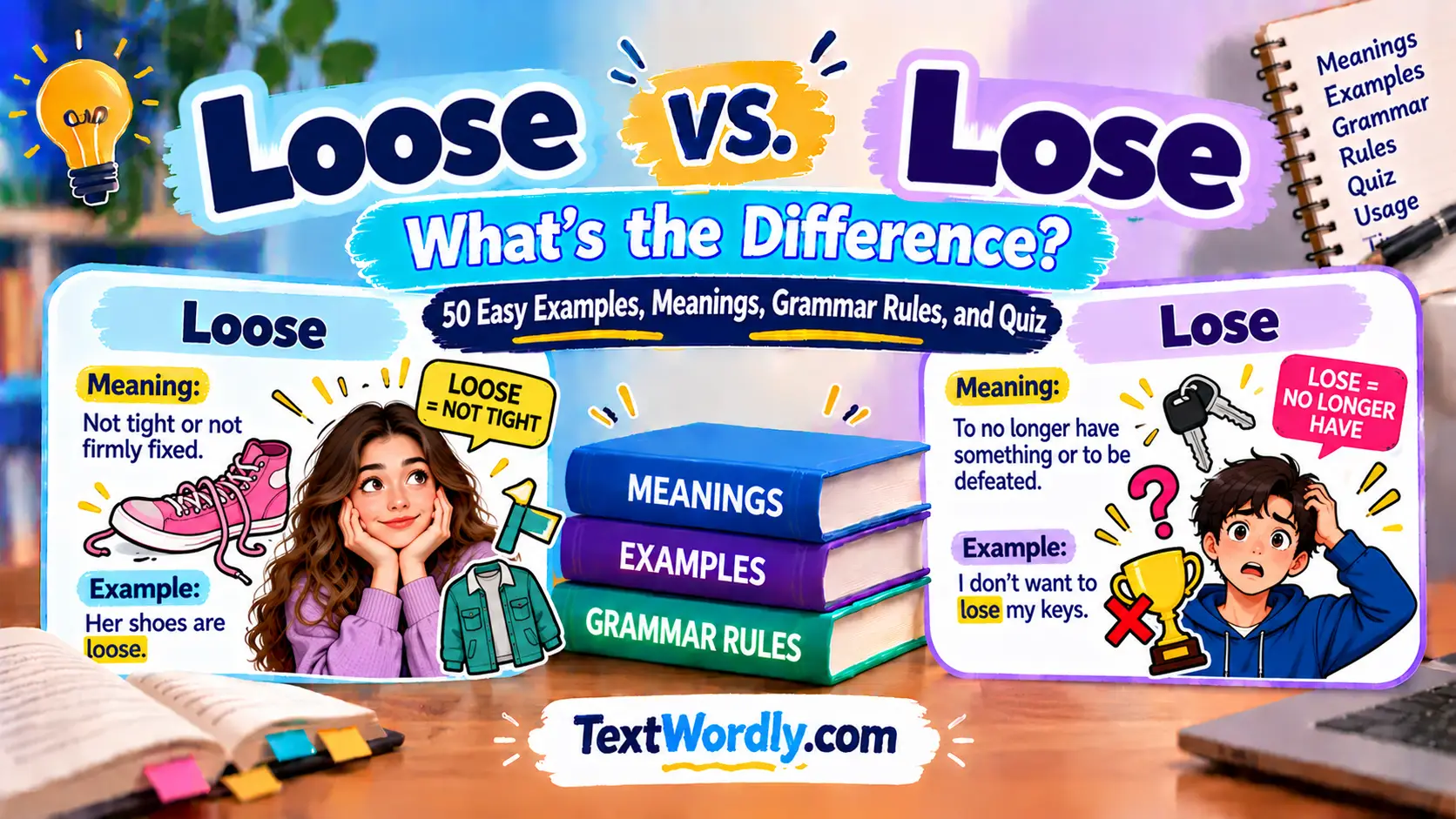
Loose and lose look similar, but they have different meanings and pronunciations. Loose usually means not tight or not firmly attached. Lose means to misplace something, fail to win, or no longer have something.
Compare these sentences:
- “My shoes are loose.” — They do not fit tightly.
- “Don’t lose your shoes.” — Don’t misplace them.
The pronunciation also changes. Loose ends with an S sound, while lose ends with a Z sound.
This guide explains the difference through 50 practical examples, grammar rules, pronunciation tips, common mistakes, and a short quiz.
Loose vs Lose: Quick Answer
The easiest rule is:
Loose = Not tight.
Lose = Misplace, fail to win, or no longer have.
| Feature | Loose | Lose |
|---|---|---|
| Main meaning | Not tight or firmly attached | Misplace or fail to win |
| Usual grammar role | Adjective | Verb |
| Pronunciation | /luːs/ | /luːz/ |
| Example | The rope is loose. | Don’t lose the rope. |
| Related forms | Looser, loosest | Loses, lost, losing |
Memory trick: Loose has two O’s. Imagine the extra O creating extra room. Lose has one O, which can remind you of something missing.
What Does Loose Mean?
Loose most commonly functions as an adjective describing something that is not tight, secure, or firmly attached.
It can describe clothing, objects, animals, and arrangements.
For example:
“These pants are loose around the waist.”
“The table has a loose leg.”
“The dog got loose.”
Loose can also describe something less strict or exact, as in loose rules or a loose interpretation.
Less commonly, loose functions as a verb meaning to release or set free.
For example:
“The archer loosed an arrow.”
In everyday American English, loosen is generally more common when you mean making something less tight.
What Does Lose Mean?
Lose is a verb meaning to misplace something, fail to win, stop having something, or experience a reduction.
It appears in everyday situations involving possessions, sports, work, money, and emotions.
For example:
“Don’t lose your phone.”
“Our team might lose the game.”
“She doesn’t want to lose her job.”
“You may lose track of time.”
Verb Forms of Lose
| Verb Form | Example |
|---|---|
| Lose | I don’t want to lose. |
| Loses | He often loses his keys. |
| Lost | She lost her wallet. |
| Losing | They are losing the match. |
Important: Lose is irregular. Its past tense and past participle are lost, not loosed.
Loose vs Lose: Key Differences
The most important distinction is grammatical.
Loose usually describes a condition. Lose describes an action or change.
| Question | Loose | Lose |
|---|---|---|
| Does it describe something not tight? | Yes | No |
| Does it mean to misplace something? | No | Yes |
| Does it mean to fail to win? | No | Yes |
| Is it commonly an adjective? | Yes | No |
| Is it commonly a verb? | Less commonly | Yes |
Compare Two Sentences
“The dog’s collar is loose.”
“Don’t lose the dog’s collar.”
The first describes how the collar fits. The second warns against misplacing it.
Writing tip: If you can replace the word with not tight, choose loose. If you can replace it with misplace or fail to win, choose lose.
50 Loose vs Lose Examples in Sentences
These 50 examples show how both words work in everyday American English.
Clothing and Personal Items
- My jeans are too loose.
- I don’t want to lose my favorite jacket.
- This shirt feels loose around the shoulders.
- She might lose her hat in the wind.
- The belt is too loose.
- Don’t lose your new shoes.
- His tie was hanging loose.
- I always lose one of my gloves.
- These pants have a loose fit.
- She doesn’t want to lose her scarf.
School and Education
- The notebook pages became loose.
- Don’t lose your homework.
- The teacher noticed a loose page.
- Students sometimes lose their pencils.
- The book has a loose cover.
- I don’t want to lose my notes.
- The classroom door handle is loose.
- You could lose points for missing answers.
- The papers were held in a loose stack.
- Try not to lose your place while reading.
Sports and Games
- Our team doesn’t want to lose the match.
- His shoelaces were loose during practice.
- They might lose the final game.
- The helmet strap was too loose.
- Nobody likes to lose a close competition.
- The basketball net was hanging loose.
- The team could lose its lead.
- Her running shoes felt loose.
- We can’t afford to lose another game.
- The equipment had a loose connection.
Work and Everyday Life
- I don’t want to lose my job.
- The office chair has a loose wheel.
- Don’t lose the important documents.
- The table leg is loose.
- She might lose her appointment slot.
- The cabinet handle became loose.
- I always lose track of time.
- The window frame is loose.
- He doesn’t want to lose his phone.
- The drawer has a loose screw.
Travel, Technology, and Relationships
- Don’t lose your passport.
- The suitcase handle feels loose.
- I might lose my internet connection.
- The charging cable has a loose connection.
- She doesn’t want to lose contact with her friends.
- The dog got loose in the yard.
- We could lose our reservation.
- The fence has a loose board.
- He doesn’t want to lose his confidence.
- The rope was hanging loose.
What these examples show: Loose usually describes how something fits or how securely it is attached. Lose describes misplacing something, failing to win, or no longer having something.
When to Use Loose Correctly
Use loose when describing something not tight, securely fixed, or strictly controlled.
Common Grammar Patterns
Be + loose
“The screw is loose.”
Feel + loose
“These shoes feel loose.”
Get + loose
“The dog got loose.”
Common Expressions
- Loose clothing
- Loose screws
- Loose hair
- Loose teeth
- Loose connections
- Loose rules
Loose as an Adverb
In certain expressions, loose can function adverbially.
For example:
“The dogs were running loose.”
Here, it describes their unrestricted condition.
Grammar tip: Although loose has several grammatical uses, its adjective meaning is the most common one learners need.
When to Use Lose Correctly
Use lose when describing the action of misplacing something, failing to win, or no longer having something.
Common Grammar Patterns
Lose + possession
“Don’t lose your wallet.”
Lose + competition
“They might lose the game.”
Lose + abstract noun
“She doesn’t want to lose confidence.”
Common Expressions
- Lose weight
- Lose money
- Lose a game
- Lose your keys
- Lose patience
- Lose track of time
Lose Weight or Loose Weight?
The correct expression is lose weight.
Lose describes a reduction. Loose describes something that is not tight.
Incorrect: “I want to loose weight.”
Correct: “I want to lose weight.”
Loose vs Lose Pronunciation
The words differ in their final consonant sounds.
| Word | IPA Pronunciation | Final Sound |
|---|---|---|
| Loose | /luːs/ | S sound |
| Lose | /luːz/ | Z sound |
How to Pronounce Loose
Say loos, ending with a clear /s/ sound.
How to Pronounce Lose
Say looz, ending with a voiced /z/ sound.
Pronunciation Practice
“My shoes are loose.”
“Don’t lose your shoes.”
Speaking tip: Touch your throat while saying the final sounds. The /z/ in lose produces vocal-cord vibration, while the /s/ in loose does not.
Loose vs Lose in Everyday Writing
These words are often confused in texts, emails, school assignments, and social media posts.
Everyday Examples
“The handle is loose.”
“Don’t lose your phone.”
“The dog got loose.”
“I don’t want to lose my place in line.”
Lose Your Mind or Loose Your Mind?
The correct expression is lose your mind.
It can mean becoming extremely upset, overwhelmed, or unable to think clearly, depending on context.
Lose Track or Loose Track?
The correct expression is lose track.
Example:
“I always lose track of time when I’m reading.”
Writing tip: Before sending a message, check whether you’re describing something not tight or an action involving something being lost.
Lose, Lost, Losing and Loose, Looser, Loosest
The words follow different grammatical patterns.
| Word | Form | Example |
|---|---|---|
| Loose | Adjective | The shirt is loose. |
| Looser | Comparative adjective | This shirt is looser. |
| Loosest | Superlative adjective | This is the loosest shirt. |
| Lose | Base verb | I don’t want to lose. |
| Loses | Present tense | She loses her keys. |
| Lost | Past tense | He lost his phone. |
| Losing | Present participle | They are losing the game. |
Important Spelling Rule
Losing has one O because it comes from lose.
Looser has two O’s because it comes from loose.
Correct: “The team is losing.”
Correct: “These pants are looser.”
Losing vs Loosing: What’s the Difference?
Losing and loosing are both real words, but they have different meanings.
Losing
Losing is the -ing form of lose.
It means misplacing something, failing to win, or no longer having something.
Example:
“Our team is losing the match.”
Loosing
Loosing is the -ing form of the less common verb loose, meaning to release or set free.
Example:
“The archer is loosing an arrow.”
Quick Comparison
| Word | Meaning | Example |
|---|---|---|
| Losing | Failing to win or no longer having | They are losing the game. |
| Loosing | Releasing or setting free | The archer is loosing an arrow. |
Remember: When talking about losing weight, money, games, or possessions, use losing, not loosing.
Loose vs Loosen, Loss, and Loser
Several related words can create additional spelling confusion.
Loose vs Loosen
Loose usually describes something not tight.
Loosen is a verb meaning to make something less tight.
“The knot is loose.”
“Please loosen the knot.”
Lose vs Loss
Lose is a verb.
Loss is a noun describing something lost or the experience of losing.
“We might lose money.”
“The company reported a loss.”
Looser vs Loser
Looser is the comparative form of loose.
Loser is a noun referring to someone who loses a competition. It can also be an insulting informal term.
“These shoes are looser than my old pair.”
“The loser of the match congratulated the winner.”
Memory tip: Looser has two O’s; loser has one.
Common Loose vs Lose Mistakes
These mistakes frequently appear in everyday writing.
| Incorrect Sentence | Correct Sentence |
|---|---|
| I want to loose weight. | I want to lose weight. |
| Don’t loose your keys. | Don’t lose your keys. |
| My shoes are lose. | My shoes are loose. |
| We might loose the game. | We might lose the game. |
| The screw is lose. | The screw is loose. |
| She is loosing patience. | She is losing patience. |
| I don’t want to loose my job. | I don’t want to lose my job. |
Three Quick Questions
Ask yourself:
- Does the word mean not tight? Use loose.
- Does it mean misplace, fail to win, or no longer have? Use lose.
- Does the sentence name the result or experience of losing? Consider loss.
These meaning-based checks are more reliable than spelling guesses.
Memory Tricks and Common Expressions
The easiest memory trick focuses on the number of O’s.
Loose has two O’s — imagine extra room.
Lose has one O — imagine something missing.
Common Expressions
| Expression | Meaning |
|---|---|
| Loose clothing | Clothing that does not fit tightly |
| Loose screw | Screw that is not firmly secured |
| Get loose | Escape or become free |
| Let loose | Release or allow freedom |
| Cut loose | Become free from restrictions or connections |
| Lose weight | Become lighter |
| Lose your temper | Become angry |
| Lose track of time | Stop noticing how much time has passed |
| Lose your way | Become lost or confused about direction |
| Lose out | Miss an opportunity or advantage |
Loose Ends
Loose ends refers to unfinished details or unresolved matters.
Example:
“We need to tie up a few loose ends before finishing the project.”
This expression uses loose, not lose.
Loose vs Lose Practice Quiz
Choose the correct word or form.
Question 1: My shoes are too ______.
A. loose B. lose
Question 2: Don’t ______ your keys.
A. loose B. lose
Question 3: Our team might ______ the game.
A. loose B. lose
Question 4: The screw is ______.
A. loose B. lose
Question 5: She ______ her wallet yesterday.
A. loosed B. lost
Question 6: The players are ______ the match.
A. loosing B. losing
Answer Key With Explanations
| Question | Correct Answer | Explanation |
|---|---|---|
| 1 | A — Loose | Describes shoes that are not tight. |
| 2 | B — Lose | Means to misplace something. |
| 3 | B — Lose | Means to fail to win. |
| 4 | A — Loose | Describes something not firmly secured. |
| 5 | B — Lost | Past tense of lose. |
| 6 | B — Losing | Correct -ing form of lose. |
Score guide: Six correct answers means you understand the main difference. If you missed a question, review the comparison table and try again.
Loose vs Lose FAQs
1. What is the main difference between loose and lose?
Loose usually means not tight or not firmly attached. Lose means to misplace something, fail to win, or no longer have something.
2. Is it loose weight or lose weight?
The correct expression is lose weight because lose is the verb describing a reduction.
3. Is it loose your keys or lose your keys?
Use lose your keys because the sentence refers to misplacing them.
4. Is it loose clothing or lose clothing?
Use loose clothing when describing clothes that do not fit tightly.
5. Is it losing or loosing?
Losing is correct when you mean misplacing something or failing to win. Loosing is a less common form of the verb loose, meaning to release.
6. What is the past tense of lose?
The past tense of lose is lost.
Example: “I lost my phone yesterday.”
7. Do loose and lose sound the same?
No. Loose ends with an /s/ sound, while lose ends with a /z/ sound.
8. How can I remember loose vs lose?
Remember loose has two O’s, suggesting extra room or space. Lose has one O, which can remind you of something missing.
Final Takeaway
The difference between loose and lose depends on meaning and grammatical function.
Loose usually describes something not tight, secure, or firmly attached.
Lose describes misplacing something, failing to win, or no longer having something.
When you’re unsure, ask whether the sentence describes a condition or an action involving something being lost.