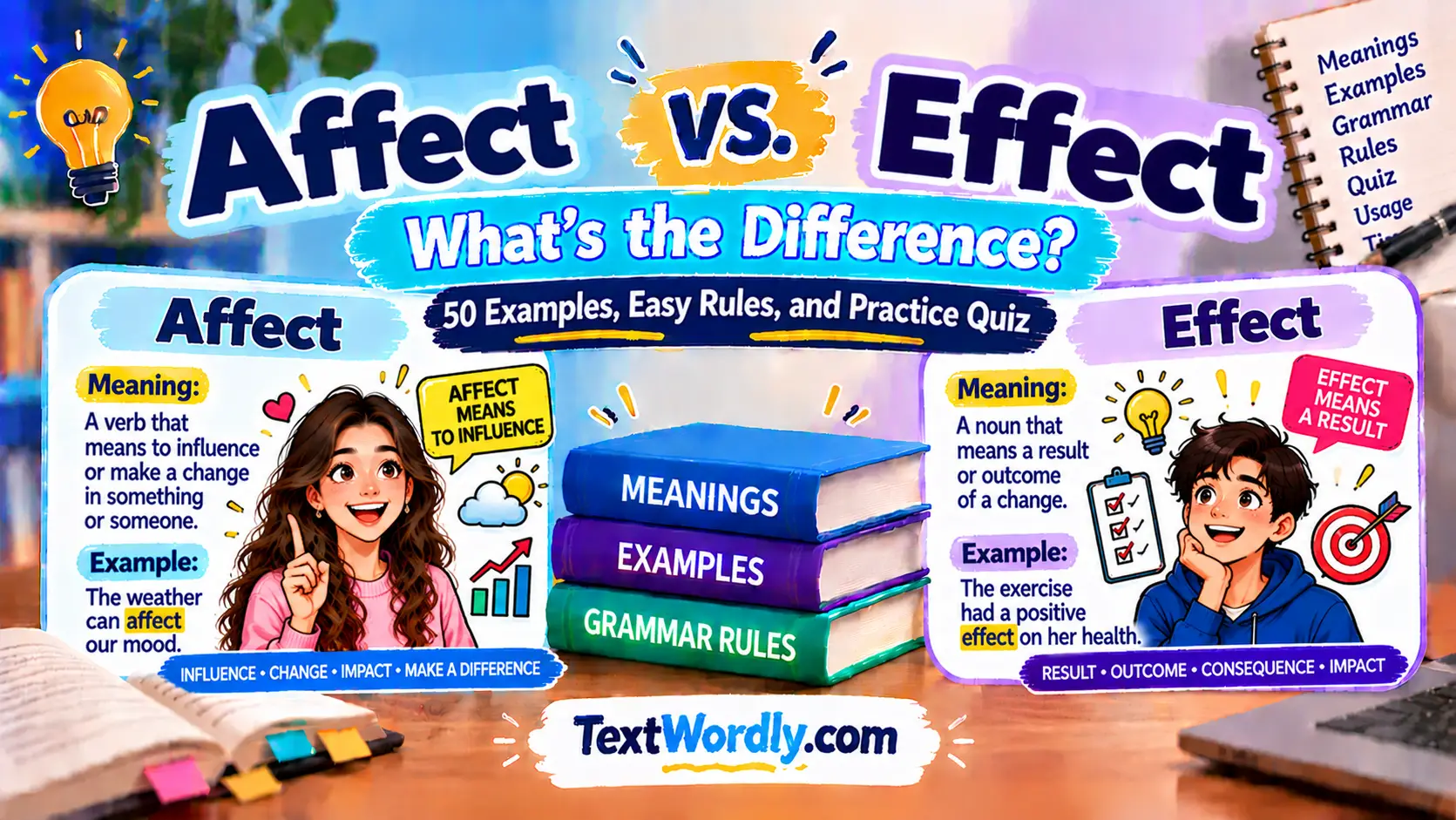
Affect vs Effect: Have you ever wondered whether to write affect or effect? You’re not alone. These two commonly confused English words sound similar, but they usually have different meanings and grammatical roles.
The good news? Once you understand one simple rule, choosing the correct word becomes much easier.
In this guide, you’ll learn the difference between affect and effect through 50 practical examples, easy grammar rules, memory tricks, common mistakes, and a six-question quiz.
Affect vs Effect: Quick Answer
Affect is usually a verb meaning to influence or change something. Effect is usually a noun meaning a result or consequence.
- Affect: The weather can affect your mood.
- Effect: The weather can have an effect on your mood.
Both sentences describe a relationship between weather and mood, but they use different sentence structures.
TL;DR
| Word | Grammar Role | Meaning | Example |
|---|---|---|---|
| Affect | Usually a verb | To influence | Stress affects sleep. |
| Effect | Usually a noun | A result | Stress has an effect on sleep. |
Easy memory trick: Affect = Action. Effect = End result.
This rule works in most everyday situations, although there are a few important exceptions.
What Does Affect Mean?
Affect means to influence, change, or make a difference to something.
It usually functions as a verb because it describes an action or influence.
Examples of Affect in Sentences
- Bad weather can affect travel plans.
- Lack of sleep may affect your concentration.
- Exercise can affect your energy levels.
- Loud noises often affect productivity.
- Your attitude can affect your relationships.
In each example, one thing influences another.
Simple Grammar Rule
Use this common pattern:
Subject + affect + object
Example: The announcement affected everyone.
The verb changes form depending on tense and subject: affect, affects, affected, or affecting.
What Does Effect Mean?
Effect usually means a result, outcome, or consequence of an action.
It is most commonly a noun.
Examples of Effect in Sentences
- The medicine had a positive effect.
- The movie had a powerful effect on viewers.
- The new policy produced an unexpected effect.
- Regular exercise can have beneficial effects.
- The storm’s effects lasted several days.
Each sentence describes a result rather than the action producing it.
Simple Grammar Rule
Common expressions include:
- Have an effect on
- Produce an effect
- Notice an effect
- Experience the effects of
Helpful tip: If you can replace the word with result or consequence, effect is often the correct choice.
Affect vs Effect: Key Differences
The main difference between affect and effect is their usual grammatical function.
| Feature | Affect | Effect |
|---|---|---|
| Part of speech | Usually verb | Usually noun |
| Meaning | Influence | Result |
| Focus | Action or change | Outcome |
| Common synonym | Influence | Consequence |
| Example | Noise affects sleep. | Noise has an effect on sleep. |
Compare These Sentences
- The rain affected our picnic.
- The rain had an effect on our picnic.
Both sentences are correct.
The first emphasizes what influenced the picnic. The second identifies the influence as a result or consequence.
Remember that affect and effect are not normally interchangeable, even when the sentences communicate similar ideas.
50 Affect vs Effect Examples in Sentences
The following examples show how both words appear naturally in American English.
Everyday Life Examples
- Cold temperatures can affect your comfort.
- Music can affect your emotions.
- The delay had an unexpected effect on our schedule.
- Good habits can have a lasting effect on your life.
- Family decisions sometimes affect everyone.
Health and Wellness Examples
- Poor sleep can affect memory.
- Hydration may affect physical performance.
- The treatment produced a noticeable effect.
- Stress can have several effects on the body.
- Daily exercise can affect overall fitness.
School Examples
- Noise can affect classroom learning.
- The teacher’s encouragement affected my confidence.
- The new teaching method had a positive effect.
- Reading regularly can affect vocabulary development.
- The experiment demonstrated the effect of heat on water.
Workplace Examples
- Budget changes may affect employee benefits.
- The new schedule had an effect on productivity.
- Poor communication can affect teamwork.
- The training program produced measurable effects.
- Leadership decisions often affect workplace morale.
Technology Examples
- Software updates can affect device performance.
- The update had an unexpected effect on battery life.
- Internet speed can affect video quality.
- The new design created an interesting visual effect.
- Security changes may affect account access.
Weather and Environment Examples
- Heavy rain can affect road conditions.
- The drought had serious effects on local farms.
- Pollution can affect air quality.
- The storm’s effects were visible for weeks.
- Rising temperatures can affect wildlife habitats.
Relationships and Emotions Examples
- Kind words can affect someone’s confidence.
- Her advice had a lasting effect on me.
- Arguments can affect family relationships.
- The surprise had an emotional effect on everyone.
- Personal experiences often affect our opinions.
Business and Financial Examples
- Inflation can affect household spending.
- The advertising campaign had a positive effect on sales.
- Market conditions may affect investment decisions.
- The price increase produced an immediate effect on demand.
- Customer feedback can affect future product development.
These 50 examples demonstrate the most common uses of affect and effect across different situations.
When to Use Affect Correctly
Use affect when you need a verb meaning influence.
Common Verb Forms
| Form | Example |
|---|---|
| Affect | Changes can affect everyone. |
| Affects | The noise affects my focus. |
| Affected | The delay affected our plans. |
| Affecting | The problem is affecting sales. |
Important Grammar Tip
Use affects with a singular third-person subject in the simple present tense.
Correct: The weather affects traffic.
Correct: Weather conditions affect traffic.
The difference depends on subject–verb agreement, not the meaning of affect.
When to Use Effect Correctly
Use effect when naming the result of an action.
It frequently appears after words such as an, the, positive, negative, and lasting.
Common Sentence Patterns
| Pattern | Example |
|---|---|
| Have an effect on | Noise has an effect on sleep. |
| Produce an effect | The change produced an effect. |
| Notice an effect | We noticed an effect immediately. |
| Effects of something | The effects of stress vary. |
Singular vs. Plural
Effect refers to one result.
Effects refers to multiple results.
Example: The decision had several unexpected effects.
Affect vs Effect in School and Academic Writing
In academic writing, these words frequently appear in explanations of causes, results, and relationships between variables.
Use affect when describing how one factor influences another.
Use effect when describing the result being studied.
Academic Examples
- Temperature can affect chemical reactions.
- Researchers studied the effect of temperature on reaction rates.
- Study habits may affect exam performance.
- The report examined the effects of sleep deprivation.
Writing tip: In research papers, effect is often used when discussing measurable outcomes, while affect describes influence. However, always choose based on grammatical meaning rather than academic context alone.
Affect vs Effect at Work and in Everyday Life
Professional communication benefits from clear, direct sentences.
Compare these examples:
Sentence A: The new rules will affect employees.
Sentence B: The new rules will have an effect on employees.
Both are correct, but Sentence A is shorter.
In business emails, reports, and everyday conversations, using affect as a verb often makes a sentence more concise.
Use effect when the outcome itself deserves emphasis.
For example:
“The policy had a significant effect on customer satisfaction.”
This wording emphasizes the result of the policy.
Affected vs Effected: What’s the Difference?
Affected and effected are both valid English words, but they have different meanings.
Affected means influenced or changed.
Effected means brought about or accomplished.
Examples
- The storm affected thousands of residents.
- The organization effected major reforms.
- The announcement affected employee confidence.
- The committee effected a policy change.
Affect Change vs Effect Change
| Expression | Meaning |
|---|---|
| Affect change | Influence a change or process of change |
| Effect change | Bring about change |
Important: Effect change is common in formal writing when describing successfully creating a change.
Affected change is possible, but its meaning is different and the phrase is less common.
Can Affect Be a Noun and Effect Be a Verb?
Yes. The usual rule has exceptions.
Affect as a Noun
In psychology, affect refers to an emotional state or its observable expression.
Example:
“The clinician observed a flat affect.”
This specialized meaning is different from the everyday verb affect.
Effect as a Verb
Effect can also mean to bring about or accomplish something.
Example:
“The organization hopes to effect meaningful change.”
Here, effect is a verb meaning bring about.
These less common uses are recognized by dictionaries such as Merriam-Webster.
Affect vs Effect Pronunciation and Memory Tricks
The everyday verb affect and noun effect sound very similar in American English.
Both commonly have stress on the second syllable.
The noun affect, used in psychology, is usually pronounced with stress on the first syllable.
The RAVEN Memory Trick
Remember:
RAVEN = Remember Affect Verb, Effect Noun
This mnemonic helps with most everyday situations.
The Action and Result Trick
- Affect = Action: Something influences something else.
- Effect = End result: Something happens because of an action.
Example:
“The strong wind affected the trees.”
“The effect was several broken branches.”
Use these tricks for ordinary writing, while remembering the uncommon grammatical exceptions.
Common Affect vs Effect Mistakes
One of the easiest ways to improve your grammar is to study incorrect sentences alongside corrected versions.
| Incorrect | Correct |
|---|---|
| The weather will effect our plans. | The weather will affect our plans. |
| The news had a strong affect on me. | The news had a strong effect on me. |
| Stress can effect your sleep. | Stress can affect your sleep. |
| The change had no affect. | The change had no effect. |
| The medicine had an unexpected affect. | The medicine had an unexpected effect. |
| The decision will have an affect. | The decision will have an effect. |
These corrections apply to the intended everyday meanings, not the specialized exceptions.
Quick Self-Check
Ask yourself two questions:
Am I describing an influence? Use affect.
Am I naming a result? Use effect.
This simple check prevents most common mistakes.
Common Phrases Using Affect and Effect
Some English expressions almost always use one particular word.
| Phrase | Meaning |
|---|---|
| Take effect | Begin working or applying |
| In effect | Operating, applicable, or essentially |
| Side effect | Additional result, often unwanted |
| Cause and effect | Relationship between a cause and its result |
| Lasting effect | Result that continues over time |
| Affect someone’s judgment | Influence decision-making |
Examples
- The new law will take effect next week.
- The agreement remains in effect.
- Drowsiness may be a side effect of some medicines.
- The lesson explained cause and effect.
- Lack of sleep can affect your judgment.
Remember: The correct expression is take effect, not take affect.
Affect vs Effect Practice Quiz
Choose the correct word for each sentence.
Grammar Practice Quiz
0 / 6 answered
1. The weather can ___ our travel plans.affecteffect
2. The new policy had a positive ___ on employees.affecteffect
3. Lack of sleep may ___ your concentration.affecteffect
4. The medicine had an unexpected ___.affecteffect
5. The organization successfully ___ meaningful reform.affectedeffected
6. The students were deeply ___ by the speech.affectedeffected
Check Answers
Reset
Copyable Answer Key
1. affect — Affect is the verb meaning influence. 2. effect — Effect is a noun describing a result. 3. affect — The sentence needs a verb meaning influence. 4. effect — Effect names the result of the medicine. 5. effected — Effected means brought about or accomplished. 6. affected — Affected means emotionally influenced.
Copy Answer Key
Affect vs Effect FAQs
1. What is the difference between affect and effect?
Affect usually means to influence and functions as a verb. Effect usually means a result and functions as a noun.
2. Is it affect or effect on someone?
The correct noun phrase is effect on someone. For example, “The news had a strong effect on me.” You can also say, “The news affected me.”
3. Is it affect change or effect change?
Effect change means to bring about change. Affect change means to influence a change or the process of change. Both are possible, but their meanings differ.
4. Does stress affect or effect your health?
Use affect when describing influence: “Stress can affect your health.” You can also say, “Stress can have an effect on your health.”
5. Is it positive affect or positive effect?
Positive effect means a beneficial result. Positive affect is a psychological term describing positive emotions or their expression.
6. Is it take affect or take effect?
The correct phrase is take effect. It means to begin operating, working, or applying.
7. What is the easiest way to remember affect vs effect?
Remember the RAVEN rule: Remember Affect Verb, Effect Noun. It works for most ordinary English sentences.
8. Can affect and effect be used interchangeably?
Usually, no. They typically have different grammatical functions and meanings. Their less common noun and verb uses do not make them generally interchangeable.
Final Takeaway
The easiest way to understand affect vs effect is to remember their usual grammatical roles.
Affect describes an influence or action. Effect describes the result.
Use the RAVEN memory trick, review the example sentences, and practice identifying whether a sentence needs a verb or a noun. With consistent practice, choosing the correct word becomes much easier.