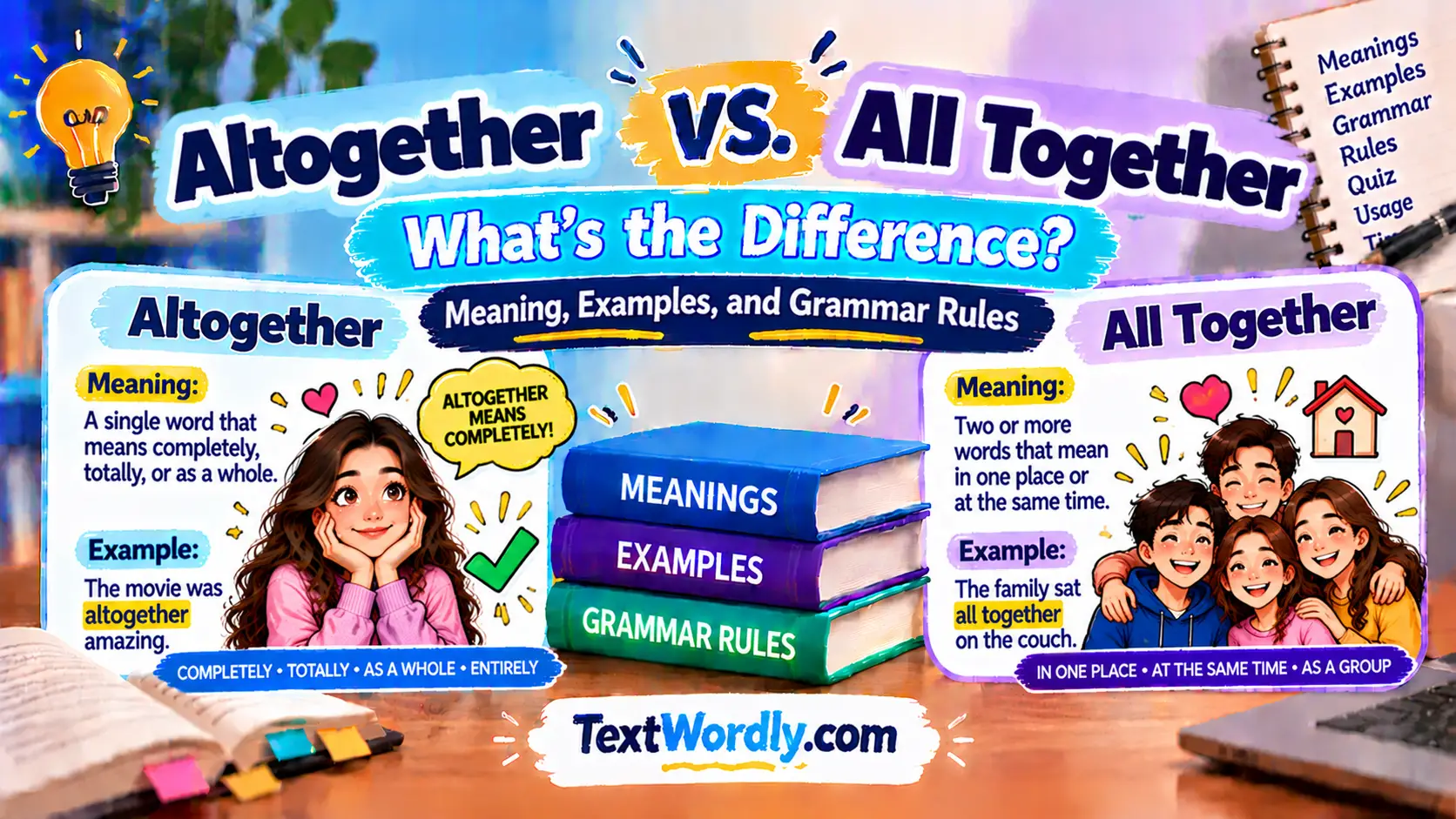
Altogether vs All Together: Have you ever wondered whether to write altogether or all together? These expressions sound the same, but their meanings are different.
Altogether means completely, in total, or overall. All together means everyone or everything gathered or acting as a group.
For example, “She stopped eating candy altogether” means she stopped completely. “The children sat all together” means they sat as one group.
Understanding the difference between altogether vs all together will help you avoid spelling mistakes and write more naturally in American English.
QUICK ANSWER
Altogether (one word): Completely, entirely, in total, or overall.
All together (two words): Everyone or everything together as a group.
| Altogether | All Together |
|---|---|
| She stopped altogether. | We worked all together. |
| There were 20 guests altogether. | The guests stood all together. |
| Altogether, it was a good trip. | The children sang all together. |
TL;DR: Use altogether when you mean completely, in total, or overall. Use all together when people or things are grouped or acting together.
1. What Does Altogether Mean?
Altogether is an adverb with three main meanings: completely, in total, and overall.
Examples:
- She stopped drinking soda altogether.
- There were 25 students altogether.
- Altogether, the event was successful.
The meaning depends on the sentence.
Remember: Altogether is always written as one word when used as this adverb.
2. What Does All Together Mean?
All together is a two-word expression describing people or things in one group or taking part in the same activity.
Examples:
- We sat all together at lunch.
- The children sang all together.
- Put the chairs all together.
It emphasizes grouping or shared action.
Easy trick: If you mean as a group, use all together.
3. Altogether vs All Together: Key Differences
The main difference is meaning, not pronunciation.
| Feature | Altogether | All Together |
|---|---|---|
| Spelling | One word | Two words |
| Grammar | Adverb | Two-word expression |
| Meaning | Completely, overall, in total | As a group |
| Example | The plan was altogether different. | We arrived all together. |
Memory trick: Altogether = completely. All together = as a group.
4. When Should You Use Altogether?
Use altogether when emphasizing completeness, calculating a total, or giving an overall opinion.
Examples:
- He abandoned the project altogether.
- The tickets cost $90 altogether.
- Altogether, the vacation was enjoyable.
You can often replace it with completely, in total, or overall.
The correct replacement depends on the intended meaning.
5. When Should You Use All Together?
Use all together when everyone or everything is included in a shared action or location.
Examples:
- Let’s take a picture all together.
- The family gathered all together.
- We placed the boxes all together.
In many sentences, you can replace the expression with as a group or in one place.
6. Altogether Meaning Completely
One common meaning of altogether is completely or entirely.
Examples:
- She gave up smoking altogether.
- The new plan was altogether different.
- He stopped attending the meetings altogether.
Here, the word emphasizes a complete change or action.
Grammar tip: If completely fits naturally, altogether may be the correct choice.
7. Altogether Meaning In Total
Altogether can also express a combined number, amount, or cost.
Examples:
- There were 40 guests altogether.
- We spent $150 altogether.
- The class collected 60 books altogether.
In these sentences, altogether means in total.
It is especially useful when discussing numbers, prices, and quantities.
8. Altogether Meaning Overall
At the beginning of a sentence, altogether can mean overall or considering everything.
Examples:
- Altogether, the trip was wonderful.
- Altogether, we enjoyed the experience.
- Altogether, the results were encouraging.
This use summarizes an opinion or judgment.
A comma commonly follows altogether when it introduces this type of statement.
9. Not Altogether Meaning
The expression not altogether means not completely or not entirely.
Examples:
- The instructions were not altogether clear.
- I’m not altogether sure about the decision.
- His explanation was not altogether convincing.
Important: “Not altogether clear” does not mean completely unclear.
It means the explanation may be partly clear but still has some problems.
10. All Together Now Meaning
All together now! is a common expression used when asking a group to do something at the same time.
Examples:
- All together now, let’s sing!
- All together now, count to three!
- All together now, say cheese!
The expression emphasizes coordinated action.
Because it refers to everyone acting together, all together is written as two words.
11. Altogether vs In All
Altogether and in all can have the same meaning when describing totals.
Examples:
- There were 30 students altogether.
- There were 30 students in all.
Both mean 30 students in total.
However, in all does not normally replace altogether when it means completely.
Correct: She stopped altogether.
Incorrect for that meaning: She stopped in all.
12. All Together vs Together
Together means with others or in a shared group.
All together emphasizes that everyone or everything is included.
Compare:
- We studied together.
- We studied all together.
- We all studied together.
All three sentences can be correct.
The last two emphasize the participation of the whole group. In everyday conversation, “We all studied together” often sounds more natural.
13. Can Both Spellings Be Correct?
Yes. Sometimes both spellings can produce grammatical sentences, but the meaning changes.
Compare:
Altogether: There were ten people altogether.
Meaning: Ten people in total.
All together: The ten people stood all together.
Meaning: Everyone stood as one group.
Another comparison:
- The students stopped talking altogether.
- The students started talking all together.
The first describes stopping completely. The second describes a shared action.
14. Common Altogether vs All Together Mistakes
Most mistakes happen when writers confuse completeness with grouping.
| Incorrect for the intended meaning | Correct |
|---|---|
| She quit smoking all together. | She quit smoking altogether. |
| We stood altogether for a photo. | We stood all together for a photo. |
| The plan was all together different. | The plan was altogether different. |
| Let’s sing altogether now! | Let’s sing all together now! |
Some sentences allow both spellings with different meanings. Always consider the context before correcting them.
Quick test: Replace the expression with completely, in total, or as a group.
15. Altogether vs All Together Examples and Practice Quiz
Choose the correct expression in each sentence.
Test Your Grammar0 of 6 answered
1. She stopped eating candy ___.altogetherall together
2. The students stood ___ for the class photo.altogetherall together
3. The tickets cost $120 ___.altogetherall together
4. ___ now, let’s sing the chorus!AltogetherAll together
5. The new design is ___ different.altogetherall together
6. Please put all the chairs ___ in the corner.altogethertogether
16. Altogether vs All Together FAQs and Final Thoughts
Frequently Asked Questions
What is the difference between altogether and all together?
Altogether means completely, overall, or in total. All together means everyone or everything acting or gathered as a group.
Is altogether one word or two?
Altogether is one word. All together is a separate two-word expression.
Does altogether mean completely?
Yes. For example, “She stopped altogether” means she stopped completely.
Can altogether mean in total?
Yes. “There were 50 guests altogether” means there were 50 guests in total.
What does all together mean?
It means people or things are gathered, grouped, or acting together.
What does all together now mean?
It is an instruction asking everyone to do something at the same time.
Is altogether the same as in all?
They can mean the same thing when expressing a total, but not when altogether means completely.
Can both expressions appear in one sentence?
Yes. For example, “There were 20 students altogether, and they stood all together for a photograph.”
Final Thoughts
The difference between altogether vs all together becomes easy when you remember two simple rules.
Altogether = Completely, overall, or in total.
All together = Everyone or everything as a group.
If you can replace the expression with completely or in total, choose altogether. If you mean as a group, choose all together.