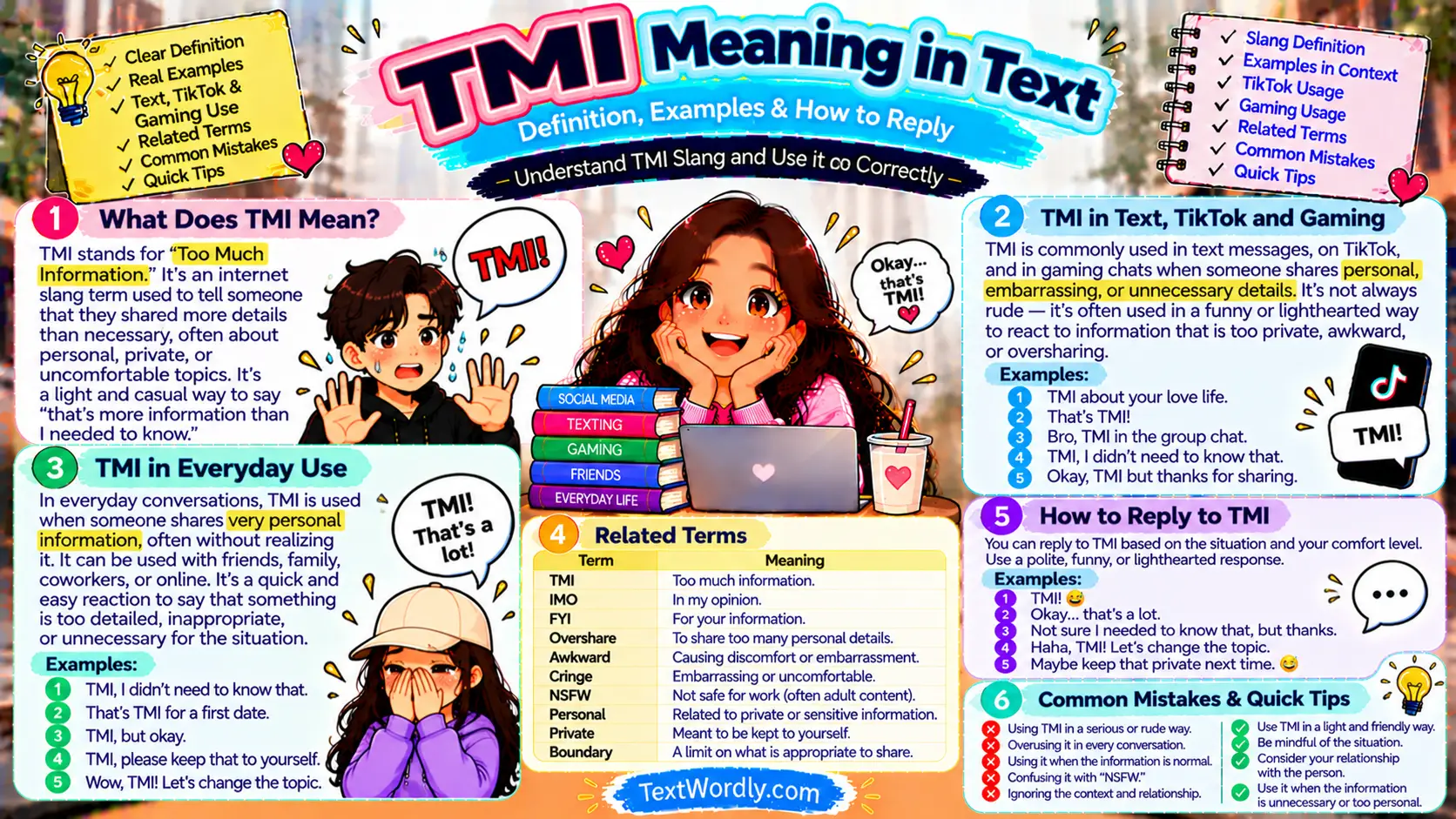
TMI Meaning in Text: Have you ever shared an embarrassing story and received a reply saying “TMI!”? Maybe a friend revealed an awkward dating detail, someone described their bathroom problems, or a person posted a surprisingly personal confession on social media.
TMI stands for “Too Much Information.” It’s a common texting abbreviation used when someone shares more personal, uncomfortable, embarrassing, or unnecessary details than another person wants to hear.
For example, if your friend starts describing an awkward bathroom experience, you might reply, “Okay, TMI! 😂”
However, TMI isn’t always rude or insulting. Friends often use it jokingly, while others use it to communicate a genuine boundary about uncomfortable topics.
You may also see expressions such as “Sorry for the TMI,” “Is this TMI?” or “TMI warning.” Each phrase communicates something slightly different.
Understanding the TMI meaning in text helps you recognize someone’s tone, avoid misunderstandings, and respond respectfully.
This guide explains what TMI means on Snapchat, TikTok, Instagram, and WhatsApp, how it works in dating conversations, and the best ways to reply.
QUICK ANSWER
TMI = Too Much Information
TMI means someone has shared more information than another person wants or needs to hear.
Example:
Alex: “Let me tell you every embarrassing detail of my date.”
Jordan: “TMI! 😂”
The reply suggests Jordan doesn’t want all those details, possibly in a joking way.
TL;DR
- TMI means Too Much Information.
- It often refers to overly personal or uncomfortable details.
- It can be playful, sarcastic, serious, or rude depending on context.
- “Sorry for the TMI” means the speaker realizes they may have overshared.
- “Is this TMI?” asks whether the information is too personal.
- “TMI warning” prepares someone for potentially uncomfortable details.
- TMI has the same basic meaning on Snapchat, TikTok, Instagram, and WhatsApp.
- Common replies include “Oops, sorry!”, “Haha, my bad!”, and “Got it, I’ll stop.”
1. What Does TMI Mean in Text?
TMI means “Too Much Information.” It’s an informal abbreviation used when someone shares details that feel excessive, unnecessary, embarrassing, or too personal.
Instead of writing:
“That’s more information than I wanted to know.”
Someone might simply reply:
“TMI!”
Both communicate a similar reaction.
People commonly use TMI in casual conversations, group chats, and social media comments.
| Text Message | Meaning |
|---|---|
| “TMI!” | That’s too much information |
| “Eww, TMI 😂” | Playful or uncomfortable reaction |
| “Sorry, TMI” | Sorry for oversharing |
| “That’s TMI” | Those details are too personal or unnecessary |
| “No TMI here” | Personal details are welcome |
| “TMI warning” | Personal or potentially uncomfortable details may follow |
| “Is this TMI?” | Am I sharing too much? |
The exact meaning depends on the topic, relationship, and tone.
TMI describes someone’s reaction to information. It doesn’t automatically mean the speaker did something wrong.
2. What Does TMI Stand For?
TMI is an initialism formed from three words:
- T = Too
- M = Much
- I = Information
The full expression is “Too Much Information.”
Is TMI Slang or an Abbreviation?
TMI is an abbreviation commonly used in informal communication.
People also describe it as internet slang because it appears frequently in text messages, social media comments, and online conversations.
Is TMI Always Negative?
No.
It can be a funny reaction between friends or a serious expression of discomfort.
For example:
“You really told me all that? TMI 😂”
This may be playful.
But:
“That’s TMI. Please don’t share those details with me.”
This communicates a genuine boundary.
Does TMI Only Refer to Private Information?
Not always.
TMI can also describe unnecessary details that make a conversation longer, more awkward, or more uncomfortable than expected.
However, it’s most commonly associated with personal information.
3. Why Do People Say TMI in Text Messages?
People use TMI to react quickly when a conversation becomes more personal or detailed than expected.
Sometimes they want to make a joke. Other times they want the speaker to change the subject.
Common Reasons for Using TMI
| Reason | Example |
|---|---|
| Reacting to oversharing | “Okay, TMI!” |
| Expressing embarrassment | “I didn’t need to know that 😂” |
| Setting boundaries | “That’s TMI for me.” |
| Apologizing | “Sorry, TMI.” |
| Warning someone | “TMI warning!” |
| Making a joke | “Wow, TMI bestie 😂” |
Does TMI Mean Stop Talking?
Sometimes.
A playful “TMI 😂” may simply acknowledge an awkward detail.
A serious “Please stop, that’s TMI” is a clearer request to change the subject.
Respect the other person’s comfort level rather than assuming every TMI response is a joke.
Why Is TMI Useful?
TMI helps people express surprise, discomfort, or humor in a short message.
However, it works best when both people understand the tone.
4. How to Use TMI in a Sentence
TMI works as a standalone reply or within a longer sentence.
As a Reaction
“TMI!”
This expresses surprise or discomfort about excessive details.
As an Apology
“Sorry, that was TMI.”
The speaker recognizes they may have overshared.
As a Warning
“TMI warning: I’m about to tell you an embarrassing story.”
This prepares the listener for personal details.
As a Joke
“Nobody asked for your entire bathroom routine. TMI 😂”
The sender is reacting humorously to oversharing.
As a Boundary
“That’s a little TMI for me. Can we change the subject?”
This clearly and politely communicates discomfort.
As a Question
“Is this TMI?”
The speaker is asking whether the information is too personal.
5. TMI Meaning on Snapchat
On Snapchat, TMI means “Too Much Information.”
People use it in direct messages and Story replies when someone shares unexpectedly personal details.
Snapchat Conversation Example
Emma: “You won’t believe how embarrassing my date was.”
Noah: “What happened?”
Emma: “Let me explain every awkward detail.”
Noah: “TMI 😂”
Noah’s reply may be a playful reaction.
What Does TMI Mean in a Snapchat Story?
Someone might post:
“TMI warning: embarrassing story time!”
This warns viewers that the Story may include personal information.
The abbreviation doesn’t have a special Snapchat-only meaning.
Is TMI on Snapchat Always Rude?
No.
Friends may use it jokingly, especially when sharing embarrassing stories.
However, a serious response should be respected.
6. TMI Meaning on TikTok, Instagram, and WhatsApp
TMI has the same basic definition across social media platforms.
However, people use it in different ways.
| Platform | Example | Meaning |
|---|---|---|
| TikTok | “TMI story time!” | Personal or embarrassing story |
| “Okay, TMI 😂” | Reaction to oversharing | |
| Snapchat | “Sorry, TMI!” | Apology for excessive details |
| “That’s a bit TMI.” | Expressing discomfort | |
| Group chat | “TMI, guys!” | Reacting to a conversation |
TMI on TikTok
Creators may use “TMI story time” as a caption to introduce a personal or embarrassing experience.
TMI on Instagram
Someone may reply “TMI!” to an Instagram Story that reveals more personal information than expected.
TMI on WhatsApp
In private or group conversations, TMI can be a joke or a polite way to communicate that a topic feels too personal.
Is TMI a Content Warning?
Not exactly.
A TMI warning generally tells people that personal or uncomfortable details may follow.
A more specific content warning may be appropriate when discussing sensitive subjects.
7. What Does TMI Mean From a Guy?
When a guy texts TMI, he usually means “Too Much Information.”
He may be joking, expressing surprise, or indicating that the conversation has become uncomfortable.
Examples
“Bro, TMI 😂” — Probably playful.
“That’s TMI for me.” — More serious discomfort.
“Sorry, TMI.” — He realizes he overshared.
Is TMI From a Guy Flirty?
Not inherently.
A playful TMI message may occur during flirting, but the abbreviation itself doesn’t express romantic interest.
Look at the complete conversation rather than assuming a hidden meaning.
Does TMI From a Guy Mean He’s Annoyed?
Not necessarily.
A joking response may simply mean he found the details surprising or embarrassing.
8. What Does TMI Mean From a Girl?
When a girl says TMI, it also means “Too Much Information.”
The definition doesn’t change based on gender.
Examples
“Girl, TMI! 😂” — A playful reaction.
“That’s a little TMI.” — Possibly uncomfortable.
“Oops, sorry for the TMI.” — Apologizing for oversharing.
Is TMI From a Girl a Sign of Disinterest?
Not necessarily.
A playful response doesn’t automatically indicate rejection or disinterest.
However, if someone clearly says they don’t want certain details, respect that boundary.
What If a Girl Says “TMI 😂”?
The laughing emoji may suggest a joking tone.
Still, the surrounding conversation matters more than the emoji alone.
9. Is TMI Flirty? Meaning in Dating and Relationships
TMI can appear in dating conversations, but it isn’t inherently romantic or flirtatious.
Sometimes people use it when a date shares unexpectedly personal information.
Dating Conversation Example
Ava: “Can I tell you something embarrassing about my last date?”
Liam: “Sure.”
Ava: “It’s kind of personal.”
Liam: “Haha, hopefully not TMI 😂”
Here, Liam uses TMI playfully.
Can TMI Be a Serious Boundary?
Yes.
If someone says:
“That’s TMI. I’m not comfortable talking about that.”
The appropriate response is to respect their request.
Does TMI Mean Someone Is Judging You?
Not always.
It may reflect personal comfort rather than a judgment about the person sharing information.
Can TMI Hurt Someone’s Feelings?
Yes.
If someone shares a vulnerable experience and receives a dismissive response, they may feel embarrassed or rejected.
Choose a respectful reply when the conversation involves sensitive information.
10. Is TMI Rude, Funny, or Serious?
The tone of TMI depends on how it’s delivered.
TMI Tone Guide
| Message | Possible Tone |
|---|---|
| “TMI 😂” | Playful |
| “Haha, TMI bestie!” | Friendly teasing |
| “That’s a little TMI.” | Polite discomfort |
| “TMI. Stop.” | Firm boundary |
| “Eww, nobody asked!” | Potentially rude |
| “Sorry, TMI.” | Apologetic |
Is Saying TMI Rude?
It can be.
A blunt or mocking response may embarrass someone who was sharing something vulnerable.
If the topic is sensitive, a more respectful response might be:
“I appreciate you trusting me, but I’m not comfortable discussing those details.”
This communicates a boundary without insulting the speaker.
When Is TMI Funny?
TMI may be funny when close friends understand each other’s humor.
However, humor shouldn’t override someone’s genuine discomfort.
When Is TMI Serious?
TMI becomes serious when someone clearly asks to stop discussing a topic.
Respect that request rather than continuing the conversation.
11. Real TMI Texting Conversation Examples
These illustrative conversations show how TMI works in everyday texting.
Example 1 — Friends
Alex: “I have the most embarrassing story.”
Jordan: “Tell me!”
Alex: “It involves a very awkward bathroom situation.”
Jordan: “TMI already 😂”
Example 2 — Apologizing
Mia: “Sorry, I probably shared too much.”
Jack: “It’s okay.”
Mia: “Yeah, that was TMI.”
Example 3 — Group Chat
Emma: “Can I tell everyone something super personal?”
Noah: “Maybe not in the group chat. TMI 😅”
Example 4 — Dating
Ava: “My last date was so awkward.”
Liam: “What happened?”
Ava: “I’ll spare you the personal details.”
Liam: “Probably a good idea 😂”
Example 5 — Workplace Conversation
Employee A: “Can I share something very personal during the meeting?”
Employee B: “Maybe we should discuss that privately.”
Employee A: “Good idea.”
This shows a professional alternative to saying TMI.
Example 6 — School Conversation
Student A: “I have an embarrassing story from yesterday.”
Student B: “Is it TMI?”
Student A: “Maybe a little.”
Student B: “Then give me the short version 😂”
Example 7 — Setting Boundaries
Sophia: “Can I explain something really personal?”
Ryan: “I’m not comfortable with that topic right now.”
Sophia: “Understood.”
This illustrates a respectful alternative to simply saying TMI.
12. How to Reply When Someone Says TMI
The best response depends on whether the sender is joking or seriously uncomfortable.
| Situation | Suggested Reply |
|---|---|
| Playful | “Haha, my bad 😂” |
| Apologetic | “Oops, sorry!” |
| Serious boundary | “Got it. I’ll stop.” |
| Friendly | “Okay, I’ll spare you the details.” |
| Unsure | “Sorry, was that too personal?” |
| Embarrassed | “Yeah, I probably overshared.” |
Funny Replies to TMI
- “Oops, no filter today 😂”
- “My bad, I’ll stop!”
- “You asked for the story!”
- “Okay, deleting that from your memory.”
Polite Replies to TMI
- “Sorry, I didn’t mean to make you uncomfortable.”
- “Understood. Let’s change the subject.”
- “Thanks for telling me.”
- “I’ll keep that private.”
What If Someone Says TMI After You Share Something Important?
If you were sharing a serious concern, it’s understandable to feel disappointed by a dismissive reply.
You can say:
“I was trying to talk about something important. Can you listen, or should I talk to someone else?”
TMI shouldn’t automatically be used to dismiss someone who genuinely needs support.
What If You’re Not Sure Whether They’re Joking?
Ask politely:
“Sorry, did that make you uncomfortable?”
This helps clarify the tone without escalating the conversation.
13. TMI vs Oversharing, FYI, and NSFW
TMI is related to other communication terms, but each has a different meaning.
| Term | Full Form or Meaning | Common Use |
|---|---|---|
| TMI | Too Much Information | Reacting to excessive personal details |
| FYI | For Your Information | Sharing useful information |
| NSFW | Not Safe For Work | Warning about potentially inappropriate content |
| Oversharing | Revealing excessive personal details | Describing a communication behavior |
| IMO | In My Opinion | Expressing a personal view |
| BTW | By The Way | Introducing an additional point |
TMI vs Oversharing
Oversharing describes the act of revealing more information than may be appropriate for the situation.
TMI is a common reaction to that information.
However, whether something counts as oversharing depends on context.
For example, discussing personal health information with a healthcare professional may be necessary and appropriate.
TMI vs FYI
FYI introduces information that someone may find useful.
TMI suggests the information may be excessive or unwanted.
TMI vs NSFW
NSFW warns that content may be unsuitable for a workplace or public setting.
TMI indicates that someone has shared more personal information than desired.
These terms aren’t interchangeable.
TMI vs Personal Disclosure
Personal disclosure means sharing information about yourself.
It isn’t automatically inappropriate.
The key difference is whether the information fits the relationship, setting, and purpose of the conversation.
14. Sorry for the TMI, Is This TMI, and TMI Warning
Several common expressions include TMI, but they serve different purposes.
What Does “Sorry for the TMI” Mean?
“Sorry for the TMI” means the speaker recognizes they may have shared too much personal information.
It’s often used after an awkward confession or detailed story.
Example:
Emma: “Sorry for the TMI. I didn’t mean to overshare.”
Noah: “No worries.”
What Does “Is This TMI?” Mean?
“Is this TMI?” means the speaker is checking whether the information is too personal or uncomfortable.
For example:
“Is this TMI, or can I tell you what happened?”
This gives the listener an opportunity to set a boundary.
What Does “TMI Warning” Mean?
It tells the reader or listener that personal or potentially uncomfortable details are coming.
For example:
“TMI warning: this story gets embarrassing.”
What Does “No TMI” Mean?
Depending on context, “No TMI” may mean someone is comfortable hearing personal information.
For example:
“You can tell me. No TMI here.”
This suggests the listener is open to hearing the story, though boundaries still matter.
What Does “That’s TMI for Me” Mean?
It means the listener personally finds the information excessive or uncomfortable.
This is a more direct way of expressing a boundary.
15. Common TMI Mistakes and Misunderstandings
TMI is simple, but its tone can easily be misunderstood.
Common Mistakes
- Assuming TMI is always an insult.
- Believing TMI always refers to sexual information.
- Thinking TMI has a different meaning on every platform.
- Assuming a joking TMI response is a serious rejection.
- Using TMI to mock someone sharing a vulnerable experience.
- Ignoring a serious request to stop discussing a topic.
- Confusing TMI with FYI or NSFW.
- Assuming oversharing is always intentional.
- Treating all personal disclosure as inappropriate.
- Assuming “No TMI” means someone has no boundaries.
Does TMI Only Refer to Intimate Details?
No.
TMI can refer to many kinds of personal information, including embarrassing experiences, private relationship matters, or unnecessary details.
Is TMI Always a Sign of Oversharing?
Not necessarily.
Some people use it humorously even when the information isn’t especially personal.
The sender’s tone and the relationship help determine the meaning.
Is Sharing Health Information Automatically TMI?
No.
Health information can be important and appropriate, especially when discussing symptoms with a healthcare professional or seeking support from someone you trust.
The setting and purpose of the conversation matter.
16. When to Use TMI and When to Avoid It
TMI is most suitable for casual conversations where the tone is understood.
It’s useful when reacting to oversharing or acknowledging that you’ve shared too much.
| Situation | Recommended Wording |
|---|---|
| Joking with a close friend | “TMI 😂” |
| Apologizing | “Sorry, that was TMI.” |
| Warning before a story | “TMI warning!” |
| Setting a polite boundary | “That’s a little too personal for me.” |
| Professional conversation | “I’d prefer not to discuss those details.” |
| Responding to vulnerability | “Thanks for trusting me.” |
Is TMI Professional?
TMI may appear in casual workplace conversations, but it’s generally better to use clear and respectful wording in formal settings.
When Should You Avoid TMI?
Avoid using TMI to embarrass someone, dismiss an important concern, or mock personal information shared in confidence.
How Can You Avoid Oversharing?
Before sharing sensitive details, consider asking:
“Are you comfortable hearing something personal?”
This gives the other person a chance to decide.
The main rule is simple: use TMI carefully, and consider whether the other person is joking, uncomfortable, or genuinely seeking support.
Frequently Asked Questions About TMI Meaning in Text
What does TMI mean in text?
TMI stands for “Too Much Information.” It usually means someone has shared more personal details than another person wants to hear.
What does TMI mean in slang?
It means “Too Much Information.” It’s a common informal expression used in texting and conversation.
What does TMI mean on Snapchat?
On Snapchat, TMI has the same meaning. People use it in chats and Story replies when someone overshares.
What does TMI mean on TikTok?
It may describe an overly personal story, confession, or embarrassing experience.
What does TMI mean from a guy?
It usually means he thinks the information is excessive or too personal.
What does TMI mean from a girl?
It has the same meaning. The tone may be playful or serious.
Is TMI rude?
It can be, especially if used to mock or embarrass someone. However, friends often use it jokingly.
Is TMI flirty?
Not inherently. It can appear in playful dating conversations but doesn’t directly mean flirting.
What does “Sorry for the TMI” mean?
It means the speaker realizes they may have shared too much information.
What does “Is this TMI?” mean?
It means the speaker is asking whether the information is too personal or uncomfortable.
What does “TMI warning” mean?
It warns that the next message may include personal or uncomfortable details.
What does “No TMI” mean?
It may indicate that someone is comfortable hearing personal details.
How do you reply to TMI?
You can say “Oops, sorry,” “Haha, my bad,” or “Understood, I’ll stop.”
What is the difference between TMI and FYI?
TMI means “Too Much Information,” while FYI means “For Your Information.”
Does TMI always mean something inappropriate?
No. It can refer to any information that feels excessively personal, unnecessary, or awkward.
Is TMI appropriate at work?
It may be acceptable in casual workplace chats, but clear and respectful wording is usually better in formal communication.
Conclusion
Understanding TMI meaning in text helps you communicate more thoughtfully in online conversations.
TMI stands for “Too Much Information.” People use it when someone shares more personal, embarrassing, or unnecessary details than expected.
The abbreviation appears on Snapchat, TikTok, Instagram, WhatsApp, and in everyday text messages.
However, TMI isn’t always rude or negative. It may be a playful joke, an apology for oversharing, or a serious request to change the subject.